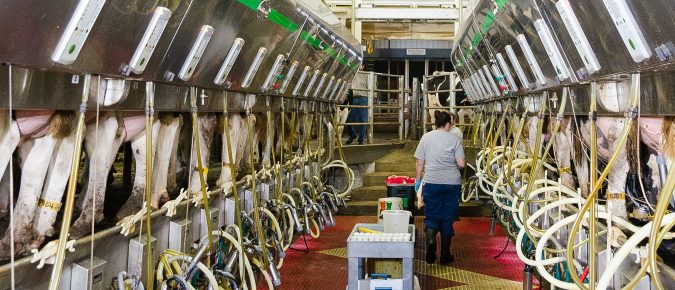
Ensuring a comfortable and safe parlor environment for both cows and workers, while efficiently using all available resources—including time—is crucial for the dairy business’ profitability. Milking time on a dairy farm is a balancing act between maintaining cleanliness and calmness while moving quickly enough to finish on time and get the cows back to their pens, where they can eat, drink, rest, and produce milk.
Es crucial para la rentabilidad del negocio lechero, garantizar un entorno cómodo y seguro en la sala de ordeño tanto para las vacas como para los trabajadores, al tiempo que todos los recursos disponibles se utilicen de manera eficiente, incluido el tiempo. El ordeño en una granja lechera es un acto de equilibrio entre mantener la limpieza y la calma, mientras se mueve lo suficientemente rápido como para terminar a tiempo y llevar a las vacas de regreso a sus corrales, donde pueden comer, beber, descansar y producir leche.
Prototheca bovis has been cultured in herds and is emerging as a threat to producers statewide. Prototheca has been linked to mastitis since 1952, however, within the last five years, the prevalence has significantly increased. Similar to Staph aureus and mycoplasma, Prototheca is hard to detect, has no known cure, and is contagious by intermittently shedding from cow to cow.
Heat stress occurs when an environment impacts the ability of a cow to get rid of body heat. Cows need to be raised in an environment where temperatures are within their thermoneutral zones to achieve their maximal genetic potential. Failures to establish adequate environmental temperatures can dramatically alter behavior, health, and productivity of cows.
UW-Extension Milk Quality Veterinarian Pam Ruegg shares in this UW-Extension Dairy Science Webinar series research findings associated with the recently published Impact of Bedding Choice on Udder Health Freestall Herds.




![Impact of Heat Stress in Mammary Gland Development and Health in Dairy Cows [Video] ▶️](https://dairy.extension.wisc.edu/files/2025/06/Impact-of-Heat-Stress-in-Mammary-Gland-Development-and-Health-in-Dairy-Cows-675x290.jpg)
![Impact of Bedding Choice on Udder Health of Freestall Herds [Video] ▶️](https://dairy.extension.wisc.edu/files/2020/10/cows-1264545_1920-675x290.jpg)