Publication ID: A4192-005/AG-919-05
Introduction
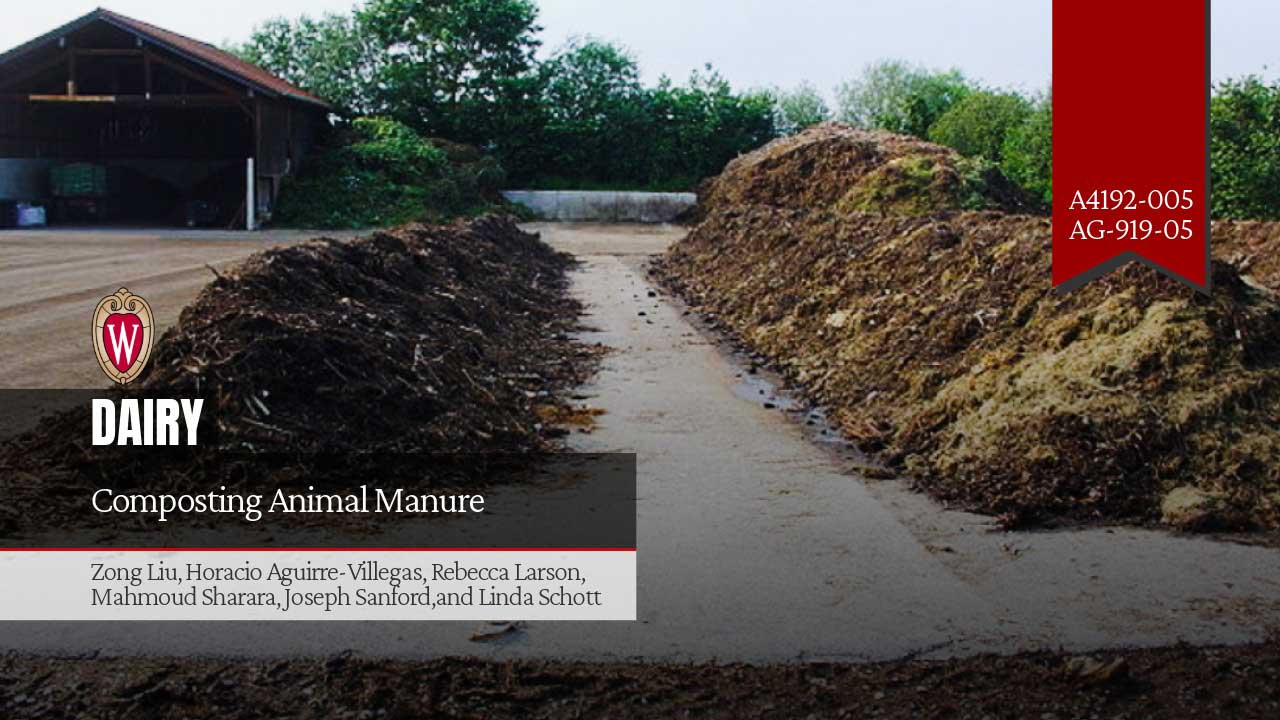
Composting is the process in which microorganisms degrade organic feedstocks in a controlled manner to produce a high quality, stable product that can be used as fertilizer. Composting is a process that can be implemented on nearly all sizes and types of animal feeding operations. By composting manure, pathogen concentrations, weed seeds, odor, and overall by-product volume can be reduced. This process renders composted manure more useful and economical for agricultural land applications (Larney et al. 2006). In fact, composting manure and agricultural by-products can increase the feasible hauling distance by more than 2x when compared to hauling fresh manure. Composting can also be used to manage mortalities to minimize disease and odors.
In-depth resources on composting, including how to address common issues with the composting process, can be found through Natural Resource Conservation Service (NRCS) and American Society of Agricultural and Biological Engineers (ASABE) practice standards (ASABE S585.1 2021; NRCS 2007).
Technology Basics
A composting system can be implemented on nearly all sizes and types of animal feeding operations. Two of the most popular systems are windrows and bin systems, however there are more sophisticated in-vessel systems (Figure 1) as well as aerated piles. All composting systems can be either covered with a roof or uncovered depending upon the climate and budget. If an uncovered system is used, it is important to recognize that precipitation and other weather factors can have a substantial impact on the composting process and can lead to significant differences in compost produced during different seasons. As a result, runoff control and collection strategies need to be considered, especially when the composting process takes place in open areas.
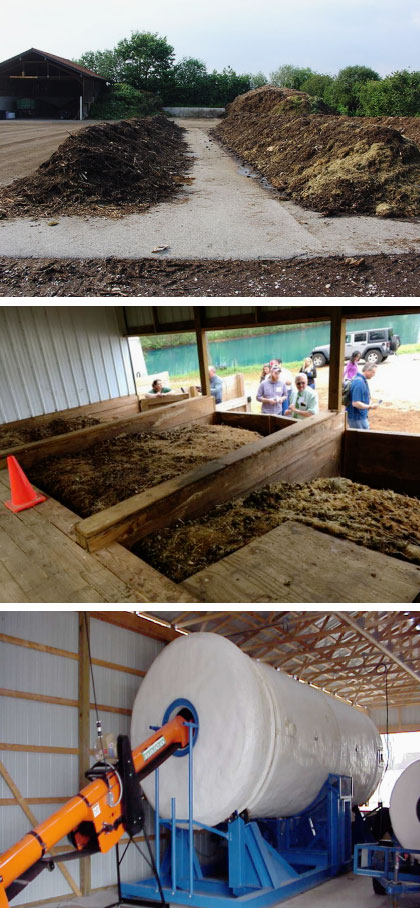
It is important to recognize that composting is a microbially mediated process. Thus, conditions within the windrow or pile must be maintained for optimal microbial activity. Factors that must be controlled and monitored include aeration (or oxygen availability), carbon to nitrogen ratio (C:N ratio), temperature, and moisture. The composting process begins with the creation of either a windrow or pile. Optimally, windrows or piles should be approximately 3.3 to 5 feet (1 to 1.5 m) high in size and constructed so that airflow through the pile is not impeded (ASABE S585.1 2021). Thus, plenums (layer of material with high porosity) might be needed in static piles to facilitate aeration, avoiding the need of manual or mechanical turning. Compost piles, in either bins or windrows, need to be turned frequently or aerated with blowers to maintain aerobic conditions and promote microbial activity.
Another important factor that should be managed is the initial C:N ratio of the compost pile. The C:N ratio can be thought of as the number of units of carbon per unit of nitrogen. The C:N ratio should be between 20:1 and 40:1 with an ideal range of 25:1 to 30:1 (Wortmann and Shapiro 2012). The ideal range is based on the C:N ratio needed by microbes to promote activity which accelerates the breakdown of organic matter. The C:N ratios of manure from various livestock species is shown in Table 1. In most cases, additional carbon (C) should be added to the manure to ensure an adequate C:N ratio. Some common C sources include straw, wood chips or shavings, and corn stalks. Temperature and moisture also need to be managed to ensure optimal microbial degradation of manure. Composting is a thermophilic process, meaning temperatures should be maintained between 104–149°F (Wortmann and Shapiro 2012). Temperature is a good indicator for when piles should be aerated through turning. It is recommended that compost reaches 145°F to kill pathogens and destroy weed seeds, but compost should be turned once it reaches this temperature to avoid killing beneficial microbes at higher temperatures. Moreover, overheated compost piles (>160°F) could spontaneously combust if they are not moist and aerated, though this is extremely rare. Temperature should be monitored and recorded daily from several locations per windrow or pile. Moisture content in the pile also needs to be monitored and managed with an optimum range between 50–60%. As shown in Table 1, the manure itself can be an important source of moisture for the composting process. Moisture in manure tends to be higher just after winter/spring and lower in summer months in most places, except for tropical and other climates with high rainfall. As the composting process proceeds and piles are aerated, moisture will be lost. Thus, water should be added back into the system when needed. Management of both temperature and moisture will likely differ between seasons due to ambient temperature and precipitation variations.
| Livestock Species | C:N | Water content (%) |
|---|---|---|
| Beef Feedlot, as collected | 10:1 – 20:1 | 20 – 80 |
| Swine, fresh | 15:1 – 21:1 | 70 – 85 |
| Dairy, fresh | 8:1 – 30:1 | 75 – 90 |
| Chicken or Turkey, fresh | 4:1 – 18:1 | 50 – 87 |
| Broiler Litter, fresh | 6:1 – 24:1 | 22 – 29 |
Performance
The quality of compost generated depends upon the type of feedstocks used, the level of management implemented, and the intended use of the finished product. In general, compost generated under intense management of its oxygen, C:N ratio, moisture, and temperature will have low odor and also reduce weed seed and pathogens. One measurement used to determine compost quality is its maturity, which can be evaluated using indicators of the senses, chemical, stability, or phytotoxicity (Sullivan and Miller 2001). Without intense and thorough management of the components, the quality of the finished product may not be as high (Table 2). However, a lower quality compost does not necessarily inhibit its use as a fertilizer. Higher compost quality is typically required when selling packaged compost to a distributer, in facilities requiring a consistent product such as greenhouses, or for use in produce gardens. Lower quality compost still has fertilizer value but may be inconsistent and is better suited for use on-farm or sold locally in bulk. However, most producers must develop the market for their compost product, so it is important to examine your location and potential customer’s needs.
| Measurement | Class A | Class B |
|---|---|---|
| pH | 6.0 – 7.0 | 6.0 – 7.5 |
| C:N Ratio | < 25 | < 30 |
| Moisture Content, percent | < 50 | – |
| Electrical Conductivity (mmho cm-1) | < 2.5 | < 5.0 |
Cost
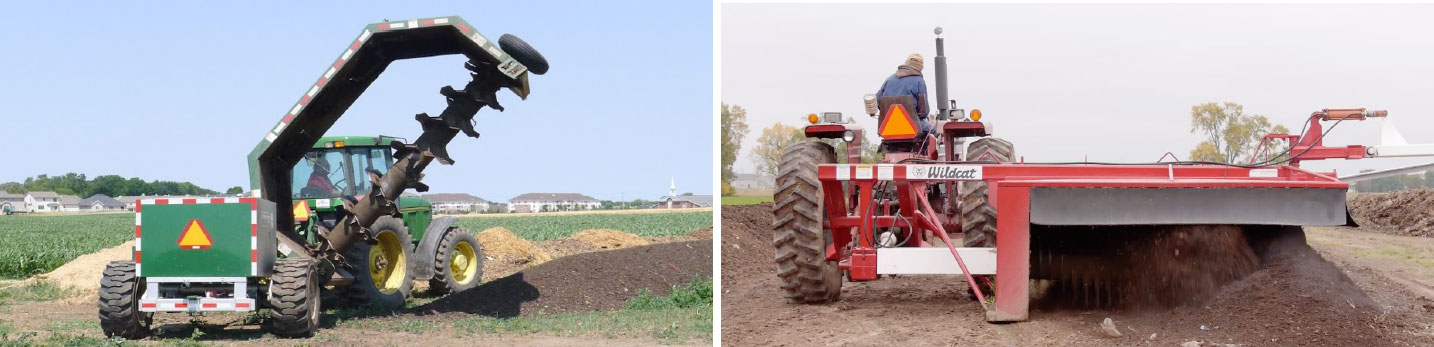
Capital and labor costs required to install and manage a composting system can vary significantly based on the type of system used (e.g., windrow or bin, covered or uncovered), size, and additional technologies used for management of products (i.e., thermocouples, moisture sensors, sprinklers for moisture additions, etc.). Windrow turners can vary in cost, ranging from tens of thousands of dollars for tractor mounted systems (Figure 2) to several hundreds of thousands of dollars for crawlers that are self-propelled systems designed specifically for compost turning. Similarly, tractors can be equipped with front end loaders in the case where tractors or skid steers are already available on-farm but will require significantly more labor to turn the compost. In addition to equipment costs, land is needed to house either the composting infrastructure or windrows.
The amount of land needed is generally scalable by the size of the animal operation with bigger operations needing more land for composting. Labor is also needed to support composting for both hauling manure from the production area to the compost site as well as turning windrows or piles, managing moisture, and monitoring
temperature regimes. This is also generally scalable by operation size but a higher investment in equipment can offset the time needed (e.g., a windrow turner would take much less time to turn large windrows compared to a front loader or bulldozer). Other cost considerations should include whether water needs to be added to maintain an optimal moisture and whether additional materials are needed to optimize C:N ratio. System profitability is highly dependent upon the market price obtained for the finished compost as well as the cost of the system. If the product can only be sold at a low market value, selecting a low-cost system may still be able to produce a profit if managed effectively. A detailed business plan is recommended before integrating a system.
Environmental Benefits and Trade-Offs
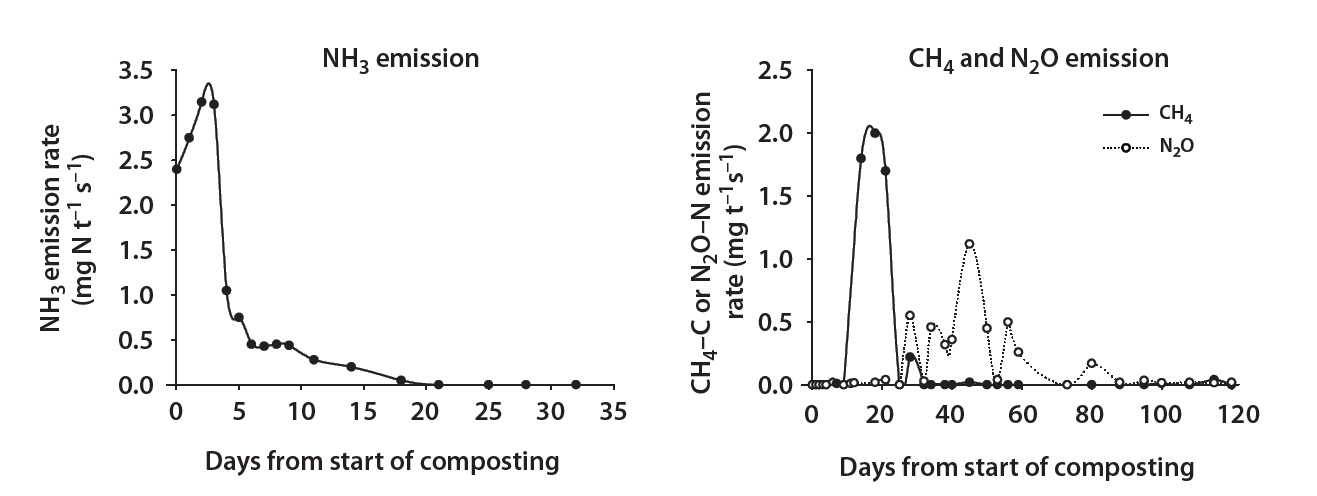
During the composting process, microbes aerobically consume organic matter and release CO₂ and other gases (Petersen et al. 2013). Most greenhouse gases (GHG), mainly methane (CH₄) and nitrous oxide (N₂O), are produced within the first 60 days (Figure 3) (Bernal et al. 2017). Formation of all GHGs during composting is biologically driven. Mismanagement of the composting process can promote the creation of anaerobic conditions in the pile (e.g., lack of oxygen, excess moisture, lack of turning) which will at the same time increase CH₄ and N₂O emissions. The larger the compost pile, the more intensely it must be managed to reduce emissions because anaerobic conditions quickly redevelop after turning (Hellmann et al. 1997). Despite that proper turning of the compost pile reduces N₂O and CH₄ emissions, increased (or excessive) turnings increase loss of ammonia (NH₃) through volatilization. A lower than ideal C:N ratio can also increase NH₃ and CH₄ emissions but does not affect N₂O; an optimal C:N ratio for reducing GHG emissions is 21:1 (Jiang et al. 2011). Emissions of NH₃ are not ideal for compost meant to supply nutrients, including nitrogen, for crop production. Moreover, NH₃ can redeposit in waterbodies and natural terrestrial systems and further transform to particular matter and/or N₂O, negatively impacting human health and air quality (Hristov et al. 2002).
Compost is generally used for land application. By composting manure, moisture and overall volume is reduced making it more feasible to haul further distances for application compared with fresh manures. This is a benefit for lands near the animal feeding operation where lands tend to receive over-applications of fresh manure. Due to volume reduction, however, compost will have higher concentrations of nutrients like phosphorus and potassium because they are not lost through emissions or other pathways like nitrogen and carbon. This makes compost a valuable as a fertilizer but also means that nutrient management strategies still need to be utilized to prevent the over-application of phosphorus to cropland. However, due to stabilization of nitrogen and loss by emissions, compost is less likely to leach nitrogen compared to fresh manure.
References
- ASABE Standard EP585.1. 2015 (R2021). “Animal Mortality Composting.” St. Joseph, MI: ASABE.
- Baba, I. A., M. T. Banday, H. M. Khan, A. A. Khan, A. Akhand, and M. Untoo. 2018. “Economics of Fermentation of Poultry Farm Waste.”
International Journal of Current Microbiology and Applied Sciences 7(06):2108–12. https://doi.org/10.20546/ijcmas.2018.706.250 - Bernal, M. Pilar, Sven G. Sommer, Dave Chadwick, Chen Qing, Li Guoxue, and Frederick C. Michel. 2017. “Current Approaches and Future Trends in Compost Quality Criteria for Agronomic, Environmental, and Human Health Benefits.” Advances in Agronomy 144:143–233. https://doi.org/10.1016/bs.agron.2017.03.002
- CIAS. 1996. “Windrow composting systems can be feasible, cost effective.” Center for Integrated Agricultural Systems Research Brief #20. University of Wisconsin-Madison.
https://cias.wisc.edu/crop-soil/windrow-composting-systems-can-be-feasable-cost-effective/ - Hellmann, B., L. Zelles, A. Paloja, and Q. Bai. 1997. “Emission of Climate-Relevant Trace Gases and Succession of Microbial Communities during Open-Windrow Composting BETTINA.” Applied and Environmental Microbiology 63(3):1011–18.
- Hristov, Alexander N., S. Zaman, M. Vander Pol, P. Ndegwa, L. Campbell, and S. Silva. 2002. “Nitrogen Losses from Dairy Manure Estimated through Nitrogen Mass Balance and Chemical Markers.” Journal of Environmental Quality 38(6):2438–48. https://doi.org/10.2134/jeq2009.0057
- Jiang, Tao, Frank Schuchardt, Guoxue Li, Rui Guo, and Yuanqiu Zhao. 2011. “Effect of C/N Ratio, Aeration Rate and Moisture Content on Ammonia and Greenhouse Gas Emission during the Composting.” Journal of Environmental Sciences 23(10):1754–60. https://doi.org/10.1016/S1001-0742(10)60591-8
- Larney, Francis J., Dan M. Sullivan, Katherine E. Buckley, and Bahman Eghball. 2006. “The Role of Composting in Recycling Manure Nutrients.” Canadian Journal of Soil Science 86(4):597–611.
https://doi.org/10.4141/S05-116 - NRCS Manure Management Technology Development Team. 2007. “Managing for Better Compost.” Washington, D.C.: NRCS.
- Petersen, S. O., M. Blanchard, D. Chadwick, A. Del Prado, N. Edouard, J. Mosquera, and S. G. Sommer. 2013. “Manure Management for Greenhouse Gas Mitigation.” Animal 7(2):266–82.
- Sullivan, D.M. and R.O. Miller. 2001. “Compost quality attributes, measurements and variability.” p. 95-120. In: P.J. Stofella and B.A. Kahn (eds.). Compost utilization in horticultural cropping systems. CRC Press. Boca Raton, FL. ISBN 9780367397593.
- University of Missouri Extension. “Compost Analysis”.
https://extension.missouri.edu/programs/soil-and-plant-testing-laboratory/spl-compost-analysis Accessed 2021 October 8. - Wortmann C., and C. Shapiro. 2012. “Composting Manure and Other Organic Materials.” Nebraska Extension Publication G1315.
University of Nebraska. http://extensionpublications.unl.edu/assets/html/g1315/build/g1315.htm
Originally Published: January 2, 2022
Reviewers:
- Rhonda Miller – Agricultural Environmental Quality Specialist, Department of Applied Sciences, Technology and Education, Utah State University
- Leslie Johnson – Animal Manure Management Educator, University of Nebraska-Lincoln Division of Extension
- Mario E. de Haro-Martí – Extension Educator Gooding County, University of Idaho Division of Extension
Authors:
- Linda Schott – Assistant Professor, Soil and Water Systems, University of Idaho
- Horacio Aguierre-Villegas – Scientist III, Nelson Institute for Environmental Studies, University of Wisconsin–Madison
- Rebecca Larson – Associate Professor, Nelson Institute for Environmental Studies, University of Wisconsin–Madison
- Mahmoud A. Sharara – Assistant Professor, Biological and Agricultural Engineering, North Carolina State University
- Joseph Sanford – Assistant Professor, Soil and Crop Sciences, University of Wisconsin–Platteville
- Zong Liu – Assistant Professor, Biological and Agricultural Engineering, Texas A&M University