Introduction
Feed efficiency is becoming a more commonly discussed measure on dairy farms. While it can be a “nice to know” number, it becomes a “need to know” tool when used intentionally to inform decision-making and drive management changes. However, collecting data without a clear path often results in wasted effort. To unlock its full potential, farms need an action plan that defines goals, outlines data collection and analysis methods, and ensures insights are applied.
As part of a series discussing feed efficiency, this article outlines how to create a practical and impactful data action plan around the feed efficiency metric. The general guidelines from this article can apply to any data used on dairy farms.
In this article, Feed Efficiency specifically refers to energy-corrected milk divided by dry matter intake (ECM/DMI), an on-farm metric to evaluate cows’ conversion of feed into milk.
Start With Your Goals
Begin with a clear understanding of why you’re tracking feed efficiency. Knowing what you hope to accomplish can clarify what course of action you should take and increase the chances of you reaching that goal (1). What do you hope to accomplish? Will ECM/DMI help you meet specific herd or farm goals? Be candid about whether feed efficiency is the best tool for your current priorities.
Consider these questions:
- Are you using feed efficiency data to monitor performance or to guide decision-making?
- Do you know what decisions you may make based on the results?
- Is feed efficiency the right focus now, or are there more pressing priorities on the farm?
Without a clear purpose, it’s easy to collect data that never leads to action. Ensure feed efficiency supports your bigger picture strategy.
Collect Effective Data
The value of feed efficiency data depends entirely on quality data. To calculate feed efficiency, you need:
- Reliable milk production and composition data
- Accurate dry matter intake values, not just formulated TMR amounts
For accurate DMI, track actual feed delivered and refusals, not just mixing sheet figures. Evaluating feed efficiency at the individual cow level requires consistent, cow-specific intake data which is often a challenge on commercial dairies. Some new technologies can help estimate individual intakes, but DMI is more commonly and easily tracked at the pen or herd level.
Set up a clear system:
- Who collects and enters the data?
- Where is it recorded and stored?
- Who oversees the process?
Consistency is key. Incomplete or inaccurate data limits usefulness (2).
Analyze and Act to Make ECM/DMI Part of the System
This is where data becomes powerful. Analyzing ECM/DMI can highlight trends, raise questions, or drive management changes, but only if used with context. For typical ECM/DMI ranges across lactation stages, refer to benchmarks provided in What Shapes Feed Efficiency in Dairy Cows?” (link).
Feed efficiency is not a perfect metric. It has limitations and blind spots as discussed in previous articles. Many factors affect feed efficiency, from diet formulation to cow comfort, so approach this data with both curiosity and caution (3).
To maximize its value:
- Pair feed efficiency with other measures, such as Income Over Feed Costs, to broaden perspective.
- Review your original goals. Are you seeing something worth acting on?
- What actions will you take? Possibilities include feed reformulation, cow grouping strategies, or investigating changes in cow health or behavior.
Finally, evaluate how ECM/DMI will become a part of your farm’s monitoring routine. If you decide this will become a regularly evaluated metric, determine how often you’ll review the data – weekly, monthly, or seasonally.
Turning Feed Efficiency Data into Action
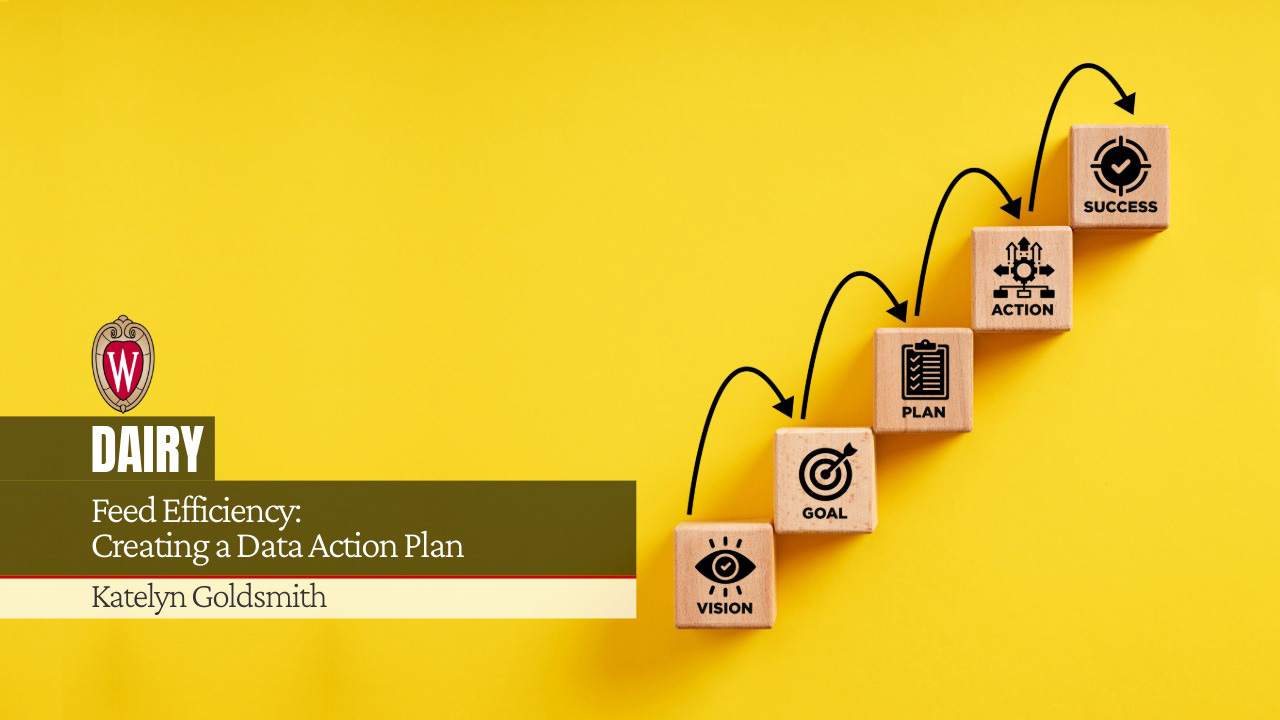
Feed efficiency can provide helpful insight, but only if you act on it. If you’re considering integrating this metric into your management toolbox, do it with a clear plan:
- Define your goals and expectations.
- Collect consistent, accurate data.
- Analyze with context and act based on findings
By treating data collection as a strategic tool rather than a routine task, feed efficiency can become more than a number. It can become a catalyst for meaningful improvement on your farm.
All articles in this series
Author

Katelyn Goldsmith
Dairy Outreach Specialist– In her role as a statewide Dairy Outreach Specialist, Katelyn connects research with practical farm management practices to create educational programming addressing the needs of Wisconsin dairy producers.
Published: January 16, 2026
This article was originally published by Dairy Herd Management Magazine
Reviewed by:
- Jackie McCarville, Regional Dairy Educator at the University of Wisconsin–Madison Division of Extension
- Matt Lippert, Regional Dairy Educator at the University of Wisconsin–Madison Division of Extension
- Stephanie Bowers, Regional Dairy Educator at the University of Wisconsin–Madison Division of Extension
References
- van der Hoek, M., Groeneveld, S., & Kuipers, B. (2016). Goal setting in teams: Goal clarity and team performance in the public sector. Review of Public Personnel Administration, 38(4):472-493. https://doi.org/10.1177/0734371X16682815
- Barchard, K., & Pace, L. (2011). Preventing human error: The impact of data entry methods on data accuracy and statistical results. Computers in Human Behavior, 27:1834-1839. https://doi.org/10.1016/j.chb.2011.04.004
- VandeHaar, M.J., Armentano, L.E., Weigel, K., Spurlock, D.M., Tempelman, R.J., & Veerkamp, R. (2016). Harnessing the genetics of the modern dairy cow to continue improvements in feed efficiency. Journal of Dairy Science, 99:4941-4954. https://doi.org/10.3168/jds.2015-10352