
Introduction
Automated Milking Systems (AMS) have transformed dairy farming by increasing milking efficiency and providing cows more freedom and flexibility. However, AMS herds face unique challenges in managing hoof health. Hoof-related issues, particularly lameness, affect cow welfare, decrease milk production, and reduce overall herd profitability.
Why Hoof Health Matters in AMS Herds
Hoof health is critical for the overall well-being of dairy cows. Whether you are 🔍 retrofitting or building new, focusing on footbath placement in barn design should be a priority in your planning. Healthy hooves ensure that cows can walk comfortably, access food and water, and visit the milking robots regularly.
Lame cows visit the robots less often and produce lower milk yields, leading to higher costs and decreased profitability. It is essential to understand the prevalence of digital dermatitis in the herd and adjust footbath treatments accordingly. Lameness increases the likelihood of needing to 🔍 fetch cows, further disrupting the milking process, and reducing overall herd performance.
Footbaths: A Crucial Preventative Measure
Footbaths are one of the most proven ways to prevent hoof infections like digital dermatitis, a leading cause of lameness in AMS herds. However, proper footbath management is necessary. Research indicates that only 70% of AMS herds use footbaths regularly, and a smaller percentage follow the recommended frequency of two to three times a week. Using a well-placed and designed footbath is critical to effectively reduce the incidence of lameness by providing targeted treatment for hoof health.
Designing Footbaths for Success
A properly sized footbath ensures that each hoof is adequately treated. Recent research from the University of Wisconsin-Madison has led to updated recommendations for footbath dimensions. According to their findings, a footbath should ideally be:
- Length: At least 10 feet
- Width: 24 inches
- Step-in height: 10 inches
The footbath should be filled to a depth of 3.5 inches, holding about 52 gallons of solution, maintaining optimal chemical concentration throughout the process.
The design also recommends sloped sidewalls at a 70° angle, ensuring cows place their feet properly in the bath with each step. Additionally, higher side walls—about 3 feet tall—are recommended to prevent cows from falling during the process. The goal is to immerse each hoof at least twice, which can be achieved at a footbath length of 10 feet, for maximum effectiveness. These new recommendations significantly improve footbath treatment success rates.
Strategic Footbath Location and Maintenance
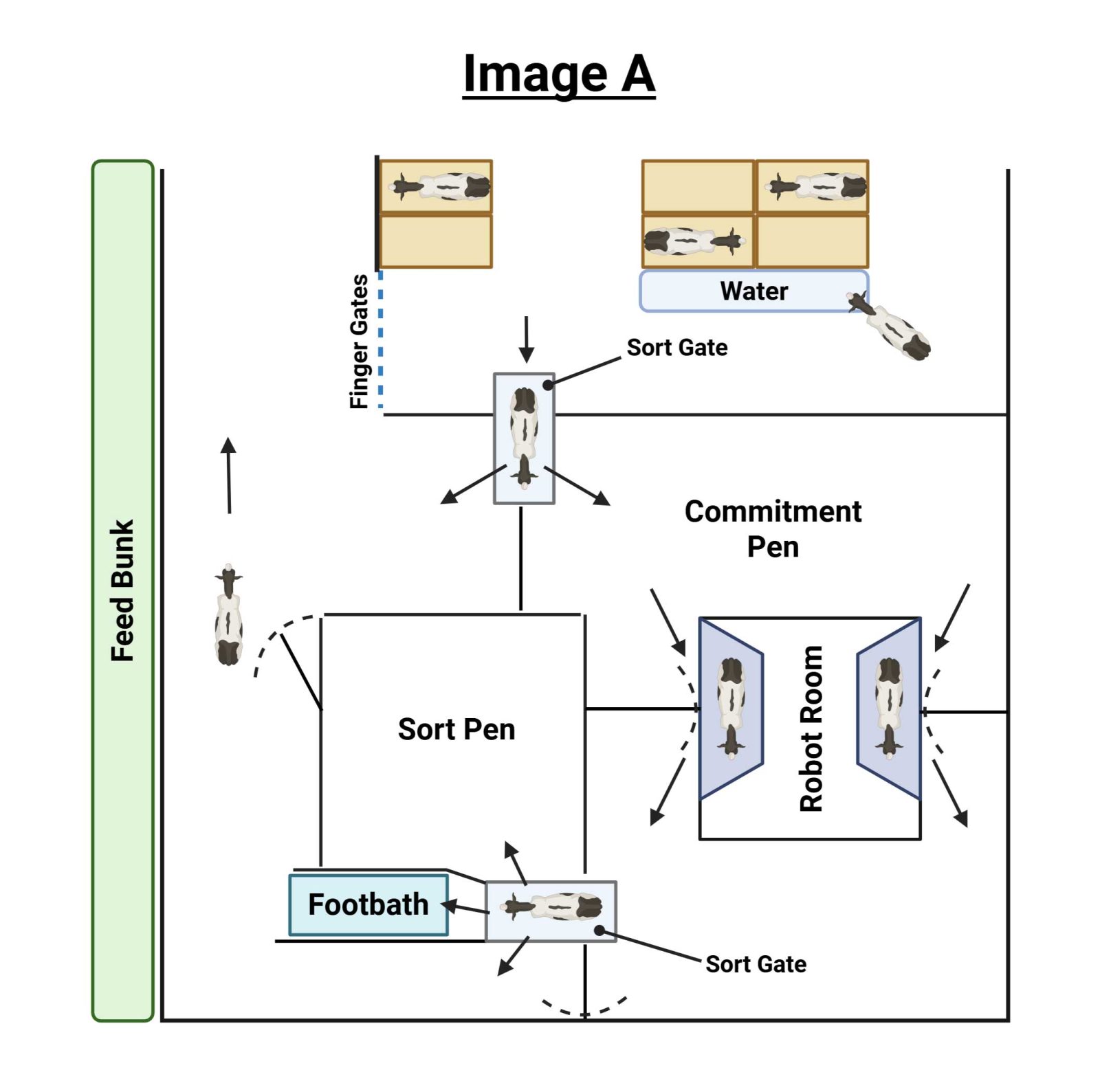
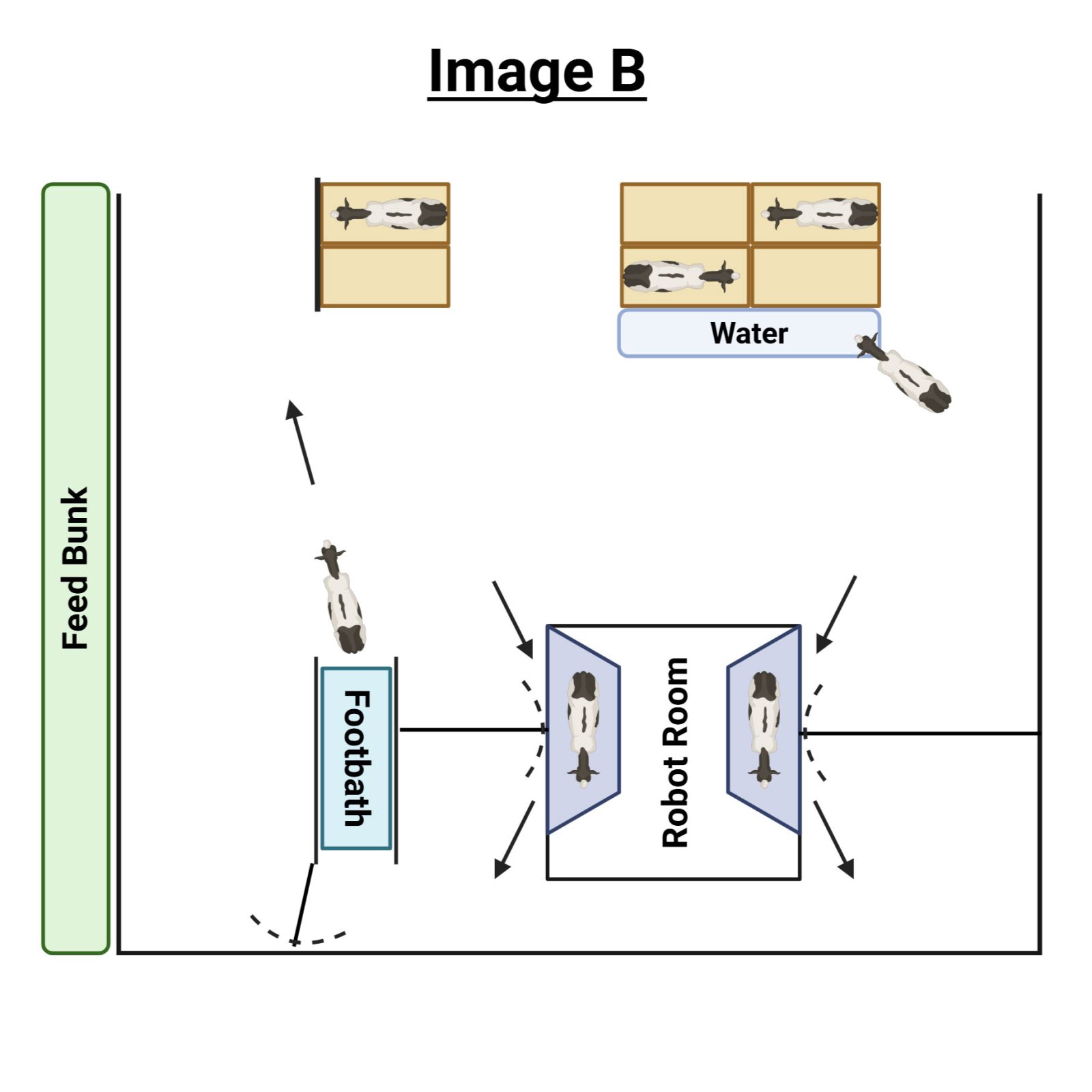
Footbath placement is crucial in AMS herds for ensuring effective hoof care. Footbaths are most effective when positioned between the milking robots or along the return lanes where cows naturally pass through after milking. For example, in 🔍 guided flow barns, post-milking 🔍 sort gates can be used to direct cows through the footbath (Image A). In 🔍 free-flow barns, temporary gating can be used to direct cows through the footbath (Image B). This strategic placement ensures that cows receive footbath treatment, reducing the risk of hoof infections like digital dermatitis. It is also helpful to have the trimming chute nearby for planned maintenance trims as well.
Maintaining footbath functionality is also key. Automated footbath systems in AMS can simplify this process by regularly refilling and adjusting the chemical concentrations to ensure consistency. Footbaths should be monitored for proper depth and solution levels and frequently cleaned to avoid contamination. Regular checks and automated refilling systems help maintain optimal conditions, reducing the incidence of hoof problems and improving overall herd health.
Conclusion
Managing hoof health in AMS herds means being proactive with both design and daily routines:
- Prioritize regular footbath use (ideally 2-3 times a week).
- Follow proven design standards for footbaths.
- Place footbaths where cows will naturally pass.
- Maintain and monitor footbath solution quality.
By integrating these practices, dairy farmers can significantly reduce lameness, improve cow comfort, and enhance herd productivity. Healthy hooves keep cows moving freely, visiting robots often, and producing more milk. As AMS technology evolves, so will the solutions for better hoof care, ensuring healthier cows, and more efficient dairy operations.
*This article was originally published in Hoards Dairyman ↗️.
Authors

Aerica Bjurstrom
Regional Dairy Educator – Aerica’s work focuses on herd health and animal welfare. She also has a strong background in meat quality and has done programming in market cow carcass quality.

Angie Ulness
Dairy Educator – Angie has been active in the dairy industry her entire life. She was raised on her family farm in Door County and currently farms with her husband Mark and their four children in Manitowoc County. Angie has previously worked as a Field Representative for Holstein USA and a Senior Territory Manager for a Pharmaceutical company. Her area of focus is Dairy Farm Management, Profitability and Efficiency.
References
- Gerbitz, J. 2025. Hoof care in robotic milking. Cow Corner. Online available at https://www.cow-corner.co/post/hoof-care-in-robotic-milking?utm_campaign=2797a8a9-af24-49e0-9eb5-9016d10dc8d9&utm_source=so&utm_medium=mail&cid=975c9211-1a80-43bb-88e6-63e074aec5af
- Gerbitz, J. 2024. Managing hoof health in robotic milking. Cow Corner. Online available at https://www.cow-corner.co/post/hoof-care-in-robotic-milking?utm_campaign=2797a8a9-af24-49e0-9eb5-9016d10dc8d9&utm_source=so&utm_medium=mail&cid=975c9211-1a80-43bb-88e6-63e074aec5af
- Binversie, L. 2023. Hoof health & nutrition. UW-Madison Extension Dairy Program. Online available at https://dairy.extension.wisc.edu/files/2023/11/hoof-and-nutrition.pdf
- Ulness, A. Using footbaths in an automated milking system to lower fetching. UW-Madison Extension Dairy Program. Online available at https://dairy.extension.wisc.edu/articles/use-footbaths-in-an-automated-milking-system-to-lower-fetchings/
- Hennes, O., & Millker, Z. 2016. The ideal footbath. UW-Madison Extension Dairy Program. Online available at https://dairy.extension.wisc.edu/files/2020/10/IDeal-Footbath-Miller-Hennes-2-1.pdf
- The Dairyland Initiative. Automated milking systems. UW-Madison School of Veterinary Medicine. Online available at https://thedairylandinitiative.vetmed.wisc.edu/home/housing-module/adult-cow-housing/automated-milking-systems/
- Cook, N. 2020. How to manage footbaths in a robot milking facility. Progressive Dairy. Online available at https://www.agproud.com/articles/36983-how-to-manage-footbaths-in-a-robot-milking-facility
- Salfer, J.A., Siewert, J.M., & Endres, M.I. 2018. Housing, management characteristics, and factors associated with lameness, hock lesion, and hygiene of lactating dairy cattle on Upper Midwest United Stated dairy farmers using automatic milking systems. Journal of Dairy Science, 101:8586-8594. doi:10.3168/jds.2017-13925
Reviewers