Publication ID: A4192-012
Introduction
Ammonia emissions from agriculture can be mitigated using management practices to reduce impacts to human health and the environment (Besson, Aguirre-Villegas, and Larson 2022a). Relevant mitigation techniques can be identified by examining how nitrogen moves through the system including in a cows’ diet, output (milk, meat, and manure), and the management of manure within the farm system.
Methodology
Farms were modeled to examine changes in ammonia emissions when integrating mitigation practices. A variety of conventional, organic, and grazing dairy farms (Table 1) were modeled using a set of defined initial management practices on the farm (also known as a base case). See “Ammonia Emissions from Manure Systems on Conventional, Organic, and Grazing Dairy Farms in Wisconsin” for a summary of the modeling methodology (Besson, Aguirre-Villegas, and Larson 2022b). Some management practices (Table 1) were then changed and new (or alternative) farm scenarios were modeled (Table 2) to quantify the effect on ammonia emissions related to the implementation of each practice. In some cases, multiple management practices were integrated to see the combined effect on ammonia emissions. The results of this analysis can be used to identify potential mitigation strategies for each farm type.
Table 1. Initial modeled farm characteristics (Besson, Aguirre-Villegas, and Larson 2022b).
| ID | Manure Type | Number of Lactating Cows | Percent of Manure Collected | Manure Storage | |||
|---|---|---|---|---|---|---|---|
| Conv. | C1 | Slurry | 50 | 100 | Storage with crust | ||
| C2 | Slurry | 200 | |||||
| C3 | Slurry | 1,000 | |||||
| C4 | Solid | 50 | Solid stack | ||||
| C5 | Liquid | 1,000 | Storage without crust | ||||
| Number of Lactating Cows | Percent of Diet as Pasturea | Non-grazing | Grazing | ||||
| Organic | O1 | Solid | 50 (Jerseys) | 55–70 | 90 | 35 | Solid stack |
| O2 | Solid | 50 | 55–70 | 35 | Solid stack | ||
| O3 | Slurry | 150 | 35–60 | 50 | Storage with crust | ||
| O4 | Solid (grazing) | 50 | 80 | 10 | Bedded pack | ||
| O5 | Solid (off-grid) | 50 | 55–70 | 35 | |||
| Grazing | G1 | Solid | 50 | 62b | 100 | 50 | Solid stack |
| G2 | Slurry | 200 | 62b | Storage with crust | |||
| G3 | Slurry | 1,000 | 62b | ||||
Table 2. Initial modeled farm characteristics (Besson, Aguirre-Villegas, and Larson 2022b).
| Management Strategy | Definition |
|---|---|
| Increase Corn Silage | Increasing corn silage by 10 to 20%, reducing 1 to 3% of alfalfa silage, and reducing corn grain by 13 to 18% while keeping dry matter intake (DMI) constant. |
| Increase Alfalfa Silage | Reducing corn silage by 9 to 13%, increasing alfalfa silage by 18 to 27%, and reducing corn grain by 0 to 9% while keeping DMI constant. |
| Reduce Crude Protein | Reducing crude protein in the cow’s diet by 20% (resulting in a reduction in nitrogen in the cows’ diet). |
| Increase Feed Efficiency | Reducing DMI by 20% but maintaining milk production, therefore, increasing feed efficiency. Manure production is also reduced based on the reduction in DMI. |
| Increase Milk Production | Increasing milk production by 20% for the same amount of DMI consumed by the cow. Manure nutrients are reduced to reflect increased nutrients in milk produced. |
| Reduce Replacement Rate | Reducing the replacement rate by 20%, which assumes a longer life for each cow with improved animal health practices. |
| Empty Storage once per Year | Reducing the emptying of manure storage from two times per year (half the annual manure produced each time) to one time per year (all the annual manure produced). |
| Cover Manure Storage | Placing an impermeable cover over the manure storage reducing losses from exposure to atmosphere and wind. |
| Inject Manure | Injecting manure into the soil subsurface during land application reducing losses from exposure to atmosphere and wind. |
| Solid – Liquid Separation (SLS) | Mechanically separating manure into a solid and liquid fraction prior to storage (solids and liquids stored and land applied separately). |
| Anaerobic Digestion (AD) | Digesting manure prior to manure storage to produce and collect biogas. This also increases mineralization of organic nitrogen to ammonium. |
| Compost | Composting manure using turning as aeration. |
Results
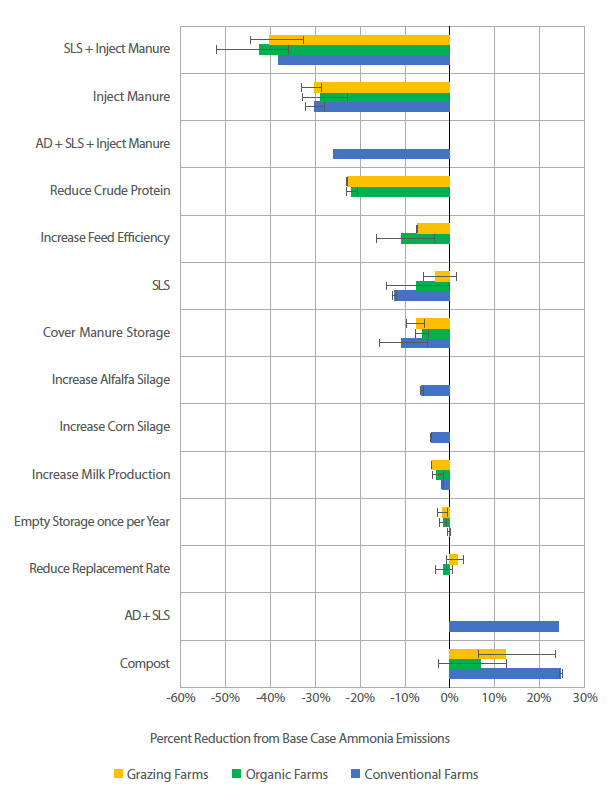
Ammonia emissions reductions after implementing specific manure management practice(s) are grouped by farm category (conventional, organic, and grazing). While most management practices reduced ammonia emissions, some resulted in an increase (Figure 1). Note that not all management practices were modeled for all farm categories.
Discussion
The most effective management practices to reduce ammonia emissions regardless of farm type is injection, and combinations of management strategies incorporating injection. Following injection are diet modifications that alter the amount of nitrogen fed to the cows (decrease dietary crude protein and increase in feed efficiency), and additional manure management practices (solid-liquid separation and manure storage covers).
Land applying manure using manure injection systems reduces ammonia emissions (Hou, Velthof, and Oenema 2015). This requires investment in injection equipment that allows manure to be applied in the soil subsurface. Many of these benefits can also be obtained by using an incorporation method directly following manure application. Any method that can increase infiltration of the manure and decrease manure’s contact with the atmosphere can decrease volatilization of ammonia.
Dietary protein contributes to ammonia emissions from manure by increasing the amount of nitrogen excreted in the products of the cow (milk, manure, etc.). Reductions in crude protein can decrease ammonia emissions in the barn by 27% without major impacts on milk quality and quantity if reductions are limited to 18% or below (Aguerre et al. 2010; Lee et al. 2014). When crude protein is sharply reduced, diet management becomes more difficult and may require dietary supplements to maintain milk yield and quality (Hristov and Giallongo 2016).
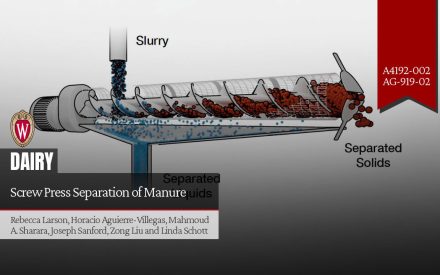
Farmers have identified costs associated with land use, energy use, labor, and capital investment in equipment as a barrier to implementing solid-liquid separation systems (M. Tan et al. 2021; Aguirre-Villegas, Larson, and Ruark 2017). However, solid-liquid separation can reduce manure hauling costs or increase the value of manure offsetting initial capital investment. Separated manure solids have increased nutrient density compared to the original manure or separated liquids. Therefore, cost savings can be incurred as more nutrients can be transported longer distances at a lower cost (e.g., less hauling trips to fields at greater distance from the farmstead) (Bittman et al. 2011).
Ammonia emissions increased when composting was integrated into the manure system. Overall, composting increases ammonia emissions as these processes increase temperature and pH, both of which are drivers for increased ammonia emissions. Acidifying compost piles can reduce ammonia volatilization and retain nitrogen and carbon (Tong et al. 2019). While composting may increase ammonia losses, it also reduces methane and nitrous oxide, decreases pathogens and odors, among other benefits, identifying a tradeoff with the integration of compost systems.
Summary
Manure management practices can reduce ammonia emissions. Through this model, it has been determined that the most effective management practices to reduce ammonia emissions across farm types are crude protein reduction in cow diets (21%-23% reduction), injection of manure during land spreading (25%-35% reduction), and a combination of solid-liquid separation and injection (33%-49% reduction). Manure injection (or incorporation) is a strong ammonia emissions mitigation tool. There are some practices that increase ammonia emissions, such as anaerobic digestion and composting. However, these processing systems have many alternative benefits, and it is recommended to use ammonia mitigation tools to offset the increase (e.g., injection).
Barriers to implementing ammonia emissions practices include capital cost, land use, energy use, and labor. Some of these costs can be offset through by-products, improved efficiencies, or reduction in operational costs. Adopting management practices identified with potential to reduce ammonia emissions from livestock systems, the largest contributor to ammonia emissions in the U.S. (U.S. EPA 2021), benefits the environment, farmers, and human health. Ammonia emissions are one metric of environmental sustainability, and tradeoffs in other metrics need to be examined when selecting management practices to improve sustainability.
References
- Aguerre, M. J., M. A. Wattiaux, T. Hunt, and B. R. Larget. 2010. “Effect of Dietary Crude Protein on Ammonia-N Emission Measured by Herd Nitrogen Mass Balance in a Freestall Dairy Barn Managed under Farm-like Conditions”. Animal 4(8):1390–1400. https://doi.org/10.1017/S1751731110000248
- Aguirre-Villegas, H. A., R. A. Larson, and M. D. Ruark. 2017. “Solid-Liquid Separation of Manure and Effects on Greenhouse Gas and Ammonia Emissions”. Manure Processing for Farm Sustainability Series UW Extension A4131-04. https://cdn.shopify.com/s/files/1/0145/8808/4272/files/A4131-04.pdf
- Besson, C. R., H. A. Aguirre-Villegas, and R. A. Larson. 2022a. “Sources and Impacts of Ammonia Emissions”. Manure Processing for Farm Sustainability Series UW Extension A4192-010. https://cdn.shopify.com/s/files/1/0145/8808/4272/files/A4192-010.pdf
- Besson, C. R., H. A. Aguirre-Villegas, and R. A. Larson. 2022b. “Ammonia Emissions from Manure Systems on Conventional, Organic, and Grazing Dairy Farms in Wisconsin”. Manure Processing for Farm Sustainability Series UW Extension A4192-011.
- Bittman, S., D.E. Hunt, C.G. Kowalenko, M. Chantigny, K. Buckley, and F. Bounaix. 2011. “Removing Solids Improves Response of Grass to Surface-Banded Dairy Manure Slurry: A Multiyear Study”. Journal of Environmental Quality 40(2):393–401. https://doi.org/10.2134/jeq2010.0177
- Hou, Y., G. L. Velthof, and O. Oenema. 2015. “Mitigation of Ammonia, Nitrous Oxide and Methane Emissions from Manure Management Chains: A Meta-analysis and Integrated Assessment”. Global Change Biology 21(3):1293–1312. https://doi.org/10.1111/gcb.12767
- Hristov, A. N., and F. Giallongo. 2016. “Feeding Low Protein Diets to Dairy Cows”. PennState Extension. 5 May 2016. https://extension.psu.edu/feeding-low-protein-diets-to-dairy-cows
- Lee, C., G. W. Feyereisen, A. N. Hristov, C. J. Dell, J. Kaye, and D. Beegle. 2014. “Effects of Dietary Protein Concentration on Ammonia Volatilization, Nitrate Leaching, and Plant Nitrogen Uptake from Dairy Manure Applied to Lysimeters”. Journal of Environmental Quality 43(1):398–408.
- Tan, M., Y. Hou, L. Zhang, S. Shi, W. Long, Y. Ma, T. Zhang, F. Li, and O. Oenema. 2021. “Operational Costs and Neglect of End-Users Are the Main Barriers to Improving Manure Treatment in Intensive Livestock Farms”. Journal of Cleaner Production 289:125149. https://doi.org/10.1016/J.JCLEPRO.2020.125149
- Tong, B., X. Wang, X. Wang, L. Ma, and W. Ma. 2019. “Transformation of Nitrogen and Carbon during Composting of Manure Litter with Different Methods”. Bioresource Technology 293:122046. https://doi.org/10.1016/J.BIORTECH.2019.122046
- U.S. EPA. 2021. “2017 NEI Data”. U.S. E.P.A.: Air Emissions Inventories. 2021. https://enviro.epa.gov/enviro/nei.htm
Originally Published: February 2023
Reviewers:
- Jackie McCarville – Agricultural Educator for Green County, Angie Ulness is the Dairy Educator for Manitowoc County, both at the University of Wisconsin–Madison Division of Extension
- Eric Ronk – Teaching faculty in the Department of Animal and Dairy Sciences at the University of Wisconsin–Madison.
Authors:
- Caleb Besson, Graduate Research Assistant, Biological Systems Engineering, University of Wisconsin–Madison
- Horacio Aguierre-Villegas, Scientist III, Nelson Institute for Environmental Studies, University of Wisconsin–Madison
- Rebecca Larson, Associate Professor, Nelson Institute for Environmental Studies, University of Wisconsin–Madison