Publication ID: A4192-003/AG-919-03
Introduction
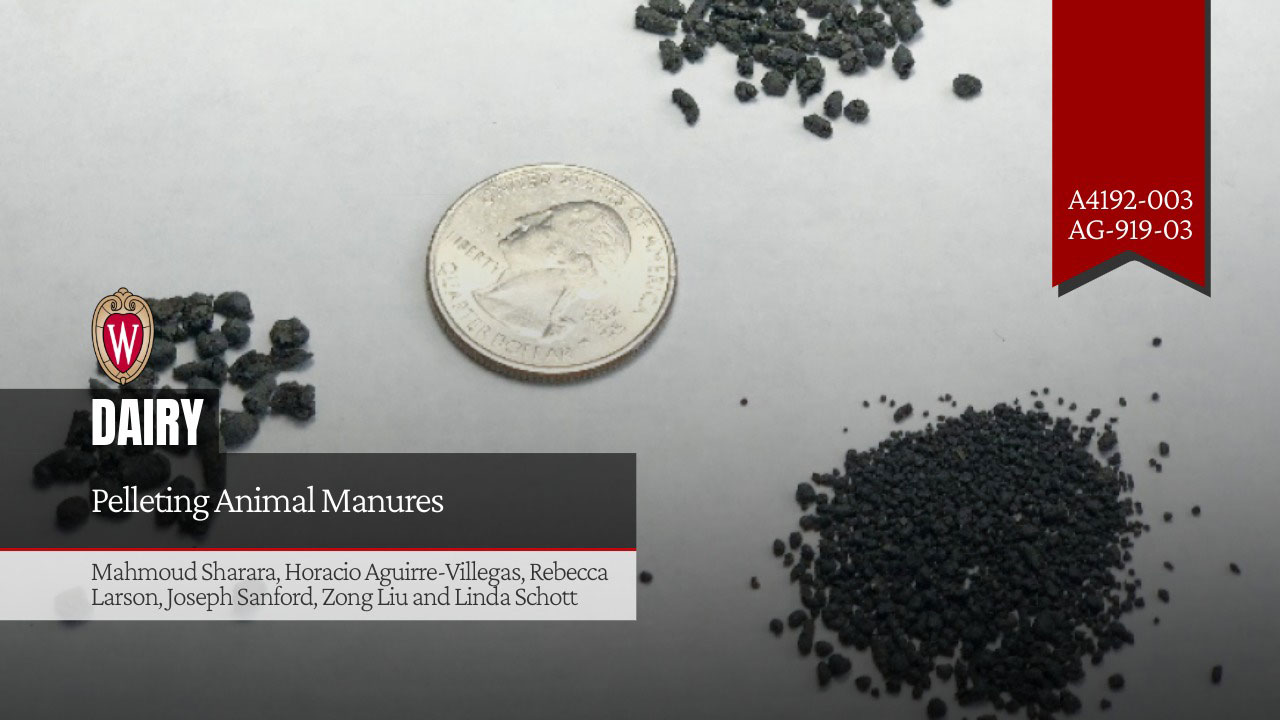
Pelleting is a mechanical process that aggregates solid material to form uniform‑sized particles referred to as pellets or granules. The binding action is achieved using any of the following methods: chemical bonding, compression, extrusion, and tumbling. Pellets are favorable to loose solid materials because they are easier to handle, store, and transport. This process allows for creating consistent mixtures of multiple ingredients by avoiding separation by particle sizes or specific gravity. Pelleting is widely used in industrial applications including pharmaceutical drug manufacturing, food processing, and production of fertilizers and animal feed. In addition, wastewater treatment solids (biosolids) are increasingly being pelleted to create commercial fertilizer products. A well-known example is Milorganite, a brand name for granulated biosolids produced by the Milwaukee Metropolitan Sewerage District since 1926 (Kadish 1928). Similar to biosolids, animal manure and composted manure can be pelleted to produce uniform-sized products that are rich in organic matter and nutrients. In addition to use as a fertilizer, pelleted manures can be used as a fuel for heat and power generation (Wzorek et al. 2021, Nagy et al. 2018). Depending on the final use of manure pellets, the pelleting process can be customized by adjusting the particle size (Figure 1) and adding co-ingredients to optimize the pellet nutrient content or energy content. In order to be effectively pelleted, manure needs to have low moisture content. Depending on the manure type, pretreatment steps such as solid-liquid separation, drying, and milling might be necessary before pelleting. It is important to ensure manure storage and processing areas are well-ventilated and monitored to avoid harmful gas emissions, self-heating fires, as well as dust generated during milling and processing.
Technology Basics
Pelleting technologies can be classified according to how solids are aggregated into: (1) compaction and (2) balling. The characteristics of the material and the intended use of the product determine which pelleting technology is preferred. The following sections briefly summarize each pelleting mode and its compatibility with manures:
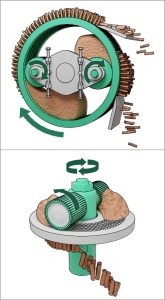
- Compaction (Extrusion): this mode uses compression or extrusion to pressurize solids and form pellets by using equipment such as extruders (Figure 2). Extruders have been used to pellet organic residue such as poultry litter (McMullen et al. 2005), dairy manure (Alcaraz et al. 2018), compost, and crop residues. Extruded pellets are cylindrical with a length typically ranging from 0.4 to over 2 inches, which can be controlled by an adjustable cutting knife. During extrusion, friction within solid particles and between particles and extruder walls releases heat that can cook the material in the dies, causing a blockage. Manure with low fiber content, such as dried swine manure, is not recommended for this technology because of the increased risk of overheating or “cooking” the fine powder onto the extruder surfaces. The product—cylindrical pellets—is not compatible with fertilizer spreaders and requires a crumbling step to achieve a ball-like shape. Pellets are more suited for energy production through combustion with other solid fuels (coal, wood chips, etc.).
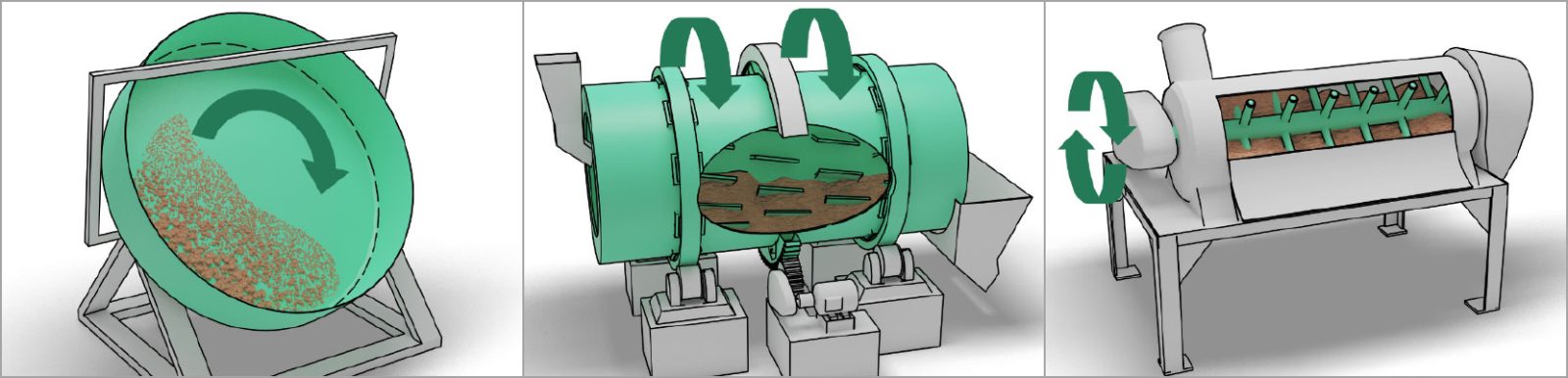
- Balling (Granulation): this process is also known as granulation. It relies on tumbling the material ingredients while adding a binder that acts like a glue to encourage the formation of ball-like aggregates (snowballing effect). Pan and drum granulators and pin mixers are popular examples of this technology (Figure 3). These systems are more suited to fine, powder-like feedstocks such as ground swine manure, fiber-free dairy manure, and biochar. The binders used in this process include molasses, starches, alginates, and lignosulfonates (Nikiema et al. 2014). Oil extraction residue (meal), like canola meal, can function as a binding agent and a source of nutrients for manure pellets (Alege et al. 2020). The process is controlled to produce granule sizes that are compatible with existing fertilizer spreaders, such as rotary or drop spreaders.
Performance
Moisture content and the particle size and shape of the feedstock being pelleted (e.g., raw material, processed manure, or compost) strongly affect the quality of the generated pellets. High moisture content in raw material (≥ 50%) reduces pellet durability and increases bulk density (Pampuro et al. 2017). Raw material that is too dry (≤ 10% moisture) requires dust collectors to improve working air quality. Drying the produced pellets or granules can increase internal stresses, leading to low‑durability pellets. The properties of the finished pellets are indicators of the performance of the pelleting process. The following section briefly summarizes key pellet properties.
Particle size uniformity
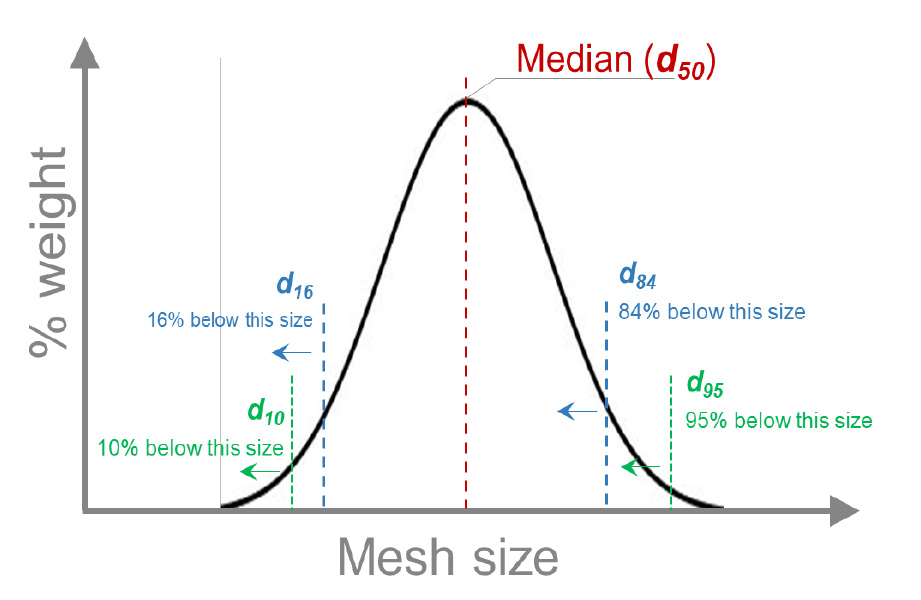
Uniformity of particle sizes for granulated manure is important to ensure it is evenly distributed during land application. Uniform particles are easier to match with standard fertilizer sizes and ensure a uniform spread pattern. Similarly, uniformity of manure pellets used to produce electricity reduces feeding complications or blockages. Particle size distribution is determined using a sieve analysis test (ASABE Standard S319.4, 2007) by weighing the pellets or granules retained on each sieve after a shaking test. The median particle size (d₅₀) is a common indicator used to describe the middle value of the size distribution. The size number guide (SGN) refers to the average particle size, in millimeters (mm), multiplied by 100. The range of sizes in the produced granules is described by the granulometric spread index (GSI) and the uniformity index (UI).
Where dₙ refers to the mesh size (d) in mm that N% of granules pass through (Figure 4). For example, if 95% of a granulated product passes through a US sieve #8, then d₉₅ for this product is 2.36 mm or 0.0937 inches. A low GSI value (10–20) is preferred because it indicates a uniform product where size segregation is unlikely to occur (Miserque and Pirard 2004). Preferred UI values are ≥ 40 for fertilizer applications.
Bulk density
Bulk density increases substantially after compaction, while granulation produces only a slight increase. McMullen (2005) reported a 390% increase in poultry manure bulk density after compaction (from 200 to 780 kg/m³), and Pampuro (2017) reported a 280% increase in composted swine manure bulk density after compaction (from 240 to 680 kg/m³). This increase is inversely related to particle size. Higher pellet moisture content also increases bulk density (Zafari 2012).
Durability
Pellet durability reflects how resistant pellets are to breaking under mechanical stress. Durability depends on pellet dimensions, production pressure (for extrusion), and moisture content. Increasing pellet length or moisture content beyond critical points reduces durability. Durability is measured according to ASABE S269.4 (2007) by placing a ~500 g pellet sample in a rotating chamber (tumbling box) for 10 minutes at 50 rpm. The pellet durability index (PDI) is calculated as:
Where mₐ and mₑ are the masses of intact pellets after and before the test, respectively.
Cost
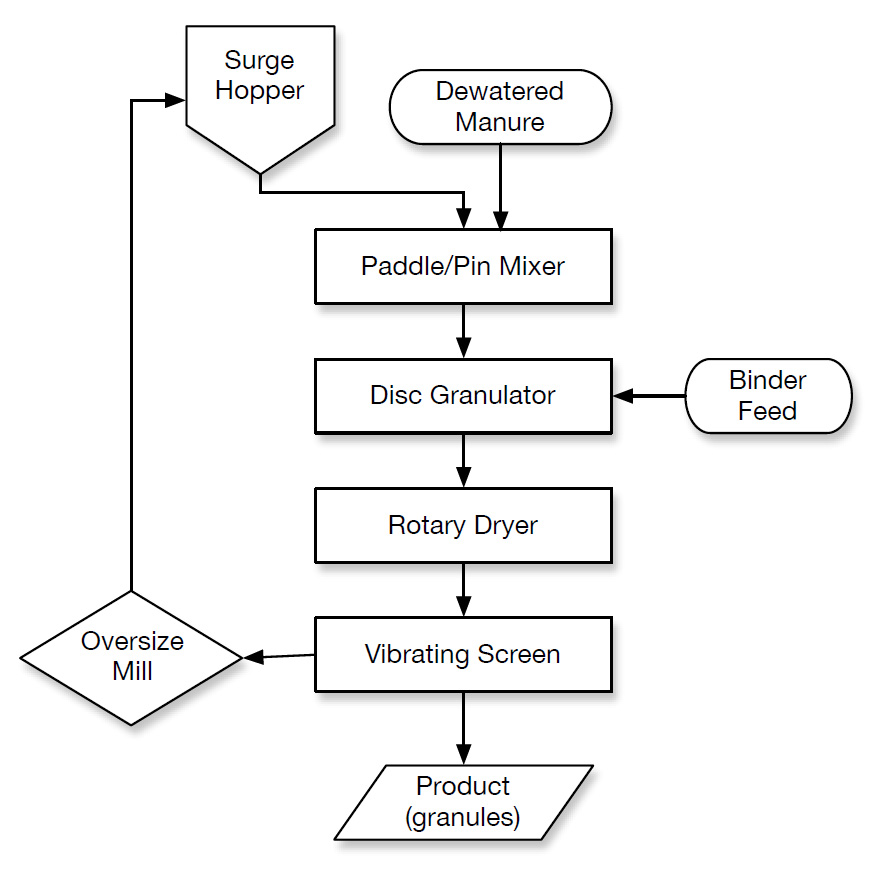
The pelleting process cost varies widely with the type of equipment and binder used. In addition, manure pelleting involves both pretreatment and post-treatment steps. Pretreatment processes includes solid-liquid separation and drying, for liquid and slurry manures such as dairy and swine manures. Post-treatment, on the other hand, can include screening and milling. The capital cost for such system is in the millions of dollars, which makes it only feasible for very large farms (around 15,000 dairy cows) or a cooperative of several farms (WaterWorld 2001). Figure 5 shows a flow chart of a facility that pelletizes dairy manure solids. In a study evaluating the cost of this system to granulate manure from several farms in two counties (total cow populations were 28,854 and 36,402 cows), the cost was between $330 and $343 per ton of granulated product (Sharara et al. 2018). When the cost to acquire the manure was eliminated, the granulation cost dropped to $300 to $313 per ton of product. A comparison between the operating cost for dairy manure granulation and extrusion showed granulation to be at least 3.5 times greater than pelleting due to the cost of binder and energy required for granulation (Runge et al. 2018).
Environmental Benefits and Trade-Offs
Through pelleting, nutrient-rich manure solids become less expensive to transport and can be fortified with nutrients to achieve desired ratios and bagged for wider distribution. This is particularly useful in areas of dense animal production where available fields for manure land application are limited. Adopting this technology for manure nutrient export can reduce surplus nutrients, particularly phosphorus, which can reduce chronic eutrophication (Sampat et al. 2019). Other benefits of pelleting include reducing odor, vectors, and flies. In addition, the uniform land application of manure pellets expands the potential for precision application of manure-based nutrients. It also makes manure nutrients accessible to non-agricultural applications, such as lawns, gardening, and golf courses, which expands the market opportunities for manure. Because of its capital- and labor-intensive nature, pelleting is not recommended for small or medium farms unless a niche market exists to support these costs. More commonly, this technology is implemented on mega-farms or at a centralized site that operates as a cooperative serving several operations. Another consideration with pelleting is the high-energy demand, particularly when relying on natural gas for manure drying. This can increase the carbon footprint of animal production. Relying on low-carbon drying systems, such as ambient or greenhouse drying, can significantly lower the greenhouse gas (GHG) emissions associated with this technology.
References
- Alcaraz, J., E. Baticados, S. Capareda, A. Maglinao Jr., and H. Nam. 2018. “Drying and pellet characterization of sand separated dairy manure from Stephenville Texas, USA.” Applied Ecology and Environmental Research 16(1):29-38.
- Alege, Femi Peter, Gilbert John Miito, Lisa W. DeVetter, Haiying Tao, and Pius M. Ndegwa. 2020. “Effects of Blending Dairy Manure Compost and Canola Meal on Pellets Quality and Nutrients Concentrations.” Transactions of the ASABE 64(2):353-363. https://doi.org/10.13031/trans.14057
- ASABE Standard S269.4. 1991 (R2007). “Cubes, pellets, and crumbles-definitions and methods for determining density, durability, and moisture content.” St. Joseph, MI: ASABE.
- ASABE Standard S319.4. 2008 (R2017). “Method of determining and expressing fineness of feed by sieving.” St. Joseph, MI: ASABE.
- Fulton, John, and Kaylee Port. 2016. “Physical properties of granular fertilizers and impact on spreading.” Ohio State University, FABE-550.1.
- Kadish, Victor H. 1928. “Milorganite–A New Fertilizer Material.” Industrial & Engineering Chemistry 20(1):9-10. https://doi.org/10.1021/ie50217a008
- McMullen, J., O. O. Fasina, C. W. Wood, and Y. Feng. 2005. “Storage and handling characteristics of pellets from poultry litter.” Applied Engineering in Agriculture 21(4):645-651. https://doi.org/10.13031/2013.18553
- Miserque, Olivier, and Eric Pirard. 2004. “Segregation of the bulk blend fertilizers.” Chemometrics and Intelligent Laboratory Systems 74(1):215-224. https://doi.org/10.1016/j.chemolab.2004.03.017
- Nagy, D., P. Balogh, Z. Gabnai, J. Popp, J. Oláh, and A. Bai. 2018. “Economic analysis of pellet production in co-digestion biogas plants.” Energies 11(5):1135. https://doi.org/10.3390/en11051135
- Nikiema, Josiane, Olufunke Cofie, Barbara Asante-Bekoe, Miriam Otoo, and Noah Adamtey. 2014. “Potential of locally available products for use as binders in producing fecal compost pellets in Ghana.” Environmental Progress & Sustainable Energy 33(2):504-511. https://doi.org/10.1002/ep.11790
- Pampuro, Niccolò, Giorgia Bagagiolo, Paolo C. Priarone, and Eugenio Cavallo. 2017. “Effects of pelletizing pressure and the addition of woody bulking agents on the physical and mechanical properties of pellets made from composted pig solid fraction.” Powder Technology 311:112-119. https://doi.org/10.1016/j.powtec.2017.01.092
- Runge, Troy M., Mahmoud A. Sharara, and John G. Primm. 2018. “Comparison of dairy manure pelletization to granulation for facilitating farm nutrient export.” In 2018 ASABE Annual International Meeting, American Society of Agricultural and Biological Engineers. https://doi.org/10.13031/aim.201801674
- Sampat, Apoorva M., Yicheng Hu, Mahmoud Sharara, Horacio A. Aguirre-Villegas, Gerardo Ruiz-Mercado, Rebecca A. Larson, and Victor M. Zavala. 2019. “Coordinated management of organic waste and derived products.” Computers & Chemical Engineering 128:352-363. https://doi.org/10.1016/j.compchemeng.2019.06.008
- Sharara, Mahmoud A., Troy Runge, Rebecca Larson, and John G. Primm. 2018. “Techno-economic optimization of community-based manure processing.” Agricultural Systems 161:117-123. https://doi.org/10.1016/j.agsy.2018.01.006
- WaterWorld. 2001. “Perdue AgriRecycle opens first pellet fertilizer plant.” July 10, 2001. Online at: https://www.waterworld.com/technologies/article/16208863/perdue-agrirecycleopens-first-pellet-fertilizer-plant
- Wzorek, M., R. Junga, E. Yilmaz, and P. Niemiec. 2021. “Combustion behavior and mechanical properties of pellets derived from blends of animal manure and lignocellulosic biomass.” Journal of Environmental Management, 290:112487. https://doi.org/10.1016/j.jenvman.2021.112487
- Zafari, Abedin, and Mohammad Hosein Kianmehr. 2012. “Effect of temperature, pressure and moisture content on durability of cattle manure pellet in open-end die method.” Journal of Agricultural Science 4(5):203-208. https://doi.org/10.5539/jas.v4n5p203
Originally Published: September 2021
Authors:
- Mahmoud A. Sharara – Assistant Professor, Biological and Agricultural Engineering, North Carolina State University
- Horacio A. Aguirre-Villegas – Associate Scientist, Biological Systems Engineering, University of Wisconsin–Madison
- Rebecca A. Larson – Associate Professor, Biological Systems Engineering, University of Wisconsin–Madison
- Joseph Sanford – Assistant Professor, Soil and Crop Sciences, University of Wisconsin–Platteville
- Zong Liu – Assistant Professor, Biological and Agricultural Engineering, Texas A&M University
- Linda Schott – Assistant Professor, Soil and Water Systems, University of Idaho
Reviewers:
- Troy Runge – Professor, Biological Systems Engineering Department at the University of Wisconsin–Madison
- Sanjay Shah – Professor and Extension Specialist, Department of Biological and Agricultural Engineering at North Carolina State University
- John Classen – Associate Professor, Department of Biological and Agricultural Engineering at North Carolina State University