
Conception rates when using artificial insemination for bovines and other livestock can be severely reduced if semen is not handled properly. Proper semen handling requires being comfortable with a liquid nitrogen tank so you can work quickly and effectively to avoid damaging frozen semen.
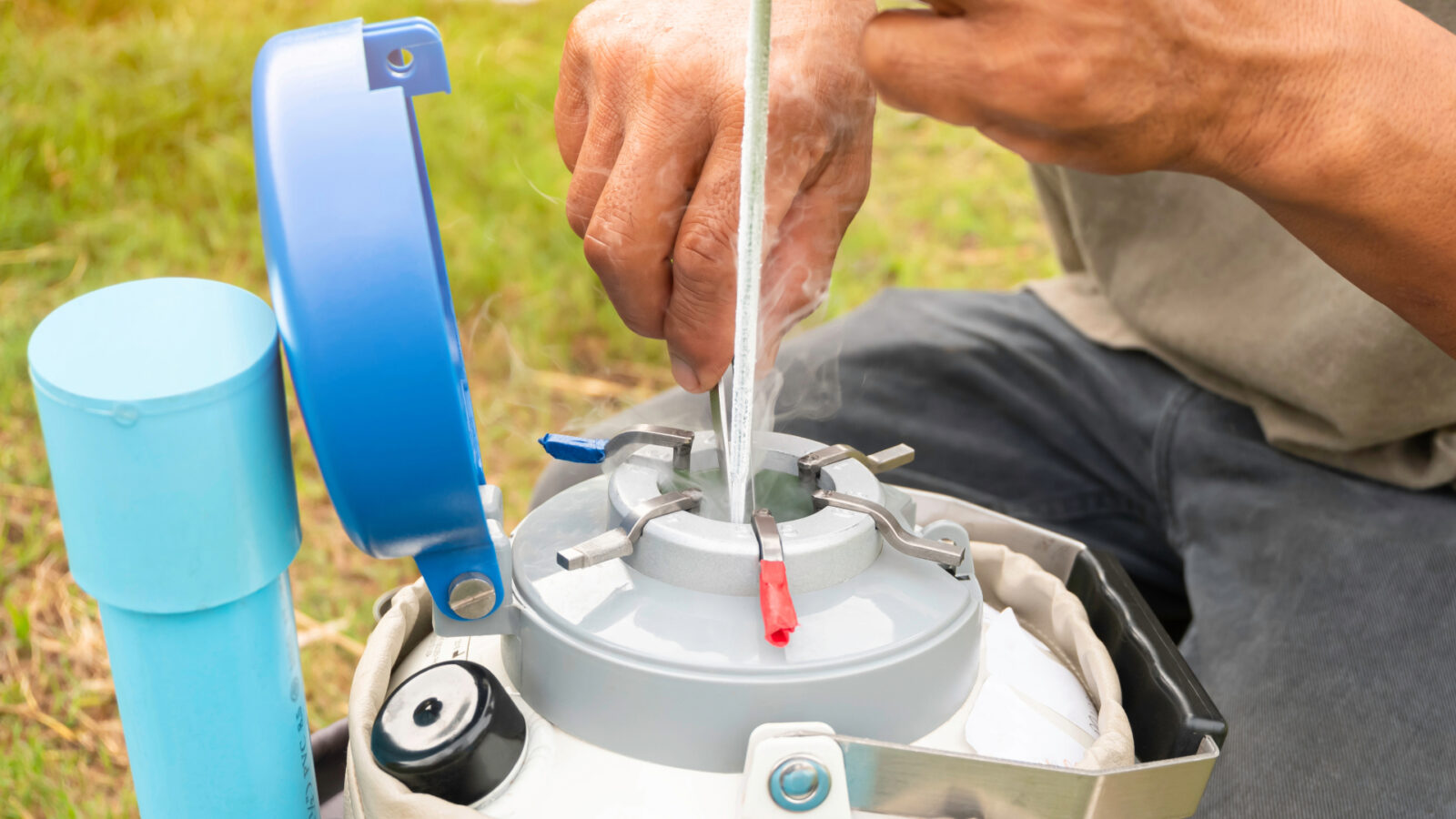
A liquid nitrogen tank is a double-wall container in which two tanks are fused together with a fiberglass neck. A hinged lid covers the tank canister area, and a Styrofoam cork fits loosely in the tank neck. Stainless steel canisters hold the semen canes in the tank and have handles that rest on the outside of the tank. The neck of the tank is labeled with a number where each canister handle rests. These numbers are crucial for inventory management, allowing you to identify each canister and the semen it contains. A well-maintained inventory can help you find the straw you want to retrieve in a timely manner, preventing repeated lifting and raising of canisters.
When receiving a new supply of semen, it is important to work quickly and place tanks side by side to prevent canes from being out of liquid nitrogen for more than five seconds during the transfer. Ensure you are out of direct sunlight and only remove the canes being transferred.
When removing semen for insemination, raise the canister until the cane tops are a few inches below the tank’s opening. Do not raise a canister above the frost line. The canister should not be raised into the neck of the tank for more than eight seconds when removing straws or looking for the right cane. If eight seconds have passed, lower the canister back into the tank to ensure the straws remain fully frozen. After identifying the cane you want to remove the semen from, use tweezers to remove the semen straw. Your fingertips are a heat source and should not be used to grasp the semen straws.
Before retrieving a straw, prepare a thaw bath at the correct temperature. As a general rule, straws should be thawed in 96 degrees Fahrenheit water for a minimum of 45 seconds. Other thawing procedures may be acceptable depending on the extender used; check with the semen company for details. If using an electronic water bath, ensure the unit is turned on and has reached the correct temperature. If hot rather than cold water has been placed into the unit, the water could be too hot. Use a thermometer to confirm the temperature of the water before inserting a straw of semen. Occasionally, these units may need calibration to keep the water at the recommended temperature.
Once a straw is thawed, it is critical to maintain it at approximately 96 degrees Fahrenheit until deposited in the cow. Straws can remain in the water bath for some time. However, straws should be deposited into the cow within 10 minutes of thawing. Multiple straws can be thawed at once, but attention to detail is critical when thawing multiple straws in the same thaw unit. First, it is critical to keep straws identified within the thaw bath to avoid confusion or using the wrong straw. Second, straws should not stick together in the thaw unit as this can cause uneven or incomplete thawing of straws. Third, use caution regarding the number of frozen straws placed into the unit at any time. Each straw is essentially an ice cube that can temporarily cool the water in the thaw bath.
Artificial Insemination guns must be warmed before semen straws are inserted to ensure sperm survivability. To warm your gun, place it inside your shirt until you are ready to load it. Sheaths can also be tucked into your shirt to keep them warm if it is cold outside. When ready to load an AI gun, ensure you are out of direct sunlight in a sheltered area and work quickly to avoid exposing the straw to temperature swings. Pull the plunger on the AI gun back about six inches to allow for the insertion of the straw. Remove the straw from the thaw unit with tweezers and place it in a paper towel. While keeping the straw protected from sunlight, dry the straw thoroughly. The paper towel also protects the straw from ambient temperature and wind. Using scissors or a straw cutter, cut a quarter inch below the sealed end of the straw at a 90-degree angle. Insert the cotton plug end of the straw into the AI gun and slide the plastic sheath over the gun. Most sheaths are designed with a tip that will lock into place to prevent backflow. It is important to ensure the sheath is secured on the flange of the AI gun. Once you have loaded the AI gun, insert it into your shirt to keep the semen warm and out of direct sunlight.
Knowing how to handle semen properly will help enhance your reproductive efficiency when using artificial insemination for bovines and other livestock. Little changes like having the animal locked up before the semen is thawed and working efficiently when a loaded gun is prepared can result in increased reproductive gains.