Skip to content
UW Crest

Dairy

Division of Extension

  • HPAI
  • Topics
    • Animal Welfare & Herd Health
    • Emerging Technologies and Facilities
    • Feed and Nutrition
    • Heat Stress
    • Milk Quality and Milking Systems
    • Reproduction and Genetics
  • Events
  • News
  • Dairy Programs
    • Badger Dairy Insight
    • El “Break” Info-Lechero
    • Four-State Nutrition and Management Conference
    • Midwest Manure Summit
    • Milk Quality from the Udder World: Trainer Certification Program
  • Articles
  • Newsletters
    • Dairy Newsletter
    • Bovi-Noticias
  • People
  • About
    • About the Dairy Program
    • Our Impacts
    • Sign-up for the Dairy Program Newsletter
  • Contact Us
Search
University of Wisconsin-Extension

Reproduction and Genetics

Optimizing fertility on dairy farms is necessary and challenging on today’s dairy farms.


Focus your search

Reproduction
Genetics


Visit Dr. Paul Fricke’s: Extension Program in Dairy Cattle Reproduction

The goal of Dr. Paul Fricke’s extension program is to improve 21-day pregnancy rates by applying knowledge gained through scientific research to develop practical management strategies and assess new reproductive technologies, and to disseminate that information throughout Wisconsin, the U.S. and the world.

Articles

Sub-optimal transition cow care causes significant economic losses

Sub-optimal transition cow care causes significant economic losses

Earlier in the year, I attended the Four-State Dairy Nutrition and Management Conference, where many of the topics focused on transition cow care. One of the big take-home points from more than one speaker was that prevention of clinical disease is vital for long-term success of your cows. Issues during the transition period are associated with reduced reproduction and milk production. Prevention is followed closely by early diagnosis of clinical disease issues.

The high fertility cycle in dairy cattle

The high fertility cycle in dairy cattle

Over the past two decades, a reproduction revolution has occurred in the dairy industry. Twenty years ago, the 21-day pregnancy rate in U.S. dairy herds averaged about 14% with conception rates rarely exceeding 40%. In 1998, the annualized 21-day pregnancy rate goal was 20%, which few herds could achieve.

Calf Recumbency aka Early Onset Muscle Weakness Syndrome

Calf Recumbency aka Early Onset Muscle Weakness Syndrome

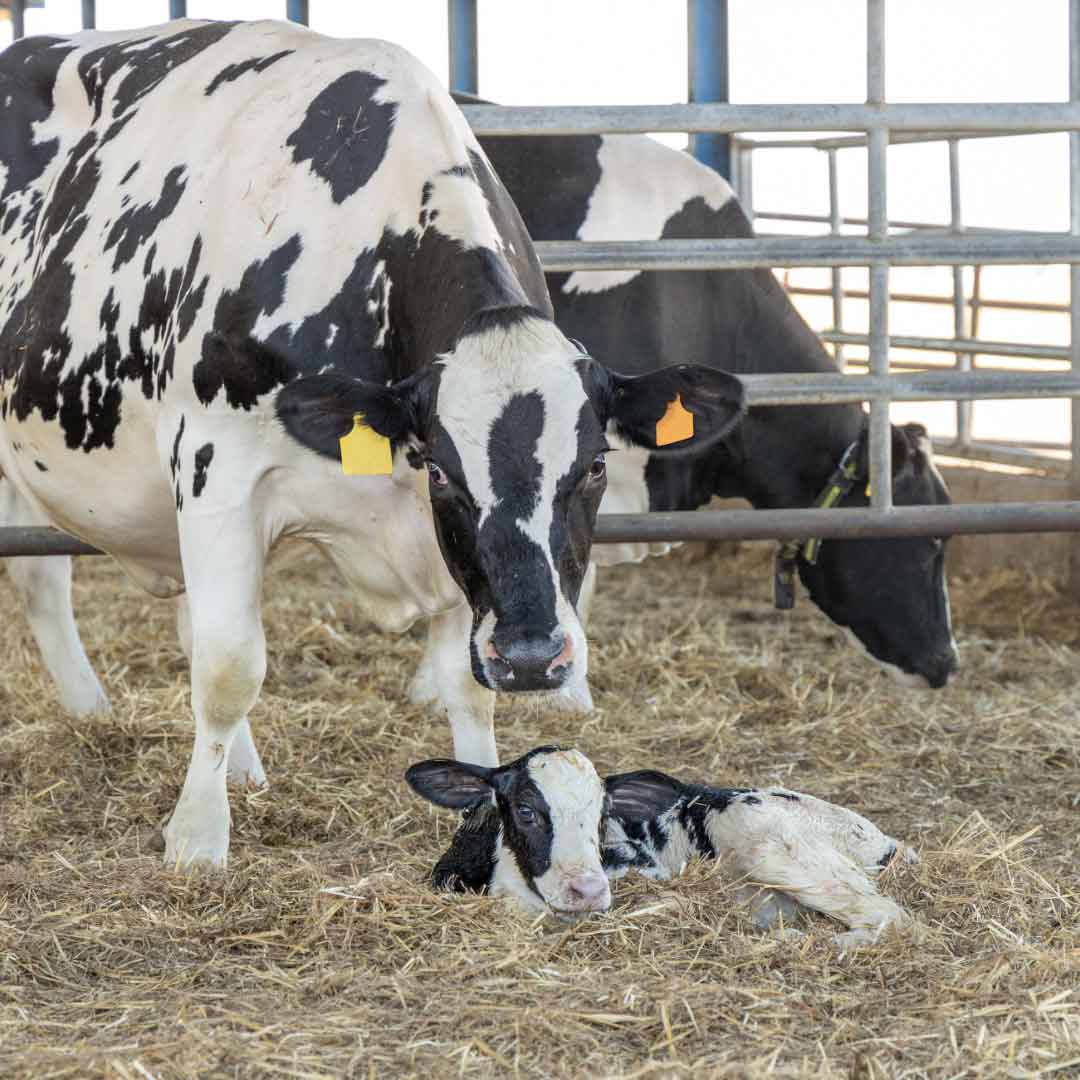
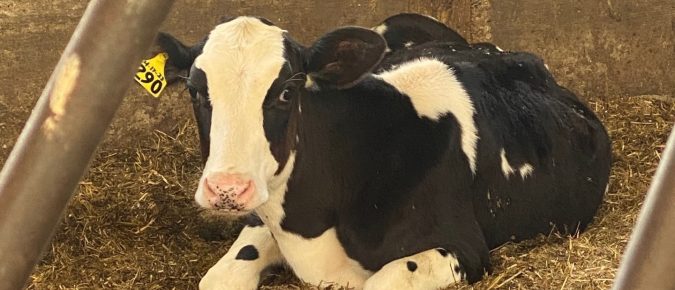
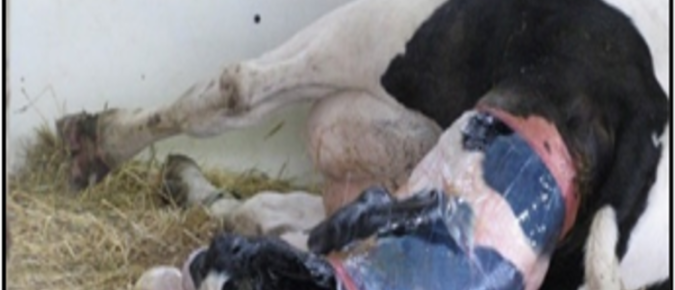
In 2020, there were multiple calves found unable to stand at birth or shortly after and were then seen by veterinarians in Pennsylvania. Calves were either weak and unable to stand immediately after birth, could stand with assistance, or lost the ability to stand within the first two weeks of life.

Single Gene Traits in Dairy Cattle

Single Gene Traits in Dairy Cattle

Early in April, the Council for Dairy Cattle Breeding (CDCB) released one of the three-times-a-year updates to sire summaries.  It can be a lot like looking through seed catalogs to find what bulls to select for the future of your herd. The rankings of bulls keep on getting better, and fast! 

Estrus detection & Estrus detection aids

Estrus detection & Estrus detection aids

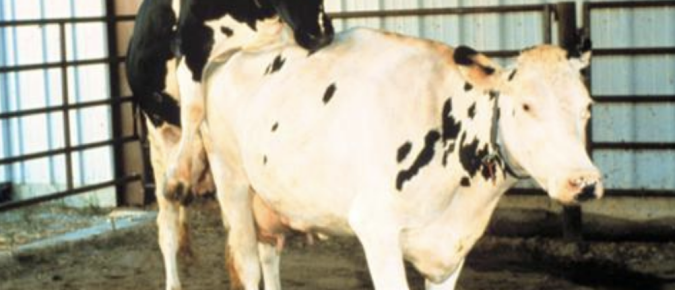
Estrus detection, commonly referred to as heat detection, is one of the most important reproductive management tasks performed on the farm. Simply put, if cows are not identified in estrus they will not be bred by Artificial Insemination (AI) and have no chance of becoming pregnant. Estrus detection accuracy is also critical.

Administering reproductive hormones to dairy cattle: Considerations for Safety and Beef Quality Assurance

Administering reproductive hormones to dairy cattle: Considerations for Safety and Beef Quality Assurance

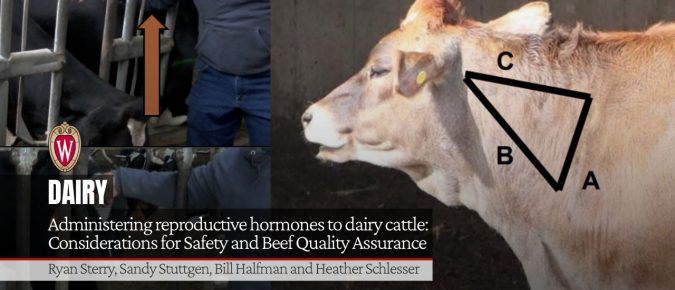
Using proper injection techniques for animal health products, including reproductive hormones, helps ensure products work effectively. In addition, it is important to safely handle animals and health products to protect both farm workers and animals.

Determining cattle pregnancy status

Determining cattle pregnancy status

Maintaining a successful reproductive program in our modern dairy and beef operations requires dedication. While it is rewarding to hear a pronouncement of pregnancy, there is not much the manager can do with that information, except wait.

Beef genetics on dairy females and examining the care of newborn calves: Results from a 2021 survey

Beef genetics on dairy females and examining the care of newborn calves: Results from a 2021 survey

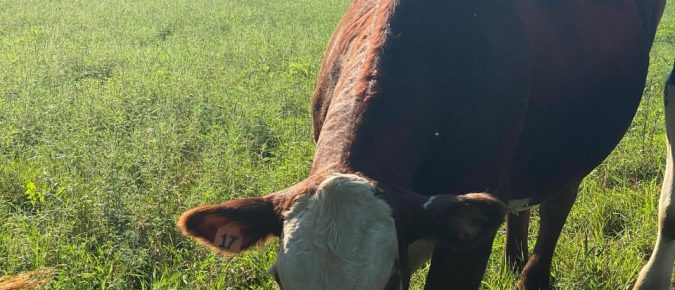
The use of beef sires on dairy females has continued to be a common and growing management practice on dairy farms.  During the summer of 2021, UW-Madison Division of Extension educators surveyed 40 dairy farms known to be using beef sires to breed dairy females to assess their beef x dairy sire selection criteria, selection of dairy females to breed to beef sires, newborn calf management, milk feeding practices, and how they market their beef x dairy cattle.

Cow fertility in the post-genomic era: progress, challenges, and perspectives

Cow fertility in the post-genomic era: progress, challenges, and perspectives

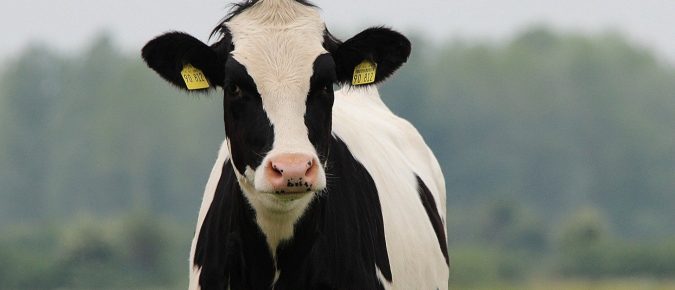
Dairy cattle selection programs aim to improve the profitability and sustainability of the dairy industry, either by targeting traits that increase revenue or traits that reduce expenses. Fertility is one of several major trait categories that includes production, longevity, health, calving ability, conformation, and sustainability.

Target age and weight when breeding dairy heifers

Target age and weight when breeding dairy heifers

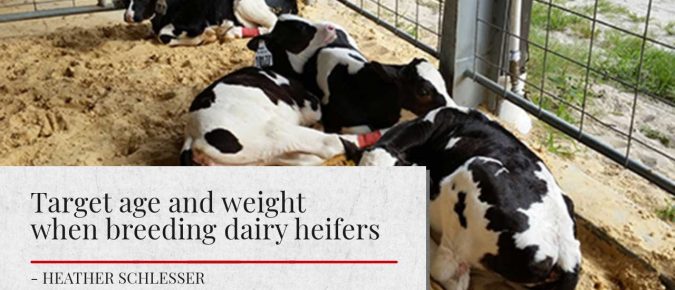
Raising heifers is one of the most cost-intensive areas of the farm.  From the day these animals hit the ground until they calve, they are a monetary burden on the farm. Therefore, getting these animals to calving as efficiently as possible makes sense.

Optimizing use of sexed semen in dairy herds

Optimizing use of sexed semen in dairy herds

During the past two decades, a reproduction revolution has occurred in the dairy industry. A consequence of increased reproductive performance has been an increase in replacement heifer inventories, which in turn have decreased replacement heifer market values. Based on the UW-Extension Dairy Replacement ICPA Survey (Akins and Hagedorn, 2015), rearing costs of Holstein heifers from birth to calving averaged $2,100 from 1999 to 2015 and exceeded $2,500 in 2015.


Do we still need the AM-PM Rule for the artificial insemination of cattle?

Do we still need the AM-PM Rule for the artificial insemination of cattle?

For nearly eighty years dairy producers have been indoctrinated in the use of the AM-PM rule for artificial insemination (AI) of cattle. The AM-PM rule dictates that a cow should receive AI 12 hours after first being observed in estrus. If a cow is seen in estrus in the AM she should receive AI that PM, and cows seen in estrus in the PM should receive AI the following AM.

Posts navigation

Posts pagination

◄ Page 1 Page 2 Page 3 Page 4 ►

Division of Extension

Connecting people with the University of Wisconsin

  • Agriculture
  • Community Development
  • Health & Well-Being
  • Families & Finances
  • Natural Resources
  • Positive Youth Development

Agriculture at Extension

  • Agriculture Water Quality
  • Crops and Soils
  • Farm Management
  • Horticulture
  • Livestock

Questions?

Contact us at dairy@extension.wisc.edu

Dairy Newsletter

Stay up to date on the latest information and upcoming programs from Extension Dairy, sign up for our newsletter.

Sign up now.

University of Wisconsin-Madison      |        Explore Extension: Agriculture Community Development Families & Finances Health Natural Resources Youth
Connect With Us
Support Extension
Extension Home

We teach, learn, lead and serve, connecting people with the University of Wisconsin, and engaging with them in transforming lives and communities.

Explore Extension »

County Offices

Connect with your County Extension Office »

Map of Wisconsin counties
Staff Directory

Find an Extension employee in our staff directory »

staff directory
Social Media

Get the latest news and updates on Extension's work around the state

facebook iconFacebook

twitter icon Follow on X


Facebook
Follow on X

Feedback, questions or accessibility issues: info@extension.wisc.edu | © 2026 The Board of Regents of the University of Wisconsin System
Privacy Policy | Non-Discrimination Statement & How to File a Complaint | Disability Accommodation Requests

The University of Wisconsin–Madison Division of Extension provides equal opportunities in employment and programming in compliance with state and federal law.