
Skip to content
UW Crest

Dairy

Division of Extension

  • HPAI
  • Topics
    • Animal Welfare & Herd Health
    • Emerging Technologies and Facilities
    • Feed and Nutrition
    • Heat Stress
    • Milk Quality and Milking Systems
    • Reproduction and Genetics
  • Events
  • News
  • Dairy Programs
    • Badger Dairy Insight
    • El “Break” Info-Lechero
    • Four-State Nutrition and Management Conference
    • Midwest Manure Summit
    • Milk Quality from the Udder World: Trainer Certification Program
  • Articles
  • Newsletters
    • Dairy Newsletter
    • Bovi-Noticias
  • People
  • About
    • About the Dairy Program
    • Our Impacts
    • Sign-up for the Dairy Program Newsletter
  • Contact Us
Search
University of Wisconsin-Extension
Articles > Biosecurity & Disease Prevention

Am I required to test for HPAI (H5N1) before transporting my cattle?

Written by Aerica Bjurstrom, Jackie McCarville and Faith Reyes
Share
  • Share:
  • Share on Facebook
  • Share on X (Twitter)
  • Share via Email
  • Copy Link

Copied!

Introduction

The Federal order regarding the HPAI (H5N1) virus situation requires testing for specific interstate (across state lines) travel of lactating dairy cattle (put into effect April 29, 2024).

Before interstate movement, lactating dairy cattle are required to receive a negative test for Influenza A virus by milk sample at an approved National Animal Health Laboratory Network (NAHLN) laboratory using an NAHLN-approved assay. Symptomatic (sick) lactating dairy cattle are ineligible for interstate movement or movement to slaughter. Nonlactating dairy cattle – including heifers, dry cows, and bull calves, along with beef cattle – are not currently subject to testing for interstate movement, but testing by nasal swab is strongly encouraged.

Proper planning around sample shipping and testing facility schedules should occur. Dairy farmers should work with their herd veterinarian to navigate this process to ensure sample collection and testing take place no more than 7 days before the transport event.

Each animal should be fit for transport before loading for a transportation journey. Animals should have a Certificate of Veterinary Inspection (CVI) or other documentation of movement approved by the sending and receiving State Animal Health Officials and provided to the sending and receiving State Animal Health Officials. In place of a CVI, an Owner Hauler Statement can currently be used for interstate travel and does not require veterinary approval, but is not accepted by all US states.  Individual states can require further action for any transportation situation, please check with your own state’s policies by referencing the state animal health website and/or NMPF’s list of specific state transportation mandates. Sale barns and auction markets may also have their requirements about receiving and marketing dairy cattle that must be adhered to as appropriate. When planning to exhibit dairy cows at cattle shows, please check with show committees on guidelines they have implemented around dairy cows.

Regardless of the type of transportation journey, whether across state lines or not, all cattle showing related signs should be tested. Proactive management and animal monitoring is critical.

Below are scenarios to assist farmers with understanding the Federal order.

Updated: 06/17/2024

Table of Contents

  1. Introduction
  2. Scenario 1
  3. Scenario 2
  4. Scenario 3
  5. Scenario 4
  6. Scenario 5
  7. Scenario 6
  8. Biosecurity and communication are key
  9. Authors

Scenario 1

A lactating dairy cow is intended to be transported to an out-of-state farm.

What am I required to do?

The animal is required to have a negative HPAI (H5N1) test before transport.
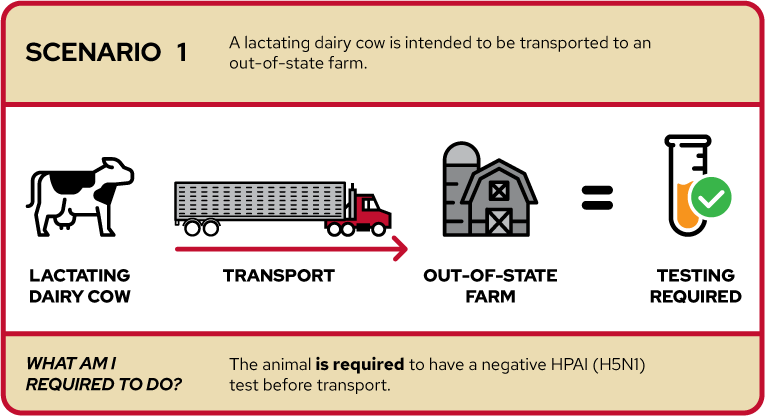
The image depicts Scenario 1, where a lactating dairy cow is intended to be transported to an out-of-state farm. It shows icons representing a lactating dairy cow, a truck for transport, an out-of-state farm destination, and a tick mark indicating testing is required. The text below states "The animal is required to have a negative HPAI (H5N1) test before transport."

Scenario 2

A lactating dairy cow is intended to be transported to an out-of-state auction/market. The cow may be sold to another farm or intended for in or out-of-state harvest after marketing.

What am I required to do?

The animal is required to have a negative HPAI (H5N1)
test before transport.
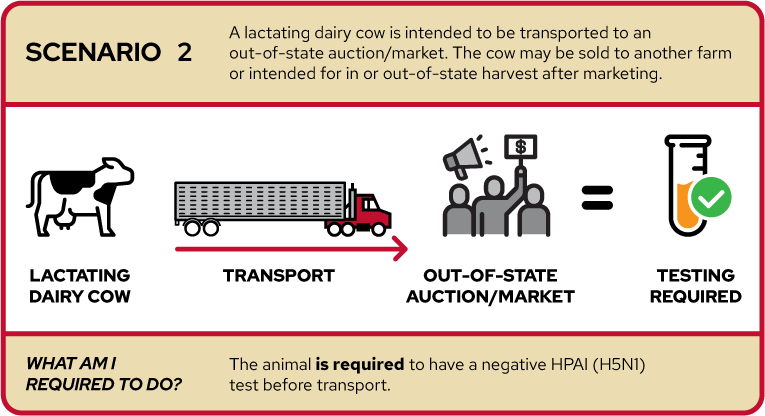
The image depicts Scenario 2, where a lactating dairy cow is intended to be transported to an out-of-state auction/market. The cow may be sold to another farm or intended for in or out-of-state harvest after marketing. It shows icons representing a lactating dairy cow, a truck for transport, an out-of-state auction/market destination with people figures and a dollar sign, and a tick mark indicating testing is required. The text below states "The animal is required to have a negative HPAI (H5N1) test before transport."

Scenario 3

A lactating dairy cow is intended to be transported to an in-state auction/sale barn and then to an out-of-state harvest facility.

What am I required to do?

Currently, no test is required, but CVI or other documentation
is needed and testing is recommended.
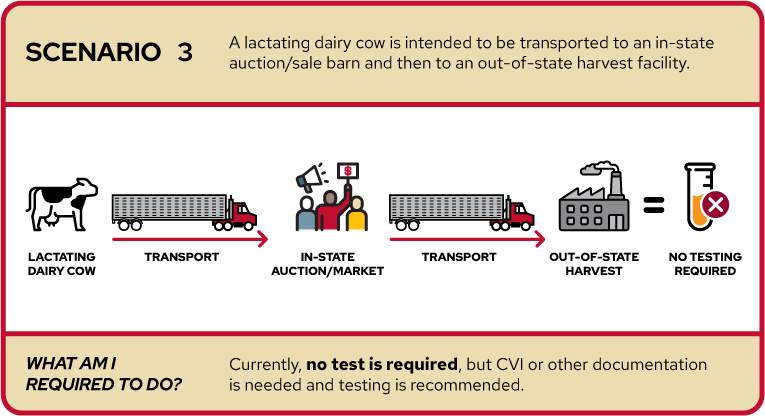
The image depicts Scenario 3, where a lactating dairy cow is intended to be transported to an in-state auction/sale barn and then to an out-of-state harvest facility. It shows icons representing a lactating dairy cow, two transport trucks, an in-state auction/market destination with people figures, an out-of-state harvest facility, and a cross mark indicating no testing is required. The text below states "Currently, no test is required, but CVI or other documentation may be recommended."

Scenario 4

A lactating dairy cow is intended to be transported directly to an out-of-state harvest facility.

What am I required to do?

Currently, no test is required, but CVI or other documentation
is needed and testing is recommended.
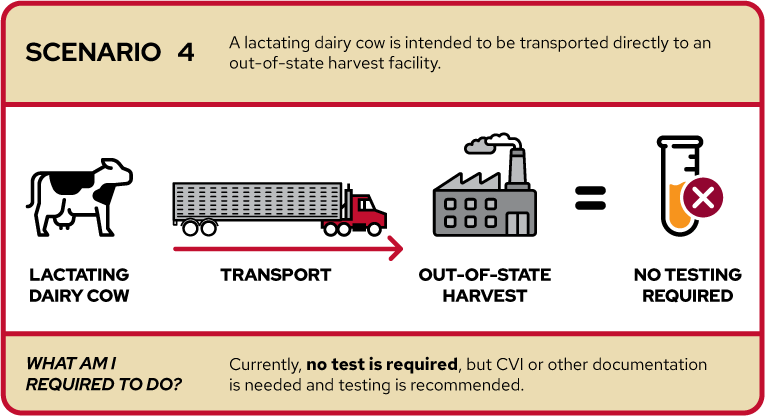
The image depicts Scenario 4, where a lactating dairy cow is intended to be transported directly to an out-of-state harvest facility. It shows icons representing a lactating dairy cow, a transport truck, an out-of-state harvest facility with a smokestack, and a cross mark indicating no testing is required. The text below states "Currently, no test is required, but CVI or other documentation may be recommended."

Scenario 5

A lactating dairy cow is intended to be transported within the same state as the originating farm.

What am I required to do?

Currently, no test is required, but CVI or other documentation
is needed and testing is recommended.
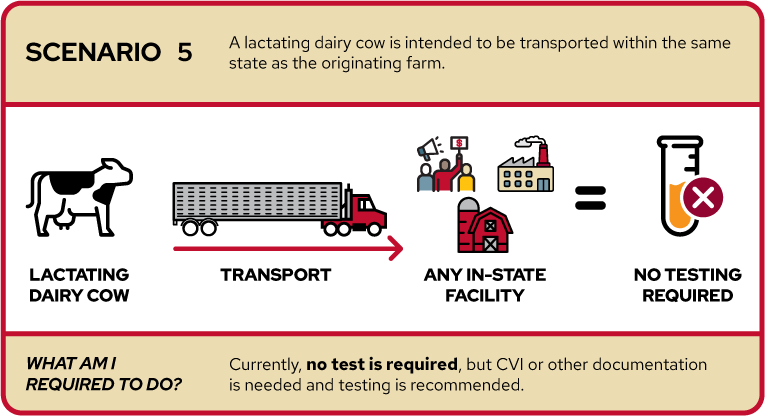
ALT Text: The image depicts Scenario 5, where a lactating dairy cow is intended to be transported within the same state as the originating farm. It shows icons representing a lactating dairy cow, a transport truck, an any in-state facility destination with people figures and a crossed-out symbol, and a cross mark indicating no testing is required. The text below states "Currently, no test is required, but CVI or other documentation may be recommended."

Scenario 6

A lactating dairy cow is intended to be transported to an exhibition or fair in Wisconsin.

What am I required to do?

The animal is required to have a negative HPAI (H5N1)
test with samples collected no more than 7 days before transport.
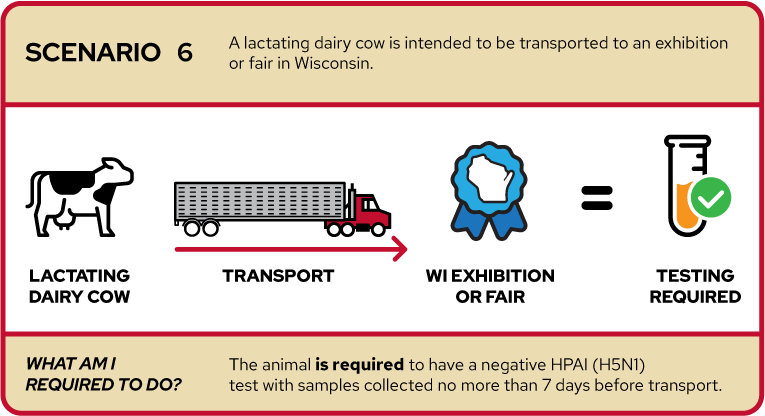
The image depicts Scenario 6, where a lactating dairy cow is intended to be transported to an exhibit or fair in Wisconsin. It shows icons representing a lactating dairy cow, a truck for transport, a Wisconsin Exhibition or Fair, and a tick mark indicating testing is required. The text below states "The animal is required to have a negative HPAI (H5N1) test before transport."

Adapted from Cornell University.

Biosecurity and communication are key

Mindful observation and critical biosecurity practices should be implemented and remain top of mind to identify sick animals and prevent the spread of the disease-related virus. All sectors of the industry, researchers, veterinarians, and farmers must work together during this situation. 

More information about HPAI (H5N1), including biosecurity resources, can be found on the UW-Madison Division of Extension Dairy Program Area website (https://go.wisc.edu/HPAI-Resources). Please stay up to date with information as the situation evolves by subscribing to updates from USDA and WI DATCP.

Image Credits

Images are not allowed for any use outside of this Article. Images may not be downloaded or shared. Images created by: Supanut Piyakanont, Juan Pablo Bravo, Nendra Wahyu Kuncoro, P Thanga Vignesh, Meko, Kukuh Wachyu Bias, Adrian Syauqi, and Funtasticon from the Noun Project.

Authors

 

Aerica Bjurstrom

Regional Dairy Educator – Aerica’s work focuses on herd health and animal welfare. She also has a strong background in meat quality and has done programming in market cow carcass quality.

Articles by Aerica Bjurstrom
Contact Aerica Bjurstrom


Jackie McCarville

Regional Dairy Educator – Jackie’s primary focus is dairy operations. She has experience in the private sector in animal nutrition and on dairy farms.

Articles by Jackie McCarville
Contact Jackie McCarville


Faith Reyes

Dairy Outreach Specialist – Faith Reyes was a Dairy Outreach Specialist in the Division of Extension at the University of Wisconsin – Madison (2023-2024). Her work aimed to understand dairy farmers’ needs to provide directed, beneficial education programs. She served as a bridge between the novel research taking place at the university level and the dairy industry by communicating research outcomes and applicable on-farm solutions.
Articles by Faith Reyes


Download Print Optimized Article
Print This Page

You May Also Like

  • Resources for Highly Pathogenic Avian Influenza (HPAI) H5N1 virus in CattleResources for Highly Pathogenic Avian Influenza (HPAI) H5N1 virus in Cattle
  • Strengthening biosecurity practices on dairy farmsStrengthening biosecurity practices on dairy farms
  • Fortaleciendo las prácticas de bioseguridad en granjas lecheras Fortaleciendo las prácticas de bioseguridad en granjas lecheras 
  • ▶️ Watch: A Clearer Picture: Using Ultrasound to Detect Calf Respiratory Issues▶️ Watch: A Clearer Picture: Using Ultrasound to Detect Calf Respiratory Issues

Division of Extension

Connecting people with the University of Wisconsin

  • Agriculture
  • Community Development
  • Health & Well-Being
  • Families & Finances
  • Natural Resources
  • Positive Youth Development

Agriculture at Extension

  • Agriculture Water Quality
  • Crops and Soils
  • Farm Management
  • Horticulture
  • Livestock

Questions?

Contact us at dairy@extension.wisc.edu

Dairy Newsletter

Stay up to date on the latest information and upcoming programs from Extension Dairy, sign up for our newsletter.

Sign up now.

University of Wisconsin-Madison      |        Explore Extension: Agriculture Community Development Families & Finances Health Natural Resources Youth
Connect With Us
Support Extension
Extension Home

We teach, learn, lead and serve, connecting people with the University of Wisconsin, and engaging with them in transforming lives and communities.

Explore Extension »

County Offices

Connect with your County Extension Office »

Map of Wisconsin counties
Staff Directory

Find an Extension employee in our staff directory »

staff directory
Social Media

Get the latest news and updates on Extension's work around the state

facebook iconFacebook

twitter icon Follow on X


Facebook
Follow on X

Feedback, questions or accessibility issues: info@extension.wisc.edu | © 2026 The Board of Regents of the University of Wisconsin System
Privacy Policy | Non-Discrimination Statement & How to File a Complaint | Disability Accommodation Requests

The University of Wisconsin–Madison Division of Extension provides equal opportunities in employment and programming in compliance with state and federal law.