Publication ID: A4192-006/AG-919-06
Introduction
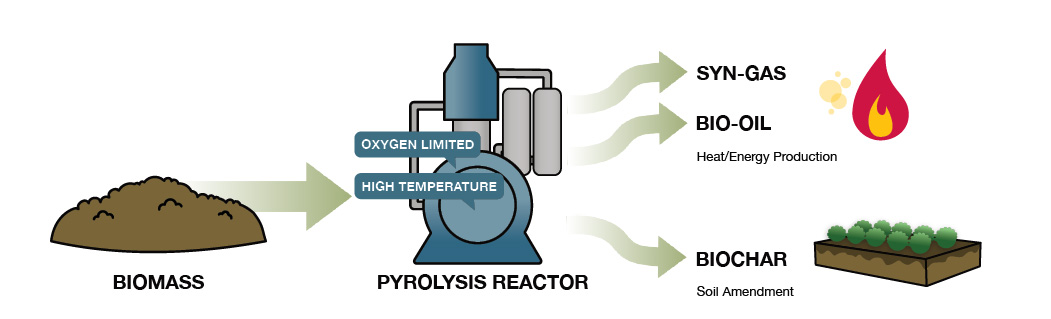
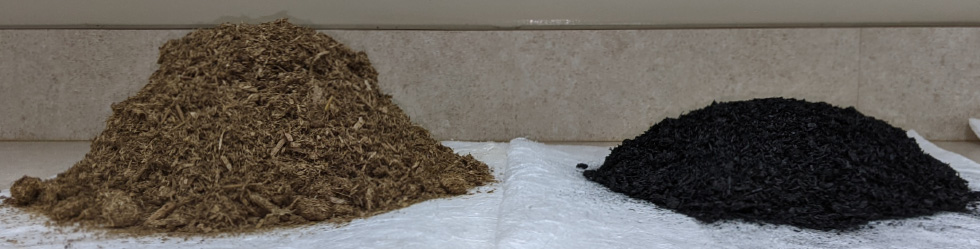
Biochar is a carbon-rich product resulting from pyrolysis, where biomass (such as wood chips, corn stover, and manure) is thermally treated at high temperatures under oxygen limited conditions (Figure 1). Pyrolysis produces syn-gas and bio-oil, fuels that can be used for heating or energy production, and a solid residual known as biochar. Biochar is porous, has a high carbon content, and low density (5 to 20pounds per cubic foot) and has recently been used as a soil amendment to fosters oil health. When integrated into fields it can sequester carbon, improve soil fertility and crop yield, decrease nitrous oxide emissions (a potent greenhouse gas), and improve nitrogen retention and reduce nitrate leaching (a groundwater contaminate) (Lehmann and Joseph 2015; Ahmed et al. 2019; Xu et al. 2016;Bradley, Larson, and Runge 2015; Sanford and Larson 2020a; 2020b)
Industrial pyrolysis systems have primarily used woody biomasses as feedstocks. However, recent research highlights the potential of using agricultural residue, including manure, as a feedstock for slow pyrolysis. Converting manure into biochar reduces the mass and volume of manure (Figure 2, Table 1), which can be used to ease transportation for land application as a fertilizer compared to the original manure solids.
Technology Basics
Pyrolysis is the process of converting an organic biomass at high temperature under oxygen limiting conditions to produce a syn-gas, bio-oil, and biochar. Any organic biomass can be used for biochar production, but moisture content should be less than 30%. If moisture content exceeds 30%, drying is suggested to decrease energy requirement to achieve desired temperature during pyrolysis (Tripathi et al. 2016). Moisture content also will impact bio-oil production, with higher moisture biomass resulting in more bio-oil production (Fonseca et al. 2019).
Pyrolysis reactors can be designed to optimize production of syn-gas, bio-oil, or biochar by varying the reactor temperature, heating rate, and holding time (Spokas et al. 2012). Slow pyrolysis technologies are used to optimize
recovery of biochar and operate in a temperature range of 300 to 700°C (572 to 1292°F) with a slow heating rate typically below 10°C (50°F) per minute. The resulting process reduces the mass of the biomass by 20 to 50 percent, into a low-density carbon-rich product.
Slow pyrolysis reactors can be designed to operate as batch or continuous systems (Boateng et al. 2015). Batch systems, commonly called batch kilns, are typically lower cost units and used when recovery of biochar (and not the syn-gas and biooil) is a priority. In a batch system, the biomass is loaded into a reactor, which is then heated at a specified heating rate to the desired temperature and then allowed to cool. Continuous systems are designed to feed biomass continually into the system where the biomass will undergo drying, preheating, pyrolysis, and cooling at different stages within the reactor. Drum pyrolizers and rotary kilns are common continuous pyrolysis systems, in which biomass enters a cylindrical drum and is moved through different stages of pyrolysis using a paddle (drum pyrolysers) or rotational gravity (rotary kiln).
Performance and End Use
Slow pyrolysis of feedstocks results in a variable mass and volume reduction dependent on pyrolysis temperature. Small scale batch pyrolysis test of dried manured solids results in a mass reduction ranging from 42 to 86% (Table 1).
| Parameter | Range (%) |
|---|---|
| Mass Reduction a, b, c, d, e | 42 – 82 |
| Phosphorus Recovery a, c, d, e | 93 – 99 |
| Nitrogen Recovery a, b, c, e | 18 – 62 |
During the pyrolysis process complete recovery of manure phosphorus occurs, while only 18 to 62% of nitrogen is recovered due to losses through volatilization and emission of ammonia and nitrogen gases. Pyrolysis temperature will impact mass and nitrogen recoveries, with higher temperatures resulting is greater mass reduction and lower nitrogen recovery (Cao and Harris 2010). The process of converting manure solids to biochar results in a nutrient-rich manure by-product (Figure 3) that can be used as a fertilizer that has undergone significant mass and volume reduction. Manure-derived biochar can be land applied as a fertilizer and acts as a slow release phosphorus fertilizer (Jin et al. 2016; Liang et al. 2014; Subedi et al. 2016).
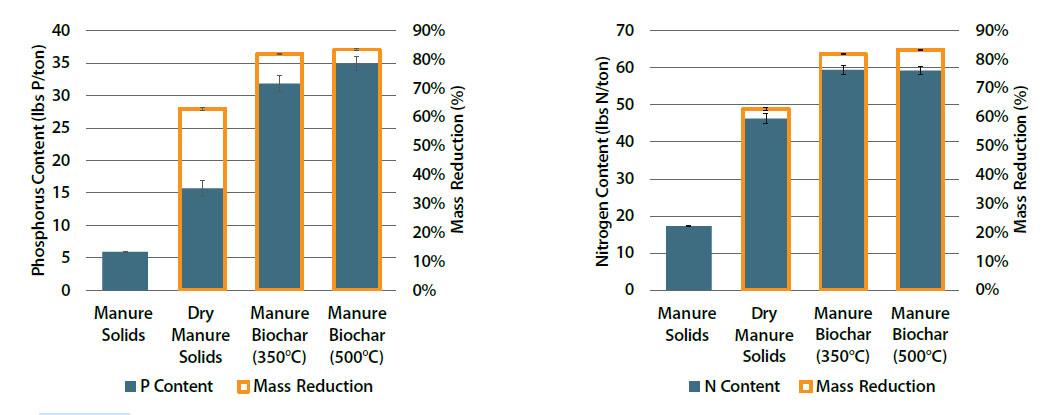
produced into biochar. Unpublished data from Sanford and Larson.
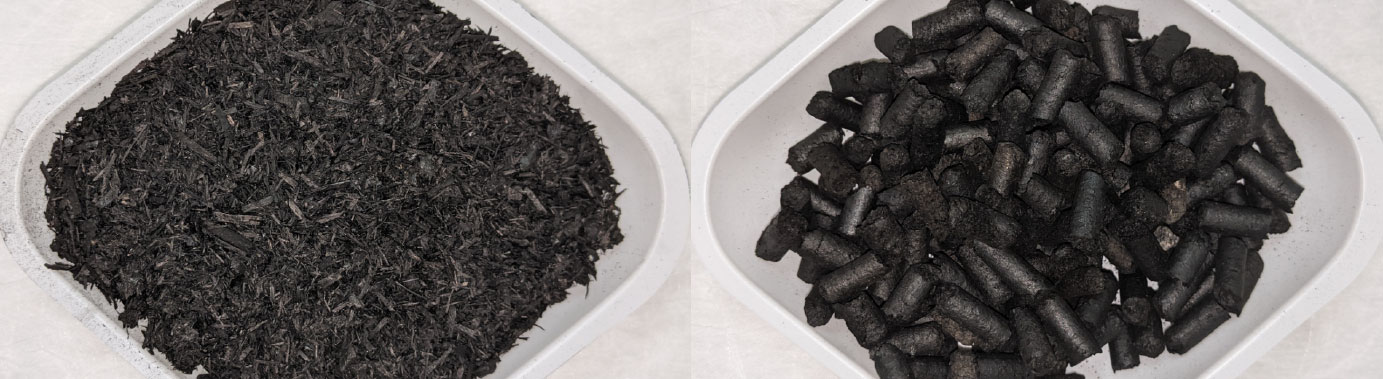
To improve handling, storage, and transport of manure-derived biochar, manure can be pelletized (See UW–Madison Extension Publication A4192-003) prior to pyrolysis (Figure 4).
Cost
Implementation of pyrolysis reactors primarily have been on an industrial scale, but on-farm pyrolysis is limited. Capital cost of slow pyrolysis reactors will vary significantly based on type of system (continuous vs batch), size, and integration of an energy recovery system for syn-gas and bio-oil. Capital cost for pyrolysis plants from small-scale (2,000 tons per year) to large-scale (over 200,000 tons per year) plants range from $1M to $90M dollars (Shackley et al. 2015). Operating cost in literature varies drastically between $20 to $330 per ton of dry feedstock, which will vary based on system type, end product objective (i.e., syn-gas, bio-oil, or biochar), temperature range, and energy cost. In addition to pyrolysis reactors, manure will require pretreatment before biochar production (solid liquid separation and
drying), and facilities will require biochar storage facilities, increasing the capital cost.
Limitations
Conversion of manure to biochar will require additional technologies for solid liquid separation and drying prior to pyrolysis as pyrolysis conditions require biomass to have a low moisture content (less than 30%). A solid liquid separation system, such as a centrifugation, screw press, incline screen, etc. will be required for preprocessing, and to decrease moisture content drying may be required.
References
- Ahmed, Rasheed, Yuzhong Li, Lili Mao, Chunying Xu, Wei Lin, Shakeel Ahmed, and Waseem Ahmed. 2019. “Biochar Effects on Mineral Nitrogen Leaching, Moisture Content, and Evapotranspiration after 15N Urea Fertilization for Vegetable Crop.” Agronomy 9(6). https://doi.org/10.3390/agronomy9060331
- Boateng, A. A., M. Garcia-Perez, O. Masek, R. Brown, and B. del Campo. 2015. “Biochar Production and Technology.” In Biochar for Environmental Management: Science, Technology, and Implementation, edited by Johannes Lehmann and Stephen Joseph, 63–87. New York, NY: Routledge.
- Bradley, A., R. A. Larson, and T. Runge. 2015. “Effect of Wood Biochar in Manure-Applied Sand Columns on Leachate Quality.” Journal of Environment Quality 44(6): 1720–28. https://doi.org/10.2134/jeq2015.04.0196
- Cantrell, Keri B., Patrick G. Hunt, Minori Uchimiya, Jeffrey M. Novak, and Kyoung S. Ro. 2012. “Impact of Pyrolysis Temperature and Manure Source on Physicochemical Characteristics of Biochar.” Bioresource Technology 107: 419–28. https://doi.org/10.1016/j.biortech.2011.11.084
- Cao, Xinde, and Willie Harris. 2010. “Properties of Dairy-Manure-Derived Biochar Pertinent to Its Potential Use in Remediation.” Bioresource Technology 101(14): 5222–28. https://doi.org/10.1016/j.biortech.2010.02.052
- Cely, P., G. Gascó, J. Paz-Ferreiro, and A. Méndez. 2015. “Agronomic Properties of Biochars from Different Manure Wastes.” Journal of Analytical and Applied Pyrolysis 111: 173–82. https://doi.org/10.1016/j.jaap.2014.11.014
- Fonseca, Frederico Gomes, Axel Funke, Andreas Niebel, Ana Paula Soares Dias, and Nicolaus Dahmen. 2019. “Moisture Content as a Design and Operational Parameter for Fast Pyrolysis.” Journal of Analytical and Applied Pyrolysis 139(Jan): 73–86. https://doi.org/10.1016/j.jaap.2019.01.012
- Haider, Ghulam, Diedrich Steffens, Gerald Moser, Christoph Müller, and Claudia I. Kammann. 2017. “Biochar Reduced Nitrate Leaching and Improved Soil Moisture Content without Yield Improvements in a Four-Year Field Study.” Agriculture, Ecosystems and Environment 237: 80–94. https://doi.org/10.1016/j.agee.2016.12.019
- Jeffery, S, D. Apalos, K.A. Spoka, and G.A. Verheijen. 2015. “Biochar Effects on Crop Yield.” In Biochar for Environmental Management: Science and Technology, 301–25.
- Jin, Yi, Xinqiang Liang, Miaomiao He, Yu Liu, Guangming Tian, and Jiyan Shi. 2016. “Manure Biochar Influence upon Soil Properties, Phosphorus Distribution and Phosphatase Activities: A Microcosm Incubation Study.” Chemosphere 142: 128–35. https://doi.org/10.1016/j.chemosphere.2015.07.015
- Laird, D., and N. Rogovska. 2015. “Biochar Effects on Nutrient Leaching.” In Biochar for Environmental Management: Science, Technology, and Implementation, edited by Johannes Lehmann and Stephen Joseph, 521–42. New York, NY: Routledge.
- Lehmann, Johannes, and Stephen Joseph. 2015. “Biochar for Environmental Management: An Introduction.” In Biochar for Environmental Management: Science, Technology, and Implementation, edited by Johannes Lehmann and Stephen Joseph, 1–14. New York, NY: Routledge.
- Liang, Yuan, Xinde Cao, Ling Zhao, Xiaoyun Xu, andWillie Harris. 2014. “Phosphorus Release from Dairy Manure, the Manure-Derived Biochar, and Their Amended Soil: Effects of Phosphorus Nature and Soil Property.” Journal of Environment Quality 43 (4): 1504. https://doi.org/10.2134/jeq2014.01.0021
- Pavuluri, Kiran, Selim Magdi, Syam Dodla, Bharat Sharma Acharya, Jim JianWang, Hari Bohara, and Murali Darapuneni. 2019. “Influence of Poultry Litter and Biochar on SoilWater Dynamics and Nutrient Leaching from a Very Fine Sandy Loam Soil.” Soil and Tillage Research 189(Jan): 44–51. https://doi.org/10.1016/j.still.2019.01.001
- Sanford, J. R., and R. A. Larson. 2020a. “Assessing Nitrogen Cycling in Corncob Biochar Amended Soil Columns for Application in Agricultural Treatment Systems.” Agronomy 10(7): 979. https://doi.org/10.3390/agronomy10070979
- Sanford, J.R., and R.A. Larson. 2020b. “Treatment of Horizontal Silage Bunker Runoff Using Biochar Amended Vegetative Filter Strips.” Journal of Environmental Management, 253. https://doi.org/10.1016/j.jenvman.2019.109746
- Shakley, S., A. Clare, S. Joseph, B. McCarl, and H-P. Schmidt. 2015. “Economic Evaluation of Biochar Systems: Current Evidence and Challenages.” In Biochar for Environmental Management: Science and Technology, 813–51.
- Spokas, Kurt A., Keri B. Cantrell, Jeffrey M. Novak, DavidW. Archer, James A. Ippolito, Harold P. Collins, Akwasi A. Boateng, et al. “Biochar: A Synthesis of Its Agronomic Impact beyond Carbon Sequestration.” Journal of Environment Quality 41 (4): 973. https://doi.org/10.2134/jeq2011.0069
- Subedi, R., N. Taupe, I. Ikoyi, C. Bertora, L. Zavattaro, A. Schmalenberger, J. J. Leahy, and C. Grignani. 2016. “Chemically and Biologically-Mediated Fertilizing Value of Manure-Derived Biochar.” Science of the Total Environment 550: 924–33. https://doi.org/10.1016/j.scitotenv.2016.01.160
- Tripathi, Manoj, J. N. Sahu, and P. Ganesan. 2016. “Effect of Process Parameters on Production of Biochar from Biomass Waste through Pyrolysis: A Review.” Renewable and Sustainable Energy Reviews 55: 467–81. https://doi.org/10.1016/j.rser.2015.10.122
Originally Published: January 2022
Reviewers:
- Jane Anklam – Agriculture and Horticulture Educator, University of Wisconsin–Madison Division of Extension, Douglas County
- Nayela Zeba – Ph.D. student, University of Wisconsin-Madison, Department of Soil Science
- Michael Holly – Assistant Professor, University of Wisconsin-Green Bay, Department of Water Science
Authors:
- Joseph Sanford – Assistant Professor, Soil and Crop Sciences, University of Wisconsin–Platteville
- Horacio Aguierre-Villegas – Scientist III, Nelson Institute for Environmental Studies, University of Wisconsin–Madison
- Rebecca Larson – Associate Professor, Nelson Institute for Environmental Studies, University of Wisconsin–Madison
- Mahmoud A. Sharara – Assistant Professor, Biological and Agricultural Engineering, North Carolina State University
- Zong Liu – Assistant Professor, Biological and Agricultural Engineering, Texas A&M University
- Linda Schott – Assistant Professor, Soil and Water Systems, University of Idaho