Introduction
Commercially launched over a decade ago, high-oleic soybeans (HOSB) have continued to spark interest as a beneficial ingredient for dairy rations. As feeding research trials continue to emerge, we’re gaining better insights into how HOSB can fit within dairy diets compared to conventional soybeans. This article discusses what makes high-oleic soybeans unique, summarizes findings from research trials, and highlights key feeding and economic considerations for farms.
What’s the Difference Between High-Oleic and Conventional Soybeans?
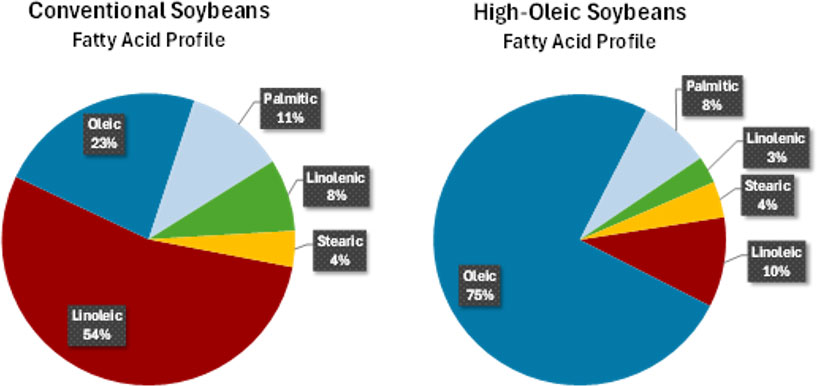
At their core, both high-oleic and conventional soybeans are a protein rich feed source that contains similar levels of crude fat, typically 20-22%. However, the difference between these beans is in the fatty acid profile that makes up that fat.
In conventional soybeans, just over half of the total fat is linoleic acid (C18:2) Linoleic acid, due to its degree of saturation and rumen fermentation characteristics, is associated with a higher risk of milk fat depression. This is a primary reason why feeding large amounts of full-fat conventional soybeans is not common practice in dairy diets.
In contrast, high-oleic soybeans contain around 75% of their total fat as oleic acid (C18:1) and substantially lower levels of linoleic acid. Oleic acid has a lower risk of contributing to milk fat depression and has been associated with improved milk production or body condition in some groups. It is important to note that oleic acid is not a “no-risk” fatty acid when it comes to milk fat depression. Oleic acid can still contribute to milk fat depression, especially at increased feeding levels, but at a much lower risk than linoleic acid.
| Conventional Soybeans | High-Oleic Soybeans | |
|---|---|---|
| Linoleic | 54% | 10% |
| Oleic | 23% | 75% |
| Palmitic | 11% | 8% |
| Linolenic | 8% | 3% |
| Stearic | 4% | 4% |
It is important to remember that, regardless of variety, soybeans are fundamentally a protein source and contain approximately 40% crude protein. High-oleic soybeans provide the advantage of a more favorable fatty acid profile compared with conventional soybeans. This difference presents farms with a potential opportunity to incorporate more home-grown protein and fat through soybeans with a lower risk of milk fat depression than is typically associated with conventional soybeans.
Trial Responses when Feeding High-Oleic Soybeans to Dairy Cattle
Most research on feeding high-oleic soybeans to dairy cattle has evaluated common production outcomes including milk yield, milk composition, and dry matter intake.
It is important to note that cow responses to HOSB can vary based on factors including overall diet formulation, processing of the soybeans, and what ingredients HOSB is replacing in the ration. These factors should be considered when evaluating how HOSB may fit into your feeding program and what responses you could expect from your herd.
Milk Yield
Across studies, milk yield responses to HOSB tend to be small, from slightly higher to slightly lower production. Variability in responses across studies may be tied to diet formulation and the ingredients that HOSB replaced. For example, when HOSB replaced soy hulls and conventional soybean meal in one trial, milk yield increased significantly as HOSB inclusion level increased. This response was likely tied, in part, to the greater energy density supplied by the full-fat HOSB compared with the soy hulls and soybean meal that it replaced.
Milk Composition
The most consistent finding across studies is an increase in milk fat concentration and yield. Milk fat concentration typically increased approximately 0.2 percentage-units when HOSB were fed in place of conventional soybeans. Multiple studies have reported relatively small, mixed changes in milk protein concentration and yield. However, few of these milk protein changes have been statistically significant.
Dry Matter Intake
Changes in dry matter intake have been inconsistent and generally non-significant. Some studies report slight reduction in intake, while others show maintained or increased intake. These mixed results may also be influenced by differences in ration formulation, processing, and the specific ingredients replaced by HOSB.
Considerations for Feeding High-Oleic Soybeans
Roasting and Processing
Roasting soybeans is considered best practice regardless of variety. Roasting improves protein digestibility, increases rumen-undegradable protein (RUP) levels, and reduces anti-nutritional factors such as urease. At the time of writing, commercial availability of roasted HOSB is limited due to the early-stage of the supply chain. While some mills may provide roasting services, at this time most HOSB roasting happens on-farm either via permanent on-farm equipment or hiring of a mobile roaster. Regardless of set-up, following best practices for roasting soybeans is important for maximizing the value of the feed.
How Fine Should You Grind High-Oleic Soybeans?
Feeding processed soybeans, conventional or high-oleic, has more consistent production benefits than feeding them whole. An optimal grind size for high-oleic soybeans has yet to be determined and likely depends on a farm’s unique nutritional needs. When feeding dairy cattle, it is recommended that soybeans should be at least cracked into quarters and halves to improve digestibility. Recent research has fed ground high-oleic soybeans to approximately 700-800 microns, similar to soybean meal, with success. For farms, this particle size range can be a practical starting point with adjustments made as needed.
Finer grinding increases rumen digestibility but subsequently decreases rumen undegradable protein. This can negate one of the main advantages of feeding roasted soybeans. Additionally, fine grinding of high-oleic soybeans could increase the availability of the fat for rumen digestion. This may increase fat digestibility but decrease fiber digestibility and have negative effects on milk fat yield. On the other hand, failing to adequately crack or grind the soybean will decrease the overall digestibility of the soybean. The right balance will depend on the farm’s nutrient needs and ration goals.
How Much Can You Feed?
An optimal inclusion rate of HOSB has not yet been established and, similar to most feed ingredients, will depend on each farm’s unique needs and rations. Research trials have fed diets containing 5% to 24% HOSB (on a dry matter (DM) basis) to high-producing cows and reported positive outcomes. It is important to note that although relatively high feeding levels have been tested, it does not mean it is nutritionally or economically practical for your farm.
Work with a nutritionist to determine how HOSB would fit into your farm’s rations. Consider starting at a modest level, approximately 8-12% of dietary dry matter, and adjusting based on diet needs, animal performance, and costs. Body weight and body condition should be monitored to ensure fat and energy are not being overfed.
Other Nutritional Considerations
HOSB is an excellent source of oleic fatty acids, but there may still be value in incorporating other fat sources in the diet. Supplemental palmitic fatty acids can complement oleic acid feeding and may be a beneficial supplement, especially when milk fat is highly valued in the milk pricing system. Feeding rates of supplemental palmitic fatty acids can likely be lower in these diets, offering cost savings. Farms with limited HOSB supply can consider prioritizing feeding the soybeans to high-producing groups who tend to respond favorably to oleic-rich diets.
Economic Considerations of Feeding High-Oleic Soybeans
Due to current premiums, when purchased, high-oleic soybeans typically cost more per ton than conventional varieties. On-farm roasting and storage adds expenses related to equipment, energy, labor, maintenance, and on-going input costs. Additionally, opportunity costs, such as land used to grow high-oleic soybeans instead of other crops or labor dedicated to roasting, should be considered in evaluations.
Increases in milk fat yield or energy-corrected milk yield, as well as potential decreases in feed costs, can help offset these costs. But financial outcomes depend on factors such as milk-fat value in the pricing system and the costs of feed ingredients.
Key Questions You Should Ask When Considering HOSB
If you’re considering incorporating high-oleic soybeans on your farm, work with your team and advisors to think through these base-level questions:
Agronomic: Will these soybeans be grown on-farm or purchased? How would my agronomic practices differ when growing HOSB compared to conventional soybeans?
Infrastructure: Do I have access to a mill offering HOSB roasting service, a reliable mobile roasting service, or my own roasting equipment? What would be the equipment and operational needs and costs for my farm to handle, store, and roast these soybeans?
Dietary Impact: How would feeding HOSB shift my farm’s ration formulations, ingredient use, and feed costs?
Animal Performance: When feeding HOSB, what production responses would be realistic for my herd based on current performance and diet.
Economic Strategy: What changes in milk fat, ECM, or reductions in other costs are needed to meet my return-on-investment goals for this change? How would shifts in feed ingredients or milk-component prices affect the feasibility of feeding HOSB on my farm? Would my farm gain more value by selling HOSB and purchasing other protein or fat sources?
Summary
High-oleic soybeans present a unique opportunity for dairy farmers to feed soybeans with a decreased risk of milk fat depression. But it is not guaranteed the best fit for every farm and ration. Instead, consider how HOSB may fit into your farm based on your needs, constraints, goals, and economic considerations.
References
- Bales, A.M., & Lock, A.L. 2024. Effects of increasing dietary inclusion of high-oleic acid soybeans on milk production of high-producing dairy cows. Journal of Dairy Science, 107:7867-7878. https://doi.org/10.3168/jds.2024-24781
- Bales, A.M, & Lock, A.L. 2024. Effects of raw and roasted high oleic soybeans on milk production of high-producing dairy cows. Journal of Dairy Science, 107:10869-10881. https://doi.org/10.3168/jds.2024-25092
- Bowen, M. 2025. The soybean solution. Michigan Milk Producers Association. Access online at https://www.mimilk.com/mi-milk-messenger/the-soybean-solution/
- Dhiman, T.R., Korevaar, A.C., & Satter, L.D. 1997. Particle size of roasted soybeans and the effect on milk production of dairy cows. Journal of Dairy Science, 80(8);1722-1727. https://doi.org/10.3168/jds.S0022-0302(97)76104-6
- Hanno, S.L., Hurst, A.M., Weaver, K., Richards, A.T., Montes, M.E., & Boerman, J.P. 2024. High oleic soybean oil maintains milk fat and increases apparent total-tract fat digestibility and fat deposition in lactating dairy cows. JDS Communications, 5(4);287-292. https://doi.org/10.3168/jdsc.2023-0411
- He, M., & Armentano, L.E. 2011. Effect of fatty acid profile in vegetable oils and antioxidant supplementation on dairy cattle performance and milk fat depression. Journal of Dairy Science, 94(5);2418-2491. https://doi.org/10.3168/jds.2010-3755
- Lopes, J.C., Harper, M.T., Giallongo, F., Oh, J., Smith, L., Ortega-Perez, A.M., Harper, S.A., Melgar, A., Kniffen, D.M., Fabin, R.A., & Hristov, A.N. 2017. Effect of high-oleic-acid soybeans on production performance, milk fatty acid composition, and enteric methane emission in dairy cows. Journal of Dairy Science, 100:1122-1135. https://doi.org/10.3168/jds.2016-11911
- Mohamed, O.E., Satter, L.D., Grummer, R.R., & Ehle, F.R. 1988. Infleunce of dietary cottonseed and soybean on milk production and composition. Journal of Dairy Science, 71(10);2677-2688. https://doi.org/10.3168/jds.S0022-0302(88)79861-6
- NASEM. 2021. Nutrient Requirements of Dairy Cattle: Eighth revised edition. The National Academies Press, Washington, DC.
- Nicholson, C., Stephenson, M.W., Armentano, L., & Harvatine, K. 2024. Economic analysis of high-oleic soybeans in dairy rations. Journal of Dairy Science, 107:3642-3650. https://doi.org/10.3168/jds.2023-23738
- Sanders, R., & Tegeder, D. 2024. US high oleic soybeans & high oleic soybean oil sourcing guide for international customers; fourth edition. Access online at https://ussec.org/wp-content/uploads/2025/08/HOSO-Sourcing-Guide-2025.pdf
- Weld, K.A., & Armentano, L.E. 2018. Feeding high oleic acid soybeans in place of conventional soybeans increases milk fat concentration. Journal of Dairy Science, 101:9768-9776. https://doi.org/10.3168/jds.2018-14498
Published: May 1, 2026
Reviewers:
- Jackie McCarville, Regional Dairy Educator for the University of Wisconsin–Madison, Division of Extension
- Matthew Lippert, Regional Dairy Educator for the University of Wisconsin–Madison, Division of Extension
Author:
- Katelyn Goldsmith, Dairy Outreach Specialist for the University of Wisconsin–Madison, Division of Extension