Introduction
Proper ventilation in calf barns is essential year-round. Many Wisconsin farmers rely on natural ventilation for their calf buildings. During winter, however, barns are often closed up to protect calves from cold weather, which can reduce airflow and lead to poor indoor air quality. The challenge is to provide adequate fresh air exchange while avoiding drafts and direct exposure of calves to cold air. Effective ventilation helps remove excess heat, moisture, harmful gases, and airborne pathogens [1,2].
Why is moisture in calf barns bad?
Excess moisture in calf barns can contribute to respiratory health problems by creating conditions that favor the survival and spread of airborne pathogens. At 37°F, a calf produces about 1.25 ounces of water vapor per hour through respiration. Over a 24-hour period, each calf adds nearly 2 pounds of water vapor to the barn air that needs to be removed from the building through ventilation [3]. If this moisture is not removed, relative humidity increases, resulting in condensation on interior surfaces, elevated moisture levels in bedding, reduced air quality, and a greater risk of respiratory disease [4].
How many air exchanges are sufficient?
Ventilation requirements vary throughout the year as weather conditions change. During the winter, calf barns should provide approximately 4 to 8 air exchanges per hour (ACH) to remove moisture and maintain good air quality while minimizing drafts. During the spring and fall seasons, ventilation rates should increase to about 20 ACH. In the summer, ventilation rates of up to 40 ACH may be needed to reduce heat stress and maintain a healthy environment for calves [2,5].
How to achieve these air exchange rates in calf barns?
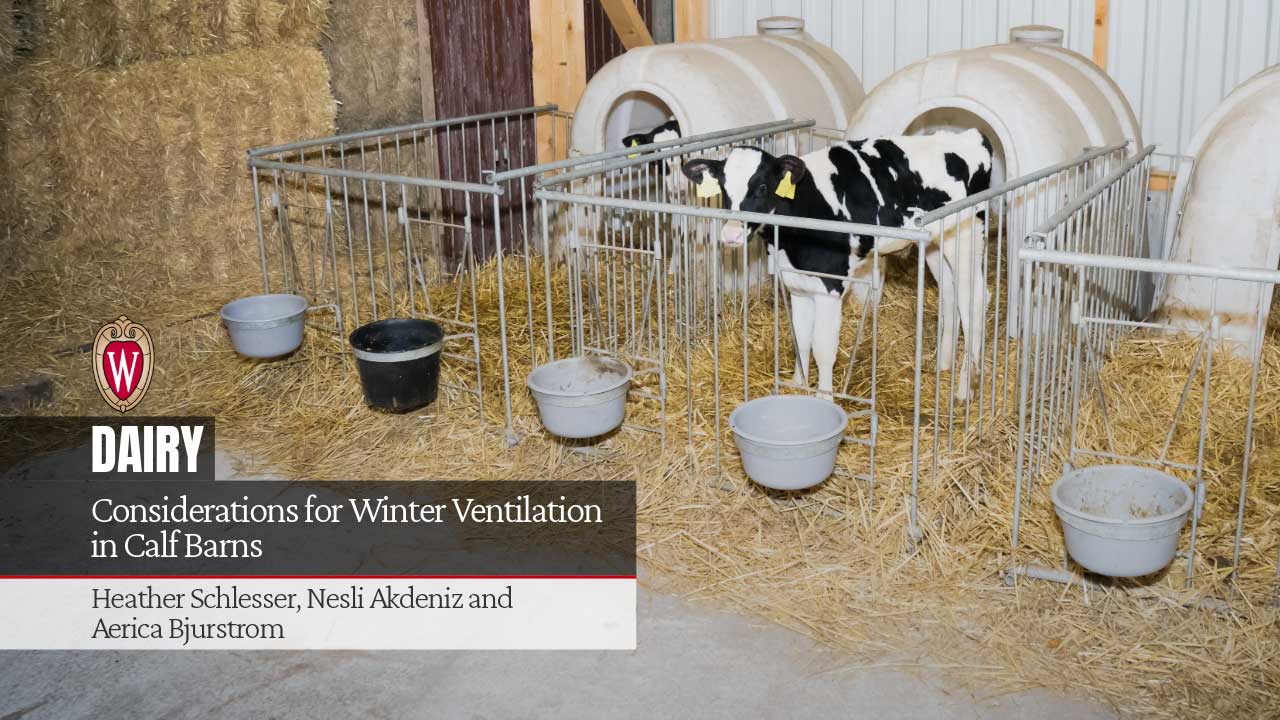
Calf barns can be ventilated using natural or mechanical systems. In Wisconsin, sidewall curtains are commonly opened during warm weather to provide natural ventilation and are partially or fully closed during the winter to protect calves from cold weather [6]. Because natural air movement is often limited when curtains are closed, some producers use positive-pressure tube ventilation (PPTV) to deliver fresh air directly to calf-occupied areas [1]. A fan mounted on an exterior wall draws outside air into a distribution tube suspended from the ceiling. Fresh air is discharged through a series of carefully sized and positioned holes along the tube. The hole size, spacing, tube diameter, and fan capacity are designed to deliver a specific airflow rate and air velocity, ensuring that fresh air reaches calf level without creating drafts [7]. Research has shown that calves housed in naturally ventilated barns without PPTV were more likely to be diagnosed with respiratory illness than calves housed in barns equipped with PPTV [8]. To maintain its effectiveness, the PPTV system should be inspected and cleaned regularly. If the system has not been operated for an extended period, dust, moisture, and microbial growth may accumulate inside the tube, and air should not be directed toward young calves until the system has been checked and cleaned as needed. When PPTV is not available, ceiling or cupola fans may also be used to improve air circulation and air distribution within the barn.
Although less common in Wisconsin, some calf barns use cross or tunnel ventilation. These systems use fans to move air through the building and maintain consistent air exchange rates throughout the year. Cross-ventilated barns draw air across the width of the building, while tunnel-ventilated barns move air along the length of the building. Barn layout should minimize the movement of airborne pathogens from older calves toward younger calves. For this reason, younger calves are often located closer to the air inlet. However, this practice increases the risk of drafts [5]. In mechanically ventilated buildings, inlet design and maintenance are critical to make sure the ventilation system delivers the intended airflow rate and distributes fresh air evenly throughout the barn [5].
How can Airflow be Improved in Calf Barns?
Calf pens should be located at least 3 ft from the sidewalls to reduce drafts on young calves and allow incoming fresh air to mix with room air before reaching the calf resting area. Sidewall height should increase with barn width to maintain effective natural ventilation. For example, barns less than 40 ft wide typically use 12 ft sidewalls, whereas a 60 ft wide barn may require 14 ft sidewalls [5]. A split-curtain design is ideal because it allows producers to control whether fresh air enters through the upper or lower part of the sidewall, depending on weather conditions and ventilation needs [5]. Curtains can be automatically adjusted in response to ambient temperature, reducing the need for manual adjustments.
In both natural and mechanical ventilation systems, it is important to minimize barriers to airflow. Group pens can help promote more uniform air distribution throughout the barn. If individual pens are used, solid-sided pens with open fronts and backs should be positioned parallel to the direction of airflow to minimize interference with air movement [5]. It is also important to avoid wind shadows caused by nearby buildings or other structures, as they can limit natural ventilation [9].
Should Calf Barns Be Heated During the Winter?
Heating calf buildings in Wisconsin during winter is not a common practice due to the cost of heating. Instead, calves are typically kept warm using deep bedding, calf jackets, and adequate energy intake while maintaining proper ventilation [3].
Ammonia volatilization from manure and urine increases as ambient temperature rises, resulting in higher ammonia concentrations in the air. Ammonia is a pungent, water-soluble gas that irritates the mucous membranes of the respiratory tract, making calves more vulnerable to viral and bacterial respiratory infections [10]. Therefore, bedding should be changed frequently enough to remain clean and dry, helping to reduce ammonia levels in the barn while also minimizing cold stress by limiting calf contact with wet surfaces. Recent research explored the use of solar-powered ventilation systems to enhance bedding drying in outdoor calf hutches during winter [11]. As advancements in this area continue, the feasibility of adapting this approach to indoor calf facilities should also be evaluated.
Summary
Proper ventilation is essential for maintaining calf health and barn air quality year-round. Adequate air exchange removes excess moisture, ammonia, and airborne pathogens while minimizing drafts and reducing the risk of respiratory disease. In Wisconsin, natural ventilation supplemented with positive-pressure tube ventilation (PPTV) is commonly used to achieve recommended seasonal air exchange rates and improve air quality during periods when sidewall curtains are closed. Research has shown that calves housed in naturally ventilated barns without PPTV are more likely to develop respiratory illnesses [8].
Barn design and management practices also play an important role in ventilation performance. Proper sidewall design, split curtains, appropriate pen placement, and minimizing barriers to airflow can improve air distribution throughout the barn. While heating calf barns during winter is uncommon, calves can be protected from cold stress through deep bedding, calf jackets, and adequate nutrition while maintaining proper ventilation. Emerging technologies, such as solar-powered ventilation systems for bedding drying [11], may provide additional opportunities to improve calf housing environments in the future.
References
- Akdeniz, N. 2023. Renovating tie-stall barns for indoor calf housing. University of Wisconsin-Madison Extension. Online available at https://dairy.extension.wisc.edu/articles/renovating-tie-stall-barns-for-indoor-calf-housing/ (accessed on November 5, 2026).
- Akdeniz, N., and McCarville, J. 2025. Air Quality in Calf Housing. University of Wisconsin-Madison Extension. Available online at https://dairy.extension.wisc.edu/articles/air-quality-in-calf-housing/ (accessed on November 5, 2026).
- Tyson, J. 2024. Winter Ventilation for Calves. Penn State Extension. Available online at https://extension.psu.edu/winter-ventilation-for-calves (accessed on November 5, 2026).
- van Leenen, K., Jouret, J., Demeyer, P., Van Driessche, L., De Cremer, L., Masmeijer, C., Boyen, F., Deprez, P., and Pardon, B. 2020. Associations of barn air quality parameters with ultrasonographic lung lesions, airway inflammation and infection in group-housed calves. Prev Vet Med 2020, 181: p. 105056. https://doi.org/10.1016/j.prevetmed.2020.105056
- Halbach, C., and Cook, N. 2024. The Dairyland Initiative Podcast. Episode 7: Calf Barn Ventilation. Available online at https://www.youtube.com/watch?v=pYqP0D1UGs4&t=299s (accessed on November 5, 2026).
- Yost, C. 2024. Winter Ventilation of Calf Housing. Penn State Extension. Available online at https://extension.psu.edu/winter-ventilation-of-calf-housing (accessed on November 5, 2026).
- Nordlund, K. 2008. Practical considerations for ventilating calf barns in winter. Veterinary Clinics of North America Food Animal Practice, 24(1): 41-54. https://doi.org/10.1016/j.cvfa.2007.10.006
- Jorgensen, M. W., Adams-Progar, A., de Passillé, A. M., Rushen, J., Godden, S. M., Chester-Jones, H., & Endres, M. I. 2017. Factors associated with dairy calf health in automated feeding systems in the Upper Midwest United States. Journal of Dairy Science, 100, 5675–5686. https://doi.org/10.3168/jds.2016-12501
- Akdeniz, N., Bjurstrom, A., Schlesser, H. 2025. Natural Ventilation in Dairy Buildings. University of Wisconsin-Madison Extension. Available online at Natural Ventilation in Dairy Buildings – Dairy (accessed on November 5, 2026).
- Bonizzi, S., Gislon, G., Brasca, M., Morandi, S., Sandrucci, A., and Zucali, M. 2022. Air Quality, Management Practices and Calf Health in Italian Dairy Cattle Farms. Animals, 12 (17): 2286. https://doi.org/10.3390/ani12172286
- Jiang, L., and Akdeniz, N. 2026. Design of ventilation systems for calf hutches to mitigate cold and heat stress using computational fluid dynamics (CFD) simulations. Applied Sciences, 16(19): 9503. https://doi.org/10.3390/app16199503
Acknowledgement
This study was supported by a Wisconsin Idea Collaboration Grant (WIC) funded through the University of Wisconsin-Madison Division of Extension and the Vice Chancellor for Research and Graduate Education.
Originally Published
November 2026
Authors
- Heather Schlesser – Division of Extension, University of Wisconsin–Madison
- Nesli Akdeniz – Division of Extension, University of Wisconsin–Madison
- Aerica Bjurstrom – Division of Extension, University of Wisconsin–Madison
Reviewers
- Jennifer Van Os – Division of Extension & Department of Animal and Dairy Sciences, University of Wisconsin–Madison
- Jackie McCarville – Division of Extension, University of Wisconsin–Madison