

The nutrient needs of dairy heifers change with age and size as they approach maturity with feed intake increasing and diet nutrient concentrations decreasing (Table 1). This is due to changes in growth with heifers having a higher rate of protein growth prior to breeding with slower protein growth as they approach mature body weight. Fat deposition is opposite as heifers have a lower rate of fat growth when young but higher fat gain closer to mature weight. Excess condition before calving can lead to negative outcomes such as dystocia and excessive weight loss during lactation. It is important heifers have optimal growth, especially during the pre-breeding phase, to avoid needing to increase growth after breeding. Desired growth for Holstein heifers is between 1.8 to 2.2 lb/day depending on the herd’s mature weight and age at desired first breeding and calving.

A major issue is that diet ingredients often have energy concentrations above pregnant heifer needs resulting in over-conditioning. One option to control heifer growth includes limit, or precision, feeding in which heifers are fed a more nutrient-dense diet but in smaller amounts to obtain desired nutrient intakes. Limit feeding can work well with good management, but animals can have abnormal behavior and poor hoof health if not managed well. Another option is an ad libitum-fed diet that is higher in fiber which helps control feed intake and nutrient intakes with no potential negative effects on animal welfare.
Fiber as an intake-limiting nutrient
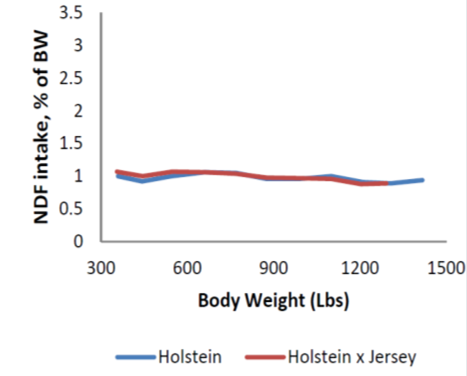
Fiber (neutral detergent fiber; NDF) is slowly digested in the rumen and has a filling effect at higher levels in the diet. By feeding a higher NDF level, feed intake generally decreases which in the case of pregnant dairy heifers can be very useful to control energy intake and have desirable weight gain. Based on thousands of intake measurements taken at the Marshfield Agriculture Research Station (MARS), it has been found that heifers will consume close to 1% of body weight as NDF each day (Figure 1). This fact can be used to estimate NDF and feed intakes if we know the animal’s weight and diet NDF%. For instance, if we have a 1,000 lb body weight (BW) heifer, we estimate she will eat 10 lb NDF each day (1,000 lb BW x 0.01 = 10 lb NDF). Then if the diet has 50% NDF (DM basis) we figure the heifer will eat 20 lb feed dry matter each day (10 lb NDF / 0.50 = 20 lb DM). Fiber content can be changed to achieve desired intakes by varying the diet ingredients. Nutritionists can then use the estimated intake and nutrient amounts needed to figure the diet concentration of nutrients needed.
High-fiber forage options
Several forage/roughage options are available to increase the diet NDF concentration including cereal grain straws, corn stover, more mature cool-season forages, warm-season annuals (sorghums/sudangrass)
and perennials (eastern gamagrass, switchgrass, others), or low-starch corn silage (tropical/high relative maturity hybrids or male-sterile types). The option used depends on how the crop may fit into the management strategy (rotation, harvest, feeding, etc.). Diet inclusion rate depends on the forage since NDF ranges from 50 to 80% across these forages, and inclusion rates range from 20 to 50% of diet DM. Based on research data and experience, the diet nutrient concentrations found to work well to control intake and allow for optimal growth of pregnant dairy heifers are 50 to 55% NDF, 13 to 14% CP, and 60% TDN. It is important to measure heifer growth to determine if diet adjustments are needed. Diet NDF and energy may need adjustment depending on the facility design, cleanliness, and weather that may affect energy needs especially during winter. To minimize sorting it helps to pre-chop straw or stover, chop silage at a smaller particle length, or use water or liquid feeds to bind ingredients. Feeding for a small amount of refusals (1 to 3% of DM amount fed) is important to reduce sorting by making heifers consume higher-fiber ingredients.
Feeding study results summary
During two studies with high-fiber forages, we tested the use of sorghum-sudangrass silage (conventional, wheat straw, corn stover, and eastern gamagrass silage) in diets fed to pregnant dairy heifers weighing approximately 1,100 lb (Table 2).

The forages increased diet NDF content up to 50 to 55% while control diets were 43 to 47% NDF. Heifers fed the control diet ate 24 lb DM in both studies with weights gains of 2.4 to 2.6 lb/day and would lead to over-conditioning. Heifers fed the test diets ate 2 to 4 lb less DM, which helped control weight gain to within the optimal range of 1.8 to 2.2 lb/day. We found sorting can be an issue for corn stover so pre-chopping to a small size (1 to 2 inches) would be helpful.
Use of high-fiber forages can also help control feed costs by using lower-cost feed ingredients and reducing feed intakes as shown in Table 3.

If considering the use of high-fiber forages, discuss potential options with an agronomist and nutritionist to determine the best option for growing and feeding.
References
- Hoffman, P.C. 2003. “Heifer Nutrition” in Raising Dairy Replacements. P.C. Hoffman and R. Plourd, eds. Ames, IA: ISU MidWest Plan Service.
- Li, L., et al. 2019. Comparison of feeding diets diluted with sorghum-sudangrass silage or low-quality grass on nutrient intake and digestibility and growth performance of Holstein dairy heifers. J. Dairy Sci. 102: 9932¬–9942.
- National Research Council (NRC). 2001. Nutrient Requirements of Dairy Cattle (7th Ed.). Washington, DC: National Academies Press.
![Milk Components for Cheese Success-Dairy Diets, Butterfat, and Protein [Video] ▶️](https://dairy.extension.wisc.edu/files/2026/10/BDI-Milk-Components-for-Cheese-Success-Goldsmith-Pena-440x275.jpg)
![Alimentando a la Vaca Lechera: Nutrientes, Manejo y Producción [Video] ▶️](https://dairy.extension.wisc.edu/files/2026/10/El-Break-Info-lechero-2026-Manuel-Pena-ES-440x275.jpg)
![Dairy Cow Nutrition: Nutrients, Management, and Production [Video] ▶️](https://dairy.extension.wisc.edu/files/2026/10/El-Break-Info-lechero-2026-Manuel-Pena-EN-440x275.jpg)
![Roasting and Feeding High Oleic Soybeans to Dairy Cattle [Video] ▶️](https://dairy.extension.wisc.edu/files/2026/10/Roasting-and-Feeding-High-Oleic-Soybeans-to-Dairy-Cattle-440x275.jpg)