
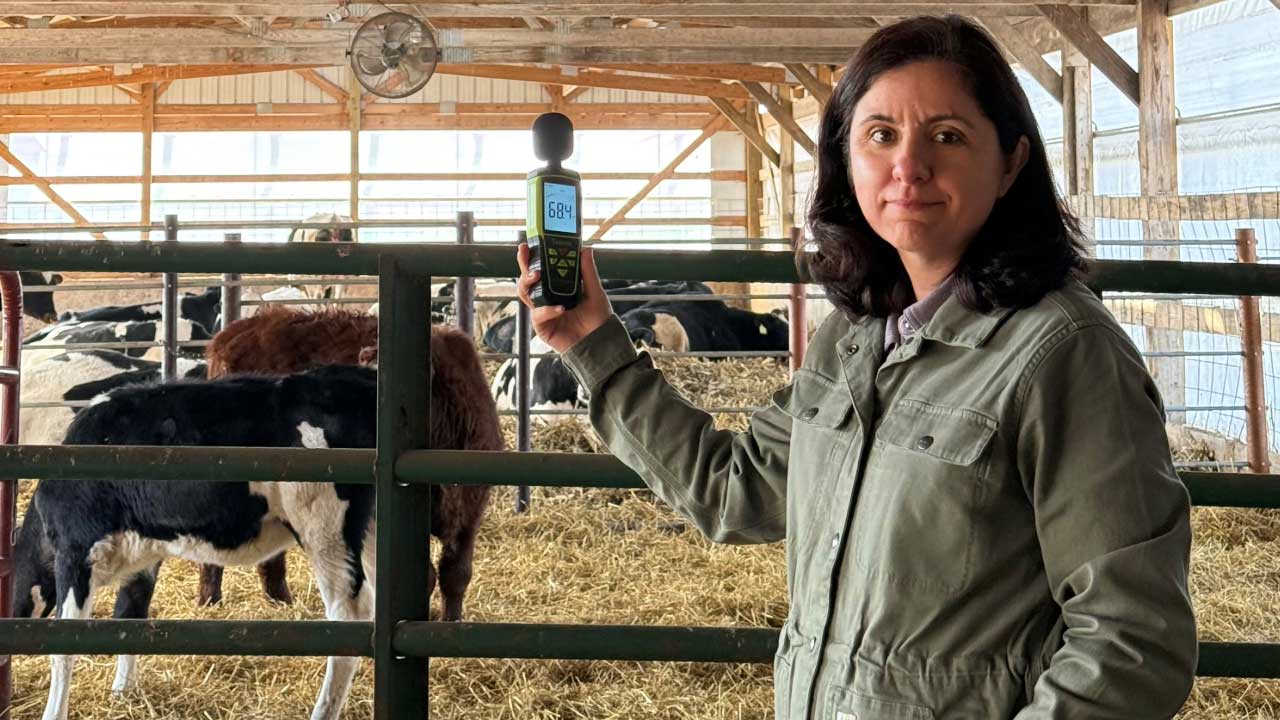
(Photo: Nesli Akdeniz)
Introduction
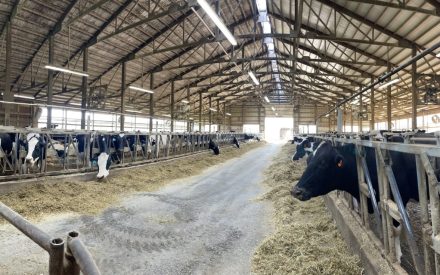
Livestock operations include potential noise sources such as mechanical equipment (e.g., tractors, feed pushers, milking machines), ventilation fans, pressure washers, and animals. Routine farm activities such as feeding, cleaning, and vehicle movement all contribute to ambient noise. Studies have measured typical sound levels in animal housing. For instance, the noise inside dairy cattle barns can range from 52 to 83 dB, with higher levels often noted during summer due to increased fan usage. The noise level of a ventilation fan depends on factors such as fan size, type, speed, installation location, and maintenance.
How Noise is Measured
Noise is usually measured in A-weighted decibels (dBA), which accounts for the human ear’s sensitivity to different frequencies. Common values for dairy ventilation fans are as follows (Figure 1):
- Circulation fans (basket or ceiling fans): 50–70 dBA
- Low-capacity supply fans (positive pressure tube ventilation): 65-75 dBA
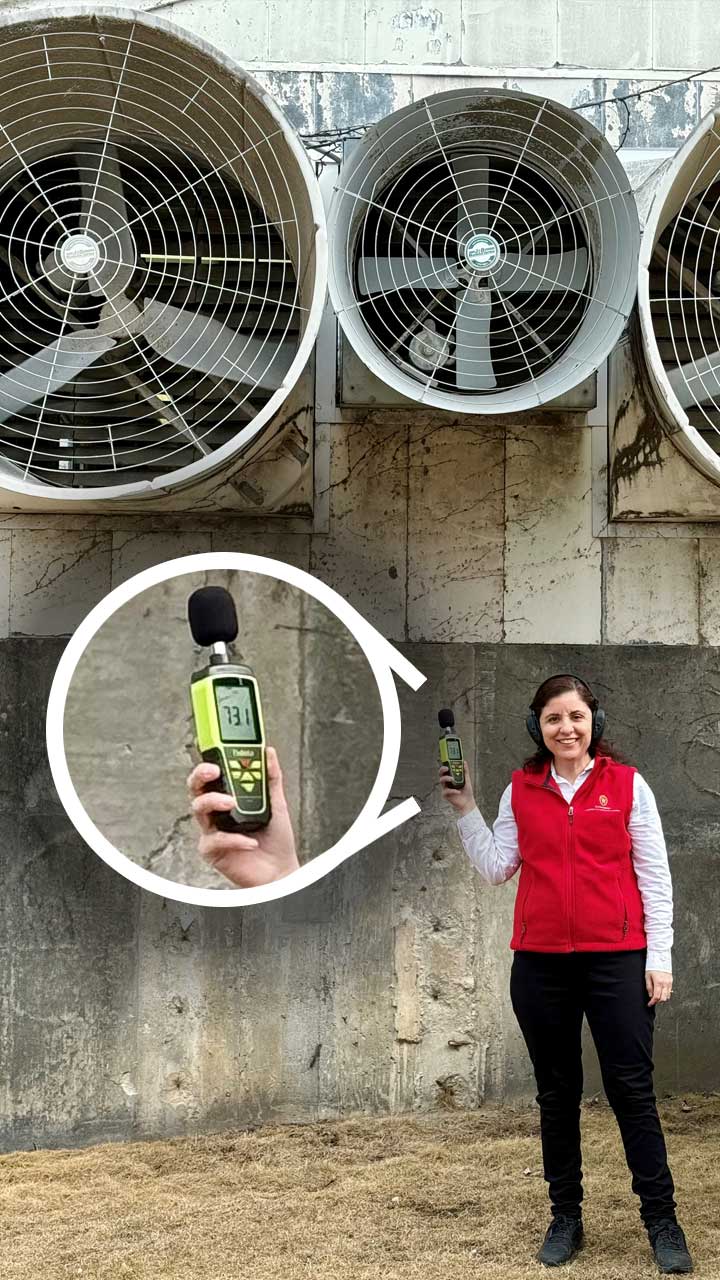
- High-capacity exhaust fans (tunnel or cross ventilation): 70–85 dBA
Other noise sources in dairy facilities may include:
- Automated milking systems (milking, cleaning, teat attachment): 65-85 dBA
- Feed pushers and automatic feeders: 65–80 dBA
- High-pressure washers for cleaning: 85–95 dBA
- Tractors and skid loaders operating in the barn: 85–105 dBA
For reference:
- Normal conversation: 50-60 dBA
- Traffic noise or vacuum cleaner: 70-80 dBA
- Potential for hearing damage with prolonged exposure: 85+ dBA
Effects of High Noise Levels
Good farms are considered to have noise levels of up to 70-75 dBA. Noise levels in dairy buildings can easily exceed 75 dBA, but exposure to these levels should be limited as much as possible.
Effects on Cows [1, 2]
- Dairy cows are sensitive to sound, and excessive noise may increase stress levels, leading to reduced feed intake and altered behavioral patterns.
- Continuous high noise levels (>85 dBA) may contribute to lower milk production and restlessness.
- Studies suggest that sudden loud noises can disrupt cow movement and response to milking systems.
Effects on Workers [3]
- Although there are differences in the perception of noise intensity, workplace noise limits have been established for workers. Prolonged exposure to noise levels above 85 dBA may cause hearing loss over time.
- Working in high-noise environments may also lead to communication difficulties and increase accident risks.
Noise Mitigation Strategies

While completely eliminating noise on a working farm is not possible, studies highlight that practical measures can significantly reduce noise exposure and its effects.
The first step in mitigating noise is measuring its levels. The National Institute for Occupational Safety and Health (NIOSH) provides a professional-grade sound level meter app for iOS that can be downloaded for free (Figure 2). Similar apps are also available for Android, which can help make informed decisions about daily exposure levels.
Ventilation Fans
- Use larger, slower-moving fans instead of smaller, high-speed fans to reduce noise.
- Variable-speed fans can help reduce noise by adjusting airflow based on barn conditions.
Equipment Selection & Maintenance
- Regularly maintain and replace old fans, motors, milking machines, and other equipment.
- When purchasing new equipment, choose models designed to be quieter.
Worker Protection[3]
- Schedule high-noise tasks (e.g., pressure washing, equipment repairs) during low-traffic barn hours.
- Take breaks or do loud tasks in shifts.
- Be precautious when the noise level is above 85 dBA and wear hearing protection.
- Wear hearing protection correctly:
- Know how much noise reduction you need and check the noise reduction rating (NRR) of hearing protection devices
- Decide what fits properly (visual check and hum test).
- Test what is most comfortable and convenient (Figure 3).
Authors

Neslihan Akdeniz
Dairy Controlled Environments Extension Specialist, Assistant Professor– Mainly focusing on intelligent ventilation for cooling and air quality management in dairy facilities, along with remote sensing applications in dairy pasture systems. The work also extends to greenhouses and other indoor plant growing systems.

John Shutske
Agricultural Safety and Health Extension Specialist, Professor, Honorary Associate/Fellow– John Shutske is a professor and Biological Systems Engineering specialist. His work focuses on agricultural safety and health promotion for farmers, family members, and workers, and also studies digital technology innovation in rural areas, including internet and information-based systems that can improve efficiency, safety, and communication. John holds an affiliate faculty appointment in the School of Medicine and Public Health.
References
- Dimo, D., Penev, T., and Marinov, I. 2023. Importance of Noise Hygiene in Dairy Cattle Farming- A Review. Acoustics 2023, 5 (4): p. 1036-1045. DOI: https://doi.org/10.3390/acoustics5040059.
- Psenka, M., Sistkova, M., Mihina, S., and Galik, R. 2016. Frequency analysis of noise exposure of dairy cows in the process of milking. Research in Agricultural Engineering 2016, 62 (4): p. 185-189. DOI: https://doi.org/10.17221/4/2015-RAE.
- NIOSH, 2024. Noise-induced hearing loss. Available online: https://www.cdc.gov/niosh/noise/about/noise.html (accessed on 3-5-2025).
Published: April 25, 2025
The University of Wisconsin–Madison Division of Extension provides equal opportunities in employment and programming in compliance with state and federal law.