Introduction
Heat stress is one of the most significant environmental challenges facing the modern dairy industry. As global temperatures continue to rise, and extreme weather events become more frequent, dairy producers are seeing the tangible impacts of heat on their bottom lines. High-producing dairy cows are particularly sensitive to heat; their high metabolic rate, necessary for significant milk production, generates substantial internal heat that must be dissipated to the environment. When ambient temperature and humidity rise, this dissipation becomes difficult, leading to a physiological state known as heat stress.
The consequences of heat stress are well-documented: reduced dry matter intake, decreased milk production, impaired reproductive performance, and increased susceptibility to metabolic diseases. While many farms have implemented some form of heat abatement, the question for many producers remains: “Is the next investment in cooling technology worth it? How quickly will it pay for itself?”
To help answer these questions, the Heat Abatement Investment Scouter has been developed by the University of Wisconsin-Madison Dairy Management Program. This decision-support tool allows dairy farmers to evaluate the Return on Investment (ROI) and payback period of investing in cow cooling systems, such as fans and soakers, tailored specifically to their regional climate and farm-specific economic parameters. The tool is available at: DairyMGT.CALS.wisc.edu. From the top menu bar, select ‘Tools,’ then choose ‘financial’ from the drop-down menu.
The Economic Impact of Heat Stress
Before diving into the tool, it is essential to understand the scale of the problem. Research indicates that heat stress begins to affect dairy cows at a Temperature-Humidity Index (THI) as low as 68. The THI is a calculated metric that combines ambient temperature and relative humidity to better represent the actual heat load on the animal. The formula used by the Scouter is:
(Where T = Temperature in °C and RH = Relative Humidity %)
For a high-producing cow, every hour spent above this threshold results in a measurable loss in production. The Scouter assumes a default approximated loss of 0.5 lbs of milk per cow per hour for every THI unit above the threshold of 68 (Zimbelman et al., 2009), based on the biological response functions established in contemporary literature (Ravagnolo et al., 2000; St-Pierre et al., 2003). As an example, if a cow experiences 5 THI units above the threshold for 10 hours, the estimated daily loss is 25 lbs (5 units * 10 hrs * 0.5 lbs). In regions like Wisconsin, where summer humidity can be high even when temperatures are moderate, the number of “heat stress hours” can reach 1,000 to 2,000 hours per year.
The economic loss is not just the milk that isn’t produced during the heat stress event. It includes the “lingering effect” of heat stress, where cows fail to return to peak production even after the weather cools, and the long-term costs of reduced fertility and increased culling. While losses differ by region, research shows that summer heat‑stress events can cost between $100 and $200 per cow if effective heat‑abatement strategies are not implemented.
Introducing the Heat Abatement Investment Scouter
The Heat Abatement Investment Scouter is designed to bridge the gap between climate science and farm economics. It provides a user-friendly interface where producers can input their farm’s data and receive a detailed simulation of how a proposed cooling system would perform financially.
How the Tool Works
The tool operates on a three-pillar system: climate estimation, economic simulation, and AI-driven expert analysis.
1. Climate Estimation
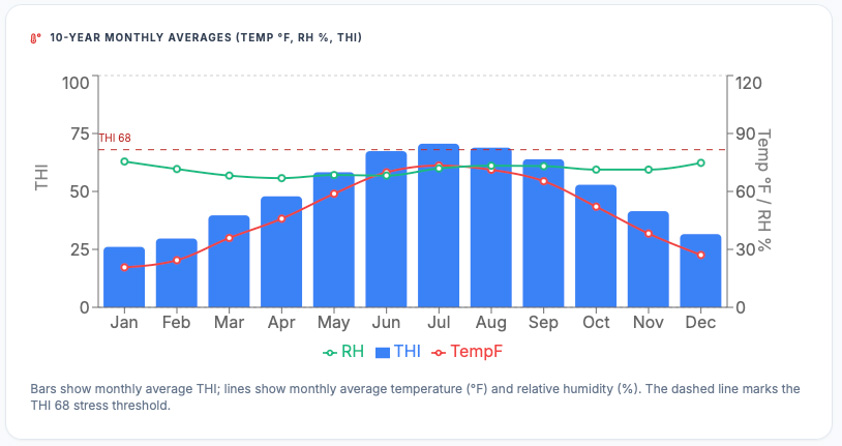
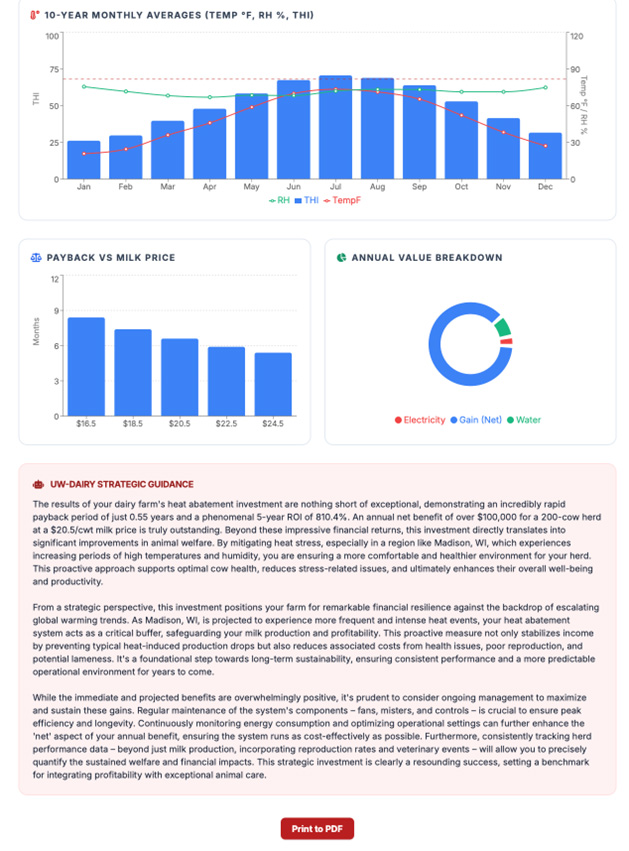
One of the most difficult variables for producers to estimate is the total number of hours their cows experience heat stress in a typical year. The Scouter converts a farm’s location into coordinates and pulls 10 years of historical hourly temperature and humidity data to calculate actual THI values and estimate heat stress hours for that specific location (Figure 1).
By processing historical climate data and current trends, the tool estimates the annual hours where the THI exceeds the critical threshold of 68 (Figure 2).
This localized approach is far more accurate than using broad state-wide averages, as it accounts for micro-climates and regional humidity patterns. The tool also retrieves the weather projections and uses them to estimate THI load projection for the upcoming five years.
2. The Simulation Engine
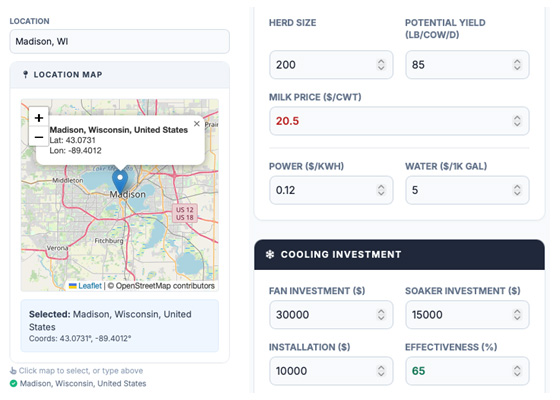
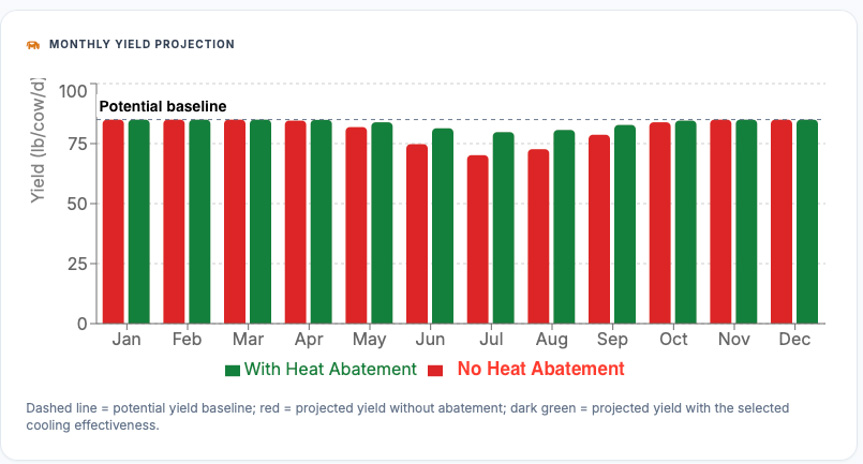
At the heart of the tool is a robust simulation engine that models “Unabated” and “Abated” scenarios. The tool then estimates total milk loss (Figure 3) and associated revenue loss in the absence of a cooling system, based on estimated heat hours and the farm’s specific milk price. Users input specifications of their proposed cooling system, which includes the fan investment, their power rating, water usage of soakers, and an abatement effectiveness factor (Figure 1) to show how much lost production can be regained (Figure 3). The simulation also accounts for operating costs including fan electricity and soaker water, using the producer’s actual utility rates for precision.
3. AI-Driven Insights
Beyond the raw numbers, the tool provides a narrative insight into regional climate trends and professional investment advice. This feature helps producers understand the “why” behind the numbers, offering context on warming trends and animal welfare considerations that might not be immediately apparent from a spreadsheet alone.
Using the Tool: A Step-by-Step Guide
The Heat Abatement Investment Scouter is designed to be intuitive. Users begin by entering their location, herd size, and current production metrics (including potential milk yield (lbs/cow/day), current milk price ($/cwt), and utility costs (electricity and water)). Next, they enter the capital costs for the proposed cooling system, including fans, soakers, and installation. With a single click, the tool contacts the climate database, runs the economic formulas, and generates a comprehensive dashboard of results.
Interpreting the Results
The output of the Scouter is focused on four key metrics that are essential for any capital investment decision (assuming all other costs and benefits remain constant):
Total Investment: The all-in cost to get the system up and running, including installation.
Net Annual Gain: The regained milk revenue minus the annual costs of electricity and water. If this number is positive, the system is actively making the farm money every year.
Payback Period: How many months or years it will take for the Net Annual Gain to cover the initial Total Investment. In many dairy scenarios, a payback period of 2 to 4 years is considered an excellent investment.
5-Year ROI: The total return on investment over a five-year horizon, expressed as a percentage. This allows producers to compare the cooling system against other potential farm improvements.
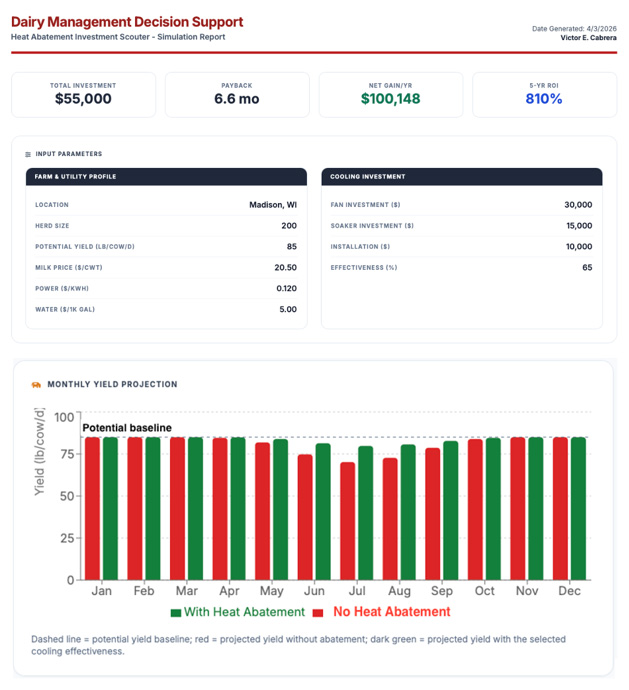
The tool also generates a professional, printable HTML/PDF report (Figure 4) designed to be shared with lenders, farm consultants, or partners. It breaks down economic metrics into clear tables showing exactly where savings are coming from and where costs are going.
Case Study: A 200-Cow Wisconsin Dairy
To illustrate the tool’s value, consider a hypothetical producer in Madison, WI, with 200 cows with a potential production of 85 lbs/cow/day, considering a $55,000 investment in a new fan and soaker system.
The Scouter estimates approximately 1669 hours of heat stress for this location. Without cooling, the farm stands to lose nearly $170,000 in revenue annually due to heat-related production declines. By installing the system, the farm can regain about 65% of that lost revenue ($110,000). After accounting for $11,500 in annual electricity and water costs, the Net Annual Gain is around $100,000.
In this scenario, the payback period is only 6.6 months, and the 5-Year ROI is a remarkable 810%. For this producer, the data makes a compelling case that heat abatement is not just an animal welfare choice, but a vital financial strategy.
Conclusion: Investing in Resilience
As the dairy industry faces a future of tighter margins and more volatile weather, data-driven decision-making becomes paramount. The Heat Abatement Investment Scouter provides producers with the clarity they need to move forward with confidence. By quantifying the hidden costs of heat stress and the tangible benefits of cooling technology, the tool empowers farmers to make strategic investments that improve animal welfare, stabilize production, and ensure the long-term financial resilience of their operations. The Heat Abatement Investment Scouter is more than just a calculator; it is a roadmap for navigating the challenges of a changing climate.
Access Heat Abatement Investment Scouter tool
You can find additional technical details and use the Heat Abatement Investment Scouter at:
https://dairymgt.cals.wisc.edu/tools.php ↗️ → FINANCIAL → Heat Abatement Investment Scouter
Free Access for Wisconsin Dairy Farmers
- Wisconsin Dairy Farmers: Complimentary access is available upon request.
- University of Wisconsin System users: Log in with your institutional credentials for automatic access.
To register or request access, please contact Victor E. Cabrera at vcabrera@wisc.edu
References
- Ravagnolo, O., I. Misztal, and G. Hoogenboom. 2000. Genetic component of heat stress in dairy cattle, development of parameter estimation. J. Dairy Sci. 83:2120–2125. https://doi.org/10.3168/jds.S0022-0302(00)75094-6
- St-Pierre, N. R., B. Cobanov, and G. Schnitkey. 2003. Economic losses from heat stress by US livestock industries. J. Dairy Sci. 86(E. Suppl.):E52–E77. https://doi.org/10.3168/jds.S0022-0302(03)74040-5
- Zimbleman, R. B., R. P. Rhoads, L. H. Baumgard, and R.J. Collier. Revised temperature humidity index (THI) for high producing dairy cows. J. Dairy Sci. 92(E-Suppl. 1):386. (Abstr.)
Originally Published: April 2026
Reviewers:
- Katelyn Goldsmith – Dairy Outreach Specialist, University of Wisconsin-Madison, Division of Extension
- Heather Schlesser – Professor and County Dairy Educator, University of Wisconsin-Madison, Division of Extension, Marathon County
Authors:
- Victor Cabrera – Professor and Dairy Systems Management Specialist, University of Wisconsin-Madison, Division of Extension
![Using Bovisync Reports to Assess Potential Impact of Heat Stress on a Dairy [Video] ▶️](https://dairy.extension.wisc.edu/files/2025/06/Using-Bovisync-Reports-to-Assess-Potential-Impact-of-Heat-Stress-on-a-Dairy-440x275.jpg)
![Using DairyComp to Assess the Potential Impact of Heat Stress on a Dairy [Video] ▶️](https://dairy.extension.wisc.edu/files/2025/06/Using-DairyComp-to-Assess-the-Potential-Impact-of-Heat-Stress-on-a-Dairy-440x275.jpg)