Introduction
The temperature-humidity index (THI) is often used to assess heat stress in dairy cows. Based on historical weather records, on average, southern Wisconsin experiences 25 days of severe heat stress (THI > 79) and 5.6 days of very severe heat stress (THI > 84) every year (ACIS, 2026). Despite the snowstorms in the Midwest, Wisconsin had already recorded two mild discomfort days and one discomfort day before April 2026 (ACIS, 2026). As temperatures rise into spring and summer, now is a good time for farmers to start thinking about ventilation for their buildings.
Proper ventilation plays an important role in maintaining animal comfort, removing heat and moisture, and maintaining good air quality inside barns. Many dairy facilities rely on natural ventilation systems (Figure 1), which work well under moderate weather conditions but are often insufficient on warm days (THI>79) or during periods of low wind speed (~1 m/s). As a result, many farmers are increasingly adopting mechanical ventilation strategies.
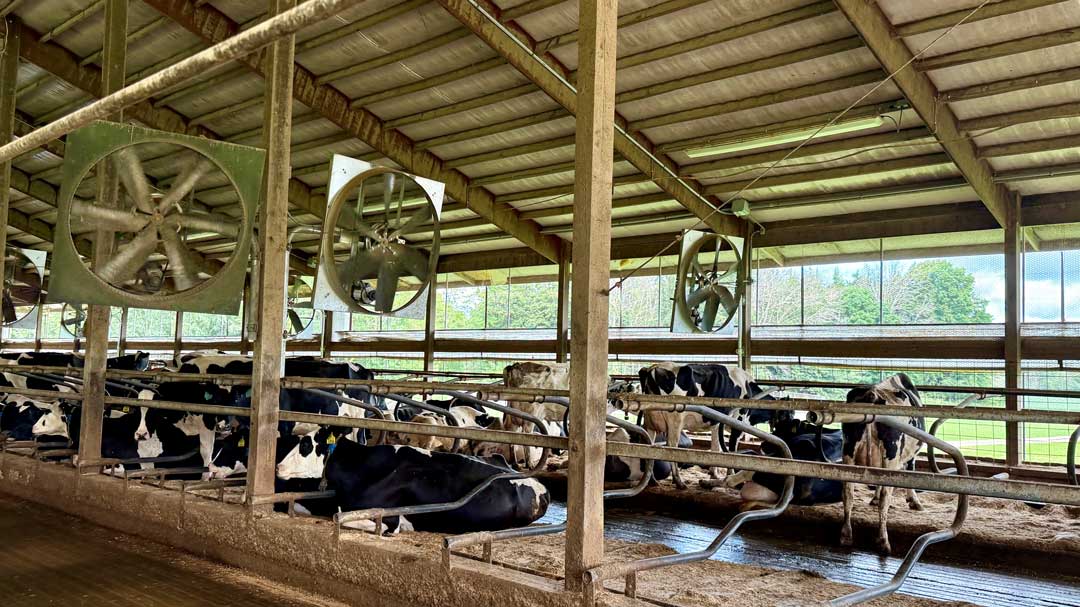
Selecting the right fans is an important part of the process. Farmers often need to decide how many fans are required and which fan models are the most suitable for their buildings. To help make these decisions, our team developed two online decision-support tools.
Tool 1: Calculator for Adopting and Evaluating Mechanical Ventilation
The first tool is an online calculator that helps users design or evaluate mechanical ventilation systems (go.wisc.edu/coolcows ↗️). The calculator uses inputs such as barn location, barn dimensions, number of cows, desired air exchange rate, and fan specifications to estimate ventilation requirements, including the number of fans required, total fan purchase costs, recommended air inlet size, and expected energy consumption. These are important factors for planning a ventilation system. Users can also adjust inputs to evaluate different scenarios. For example, the calculator can estimate how switching from a 16 cfm/W fan to an 18 cfm/W fan affects annual energy consumption per cow. In addition to planning new systems, the tool can also be used to evaluate existing ventilation systems (go.wisc.edu/coolcows2 ↗️). Using a similar set of inputs, the calculator estimates the air exchange rate achieved by the installed fans, the required inlet size, and the expected energy consumption. Discrepancies between calculator results and actual system performance may indicate opportunities to fine-tune the ventilation system to reduce energy costs and improve performance. More information about this tool is available at:
Tool 2: Interactive Graph for Fan Comparison and Payback Period
While the ventilation calculator helps determine how many fans are needed, the second tool focuses on selecting the most suitable fan models (Figure 2). This interactive graphing tool allows users to compare the performance of a specific fan to other fans of the same size (go.wisc.edu/coolfans ↗️). The tool was developed as part of a recent study that analyzed 105 agricultural ventilation fans tested at the Bioenvironmental and Structural Systems (BESS) Laboratory at the University of Illinois at Urbana-Champaign between 2015 and 2025 (Ly and Akdeniz, 2026). On the graphing page, users can enter fan efficiency at varying static pressures, and the tool compares the selected fan to low-, average-, and high-performing fans of the same diameter. This allows farmers to see how their fan performs relative to other tested fans over a range of operating static pressure conditions.
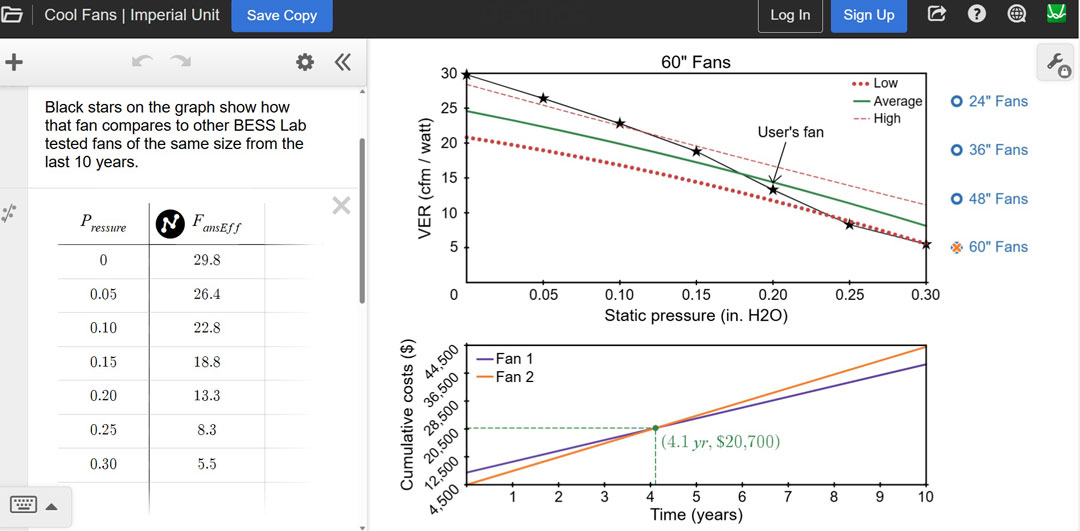
The tool also includes a feature to compare the costs of two fan options. By entering purchase price, efficiency, and capacity, users can visualize cumulative purchasing and electricity costs over time. In some cases, a higher‑priced but more energy‑efficient fan can offset its initial cost within a few years through reduced electricity expenses (Figure 2). However, when the efficiency difference between fans is small, the higher purchase price may not be recouped over the fan’s typical service life. This feature helps determine whether a fan choice makes economic sense in both the short and long term.
Putting the Tools to Work
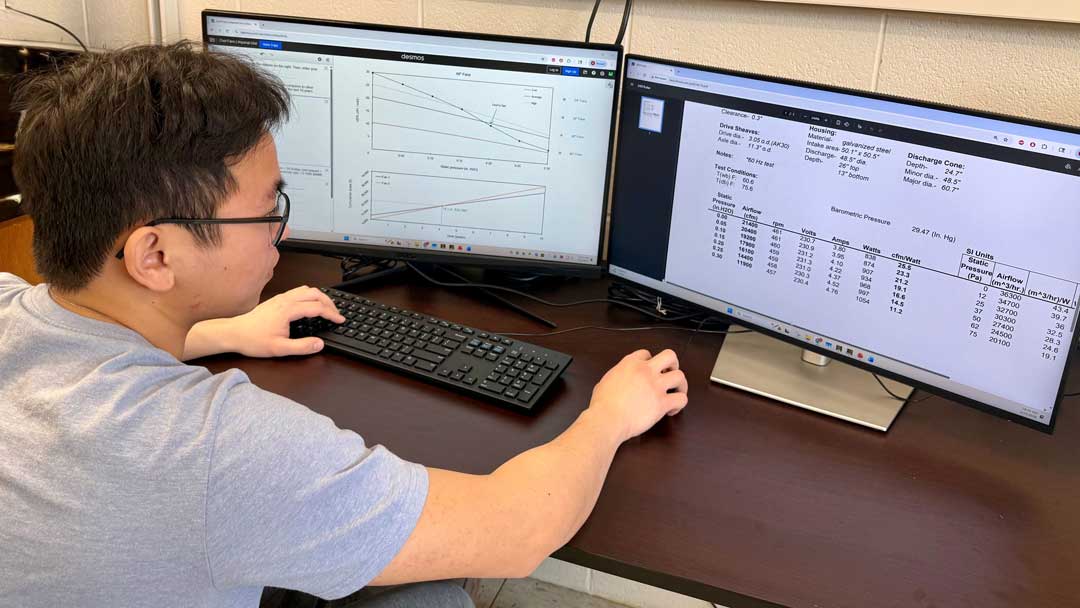
Proper ventilation is essential for reducing the risk of heat stress, maintaining animal comfort, and improving barn air quality. Fan efficiency can significantly affect electricity consumption, and a lower purchase price does not always result in the lowest long-term cost. By comparing fan performance and estimating operating costs before purchasing equipment, farmers can make more informed decisions about their ventilation systems. These two tools are designed to complement each other. Farmers can first use the mechanical ventilation calculator to estimate the number of fans required to meet ventilation goals in a barn. Then, they can use the fan comparison tool to evaluate specific fan models (Figure 3) and estimate long-term operating costs. Using both tools together helps farmers move from ventilation system design to fan selection and to cost evaluation, supporting more informed and economically sound ventilation decisions. For additional information about these tools, please do not hesitate to reach out to UW-Madison Extension.
Links to Bookmark
References
- ACIS (Applied Climate Information System), Livestock Heat Index, online available at SCAN Decision Tools (access date 4-7-2026).
- Ly, N., Akdeniz, N. 2026. Practical guidelines to improve the sustainability of ventilation fan use in agricultural operations. Sustainability, 18(5), 2453. https://doi.org/10.3390/su18052453
Originally Published: April 2026
Reviewers:
- Heather Schlesser – Professor and County Dairy Educator, University of Wisconsin-Madison, Division of Extension for Marathon County
- Angie Ulness – County Dairy Educator, University of Wisconsin-Madison, Division of Extension for Manitowoc County
Authors:
- Nilroth Ly – Graduate Research Assistant in Biological Systems Engineering, University of Wisconsin-Madison.
- Nesli Akdeniz – Assistant Professor and Extension Specialist, Biological Systems Engineering, University of Wisconsin-Madison
Funding:
This project was funded by the University of Wisconsin Consortium for Extension and Research in Agriculture and Natural Resources (CERANR) (PG000031795)