
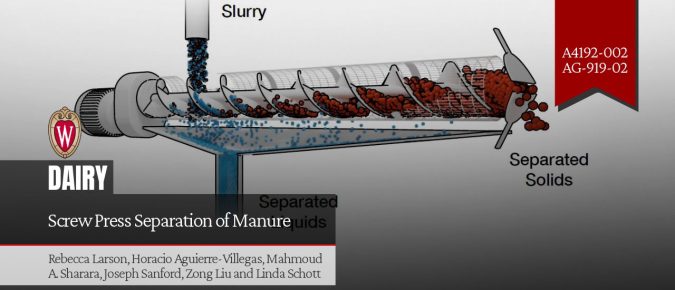
Screw Press Separation of Manure (A4192-002/AG-919-02)
Screw press separators can be used to separate manure into a solid and liquid fraction.
Division of Extension

Screw press separators can be used to separate manure into a solid and liquid fraction.
Picking animals for your farm is one of the most important decisions you can make to improve long-term profitability. Whether it is choosing replacements, or deciding who will become parents, without proper consideration the decisions could end up giving you the genetics you did not want.
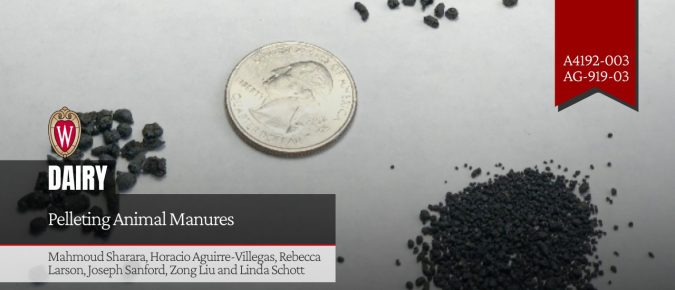
Pelleting is a mechanical process that aggregates solid material to form uniform‑sized particles referred to as pellets or granules.
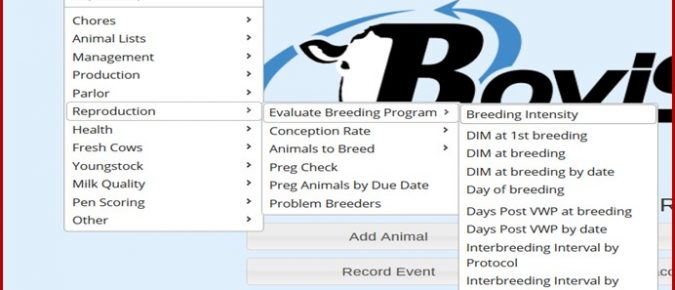
Below is a visual representation of what to enter in the report screen to generate charts similar to what is shown in the companion factsheet: “Using Bovisync Reports to Assess Potential Impact of Heat Stress on a Dairy”. Milk Production Butterfat Percent Reproduction Milk Quality Clinical Mastitis and Transition Cow Health
In this fact sheet you will see examples of the resulting data you can use to unlock the power of your herd’s Bovisync records.
Want to learn about the latest research on calf housing? Two heads are better than one: A starter guide to pairing dairy calves This series of articles is a seven-part starter guide for pairing or group-housing pre-weaned dairy calves. Throughout this guide, we cover best practices to promote good health and welfare in calves raised […]
Hot summer weather can be hard on feed ingredients and total mixed rations (TMRs). It is vital that feed quality and aerobic stability be maintained during this challenging season. Doing so will minimize nutrient losses while optimizing cow intakes which are often compromised due to heat stress challenges.
Diving into a dairy’s herd management software can help a producer quantify where the losses are occurring and, with some easy calculations, determine the profitability of investing in cow cooling measures.
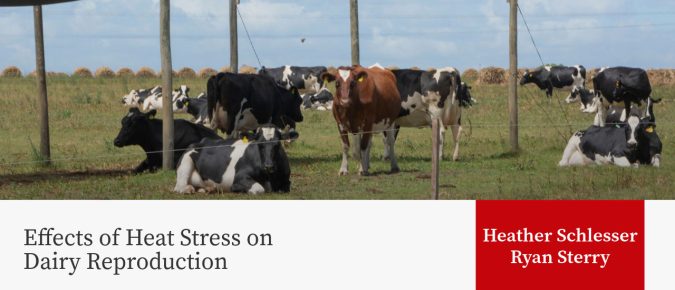
Heat stress not only affects the productive ability of your cattle but also their ability to conceive and sustain a pregnancy. It is important to understand the effect heat stress can have on reproduction and how you can help minimize the effect.
Heat stress occurs when an environment impacts the ability of a cow to get rid of body heat. Cows need to be raised in an environment where temperatures are within their thermoneutral zones to achieve their maximal genetic potential. Failures to establish adequate environmental temperatures can dramatically alter behavior, health, and productivity of cows.
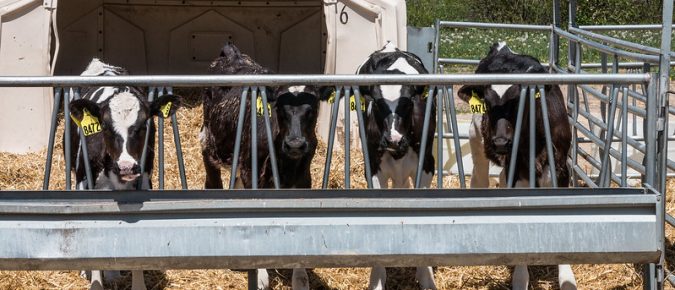
When we talk about thermal stress in pre-weaned calves, often we discuss cold stress. However, calves can become environmentally stressed when temperatures are too cold or too hot. During extreme cold or hot temperatures, calves utilize extra energy to maintain their core body temperature. The temperature range at which a calf uses no additional energy […]
Managing heat stress in dry cows is just as important as it is for lactating cows because it determines the amount of productivity and success a cow will have during her lactation. It can also influence the future success of the daughters and granddaughters of the dry cow.
![Using Bovisync Reports to Assess Potential Impact of Heat Stress on a Dairy [Video] ▶️](https://dairy.extension.wisc.edu/files/2025/06/Using-Bovisync-Reports-to-Assess-Potential-Impact-of-Heat-Stress-on-a-Dairy-675x290.jpg)

![Using DairyComp to Assess the Potential Impact of Heat Stress on a Dairy [Video] ▶️](https://dairy.extension.wisc.edu/files/2025/06/Using-DairyComp-to-Assess-the-Potential-Impact-of-Heat-Stress-on-a-Dairy-675x290.jpg)
![Impact of Heat Stress in Mammary Gland Development and Health in Dairy Cows [Video] ▶️](https://dairy.extension.wisc.edu/files/2025/06/Impact-of-Heat-Stress-in-Mammary-Gland-Development-and-Health-in-Dairy-Cows-675x290.jpg)
![Managing the heat in pre-weaned calves [Video] ▶️](https://dairy.extension.wisc.edu/files/2021/02/Managing-the-Heat-in-Per-weaned-calf-675x290.jpg)
![Dry Cow Heat Stress Management [Video] ▶️](https://dairy.extension.wisc.edu/files/2020/10/cow-354428_1920-675x290.jpg)