At a Glance
Cull dairy cows contribute 10% of U.S. beef production and up to 20% of a dairy farm’s income, making strategic management essential for farm profitability. Retaining thin, healthy cull cows on high-energy diets improves animal welfare, USDA carcass grades, and marketability. Proactive feeding programs elevate live weight and meat quality, transforming potential losses into increased financial returns.
How does finish-feeding cull cows impact operation profitability and meat quality?
Finish-feeding non-lactating cull cows for 2 to 4 months significantly increases live weight, sale price, and overall cow value. Adding condition raises intramuscular fat percentage, elevating USDA Quality Grades while improving dressing percentages and muscle yields.
What strategies optimize cull cow value while maintaining health standards?
- Proactive Selection: Remove animals from the herd before their health declines. Immediately euthanize or withhold severely lame, non-ambulatory, or sick cows that may fail USDA inspection.
- Targeted Feeding: Retain thin cows that are free of systemic illness to feed high-energy total mixed rations (13% crude protein) for 60 to 120 days.
- Defect Reduction: Transport only high body condition score (BCS) animals to eliminate buyer price discounts caused by visible physical defects.
Introduction
Culled dairy animals are often overlooked as a potential source of income or a high-quality beef product. However, dairy cows contribute roughly 10% of the U.S beef production and 10-20% of a dairy farm’s income. Dairy farms may have opportunities to increase income for their operation through cull cow management and marketing.
Choosing Animals to Keep Around
Proactive culling is step one when choosing which animals have potential to be kept and fed out. Culling dairy cows should be done in a timely manner to maintain welfare and optimize the value of the cow. If animals are sick or injured beyond recovery, in significant pain, work with your vet to decide on euthanasia timing. Do not ship sick animals, those with advanced mobility problems, those in labor, or likely to give birth. When animals arrive at a harvest facility, they must pass USDA inspections. Cull dairy animals that are non-ambulatory, severely lame, or have visible signs of systematic illness will not pass this inspection. Because of this, buyers may be less likely to bid on animals that are lame or have a low body condition score (BCS).
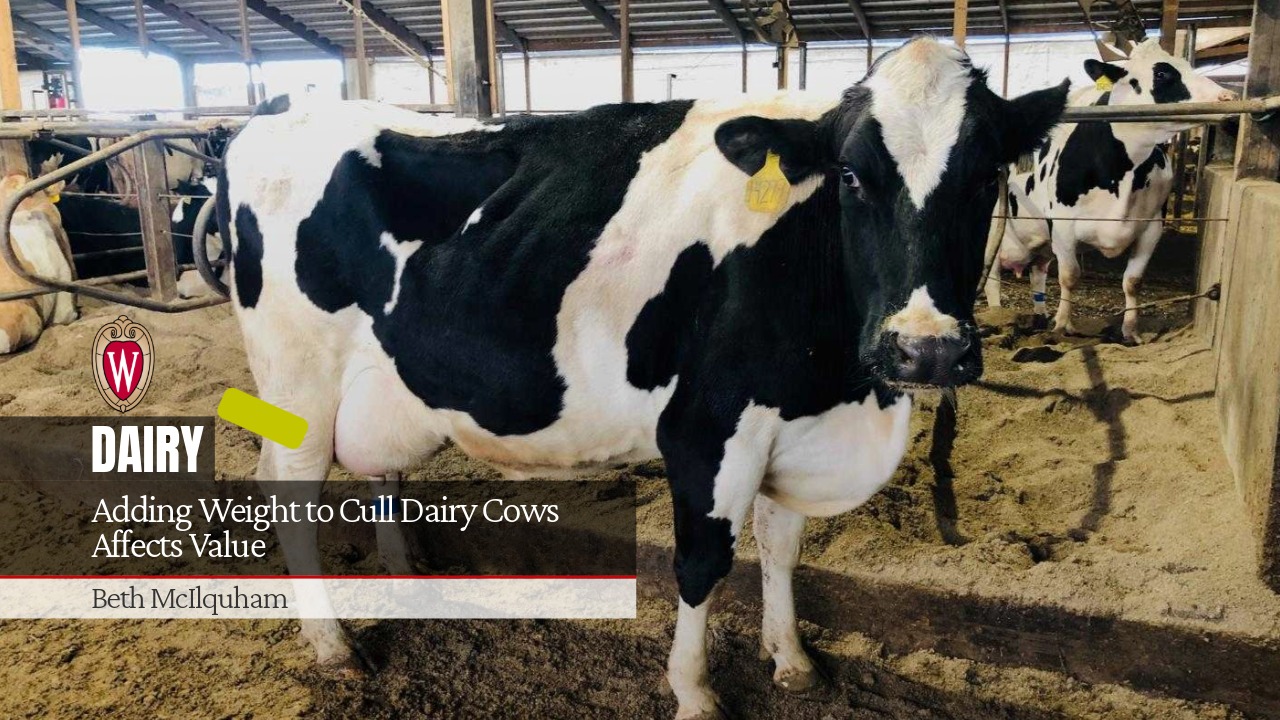
Body condition can be increased by keeping non-milking cull cows around and feeding them a high-energy diet. Thin cows that are being culled for low milk production or failed reproduction are great candidates for adding weight to. Animals that are sick or injured are not good candidates for adding weight to. Economic factors such as market timing and commodity feed prices should be considered in addition to cow health factors. When considering these factors, this tool may help weigh out the financial risks or benefits that adding weight to these cull cows can expose your operation to: https://dairymgt.cals.wisc.edu/tools/cow_value_resp_v2/
Adding Weight to Cull Cows
Retaining cull cows for an additional 60 days or more can help increase cow value, meat quality, and animal welfare. A study investigated some of the effects of feeding cull cows for an extra 2 or 4 months, as compared to not retaining them to add condition. There were three groups: (1) was not kept on the farm for additional time to add condition, (2) was kept on the farm and was finish-fed for 2 months, and (3) was kept on the farm and was finish-fed for 4 months. Table 1 displays the results of this study. The TMR was 13% crude protein and 0.75 Mcal/lb net energy lactation (NEl). Cows that were fed for either an additional 2 or 4 months weighed significantly more at slaughter than the group that was not finished. Cull animals that weigh more are more marketable at the sale barn and result in a higher check compared to an overly thin cow.
Table 1. Results of study on effects of feeding cull cows for an extra 2 or 4 months
| No Finishing | Finishing 2 Months | Finishing 4 Months | |
|---|---|---|---|
| Live Weight (lbs) | 1217 | 1376 | 1534 |
| Additional Feed Costs (lbs gained x $1.30/lb cost of gain) | $0.00 | $189.80 | $390 |
| Price at sale ($/cwt) | $157.04 | $172.00 | $174.50 |
| Cow Value | $1,911.18 | $2,366.72 | $2,676.83 |
| Profit (loss) | $0.00 | $265.74 | $375.65 |
Keeping cull cows around to add condition for an additional four months is not always realistic. Management decisions regarding adding condition to cull cows should consider animal welfare, additional expenses and potential for profit. In Table 2, you can see the difference in price if an animal from each column is sold.
Table 2. Difference in price of animal based on finishing
| No Finishing | Finishing 2 Months | Finishing 4 Months | |
|---|---|---|---|
| Live Weight (lbs) | 1217 | 1376 | 1534 |
| Additional Feed Costs (lbs gained x $1.30/lb cost of gain) | $0.00 | $189.80 | $390 |
| Price at sale ($/cwt) | $157.04 | $172.00 | $174.50 |
| Cow Value | $1,911.18 | $2,366.72 | $2,676.83 |
| Profit (loss) | $0.00 | $265.74 | $375.65 |
Cow Price When Marketing
Factors that affect cow price during marketing include health status, age, visual defects, muscling, fatness, body weight, and estimated dressing percentage. Since most cull cows are sold in auction markets, buyers have short amounts of time to assess cows to determine if they want to bid on them and how much to bid. They may not be willing to accept high-risk cows. For cows being marketing directly to the packing plant, carcass quality becomes even more important as they are likely being sold on carcass value factors.
Health
At auction markets, health status, including mobility, are the first things buyers evaluate. At the bare minimum, the buyer needs the cow to endure transportation to the packing plant and pass USDA inspection. Since health issues are one of the most common reasons for culling, health can become a problem. This is where proactive culling becomes very valuable. Culling an animal early, before her health has severely declined, is the best way to preserve the value of the animal while still moving her onto her next career of meat production.
There is a large association between the absence of visual defects and cull cow prices at live auctions. Visual defects are physical abnormalities visible on the cow’s body that can affect its health, mobility, and carcass yield which includes low BCS, lameness, leg problems, abscesses, prolapses, eye problems, and wounds.
Body Weight and Fatness
BCS is a simple live animal assessment that buyers used to predict carcass weight and dressing percentage. Cattle with a low BCS (2 or below) and cattle with low muscle scores are valued at a lower price. When culling an animal, dairy producers can incorporate BCS into culling decisions and strategically increase BCS to maximize profits.
With more body weight and condition, the animal will have a higher dressing percentage. Since dressing percentage is an indicator of red meat yield, buyers adjust to what they are willing to pay based on this observation.
Increasing Animal Welfare
The 2022 Beef Quality Audit showed an increase in overly thin dairy cull cows arriving at the sale barn. These cows have a body condition score of 2 or less and should not be transported from the farm. These cows may have a long way to go once they leave the sale barn, and an overly thin cow may not make it to the harvest date. Low body condition scores can lower market potential. Adding weight to these low body condition cows before they are shipped protects the animal from adverse welfare conditions and may be lucrative for the producer who sells them. Price is primarily affected by BCS and quality defects.
Better Meat Quality
While most think that dairy cows only contribute to ground beef production, many produce quality primal and subprimal cuts. Younger cows with sufficient fatness can be processed into primal and subprimal cuts to be sold to restaurants, buffets, and cafeterias for steaks and roasts. Older or leaner cows are de-boned and processed into high lean and low-fat concentration trimmings that can be combined with trimmings from finished steers and heifers to create intermediate fat concentration products.
In the previously discussed study, the difference in % intramuscular fat between the groups is clear. Table 1 shows that cows finish-fed for either 2 or 4 months had increased % intramuscular fat. Intramuscular fat is commonly known as marbling and affects the USDA Quality Grade of the carcass and helps predict the eating experience of the consumer. Typically, more marbling results in more flavor, which yields higher quality eating experiences. Table 3 shows the connection between % intramuscular fat and USDA Quality Grade. Assuming that all animals in this study were 42 months of age or younger, this study demonstrated that finish-feeding cull cows for 2 or 4 months could increase USDA Quality Grade significantly.
Table 3. Connection Between Percent of Intramuscular Fat and USDA Quality Grade
| % Intramuscular Fat | USDA Quality Grade |
|---|---|
| 2.3-3.0 | Select – |
| 3.1-3.9 | Select + |
| 4.0-5.7 | Choice – |
| 5.8-7.6 | Choice o |
| 7.7-9.7 | Choice + |
Summary
Each producer should evaluate cow condition and cost of feed resources to determine if adding weight to cull cows fits with their operation. No matter what, cows should never be shipped in poor condition or with questionable health status.
References
- Borders, S. E., Schwartz, T. E., Mayer, T. R., Gehring, K. B., Griffin, D. B., Kerth, C. R., Belk, K. E., Edwards-Callaway, L., Scanga, J. A., Nair, M. N., Morgan, J. B., Douglas, J. B., Pfeiffer, M. M., Mafi, G. G., Harr, K. M., Lawrence, T. E., Tennant, T. C., Lucherk, L. W., O’Quinn, T. G., … Savell, J. W. (2024). National Beef Quality Audit-2022: Transportation, mobility, live cattle, and hide assessments to determine producer-related defects that affect animal welfare and the value of market cows and bulls at processing facilities. Translational Animal Science, 8. https://doi.org/10.1093/tas/txae033
- Greiner, S. P. (2002, December). The relationship between marbling and intramuscular fat. Livestock Update. Virginia Cooperative Extension. https://www.sites.ext.vt.edu/newsletter-archive/livestock/aps-02_12/aps-171.html
- Moreira, L. C., Rosa, G. J. M., & Schaefer, D. M. (2021). Beef production from cull dairy cows: A review from culling to consumption. Journal of Animal Science, 99(7), skab192. https://doi.org/10.1093/jas/skab192
- National Dairy FARM Program. (2025). Right way. Right time.: A guide to cull dairy cattle management. https://nationaldairyfarm.com/wp-content/uploads/2025/10/Right-Way-Right-Time.pdf
- Portner, S., & Heins, B. (2024). Reasons for disposal and cull cow value of Holstein cows compared with Holstein, Jersey, Montbéliarde, Normande, and Viking Red crossbred cows. Journal of Dairy Science, 107(11), 9656–9665. https://doi.org/10.3168/jds.2024-09991
- U.S. Department of Agriculture, Agricultural Marketing Service. (2026, June 12). Negotiated sales—slaughter cows and bulls (CT103). https://www.ams.usda.gov/mnreports/ams_2467.pdf
- Vestergaard, M., Madsen, N. T., Bligaard, H. B., Bredahl, L., Rasmussen, P. T., & Andersen, H. R. (2007). Consequences of two or four months of finishing feeding of culled dry dairy cows on carcass characteristics and technological and sensory meat quality. Meat Science, 76(4), 635–643. https://doi.org/10.1016/j.meatsci.2007.02.001
Published
September 2026
Author
- Beth McIlquham – Division of Extension, University of Wisconsin–Madison
Reviewers
- Bill Halfman – Division of Extension, University of Wisconsin–Madison
- Jackie McCarville – Division of Extension, University of Wisconsin–Madison
- Aerica Bjurstrom – Division of Extension, University of Wisconsin–Madison