The Science of Cow Handling Made Practical
Why Understanding Cow Behavior Matters
How Cows Experience Their Environment
Key Cow Behaviors Every Handler Should Know
How Handler Actions Guide Cow Movement
Positive vs. Negative Handling Techniques
The Power of Positive Thinking
At a Glance
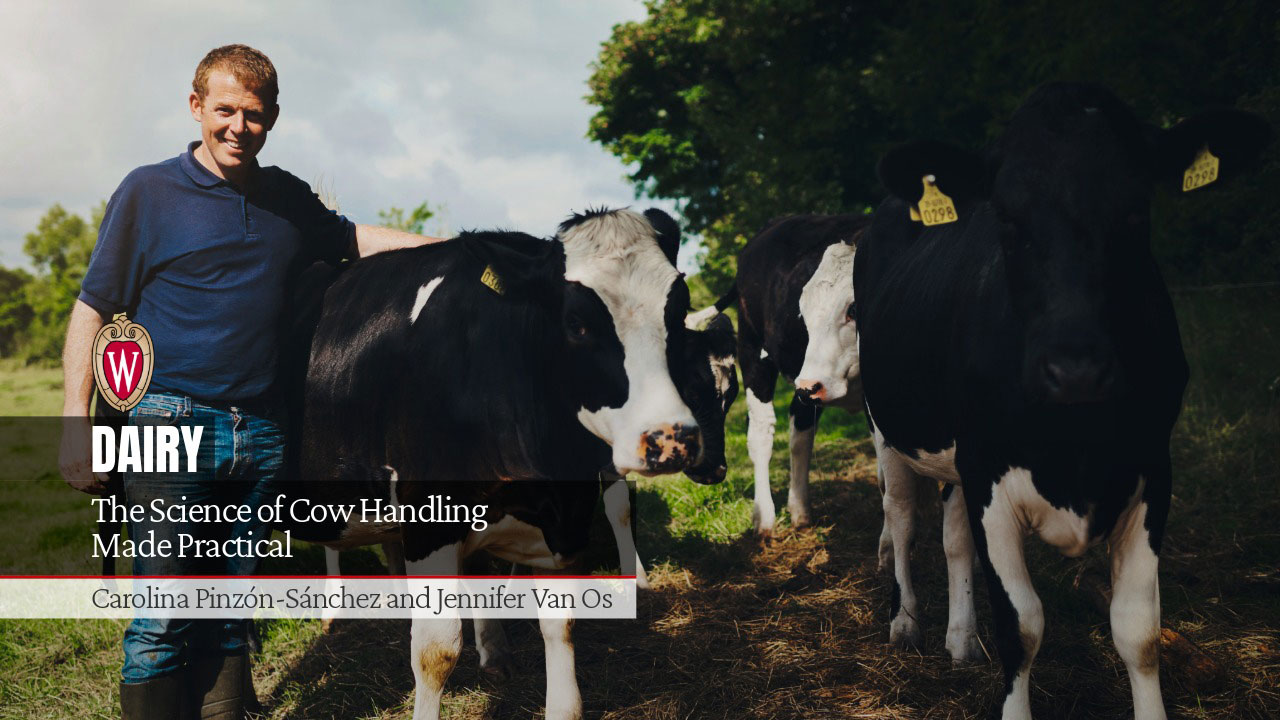
Low-stress handling of dairy cattle leverages their natural instincts to direct their movement calmly. Handler positioning relative to the imaginary flight zone and point of balance drives cows’ direction without physical force. Implementing these low-stress methods reduces injuries to livestock and people, maintains milk let-down efficiency, and protects consumer trust in dairy cattle care standards.
What Are the Impacts of Improper Cow Handling?
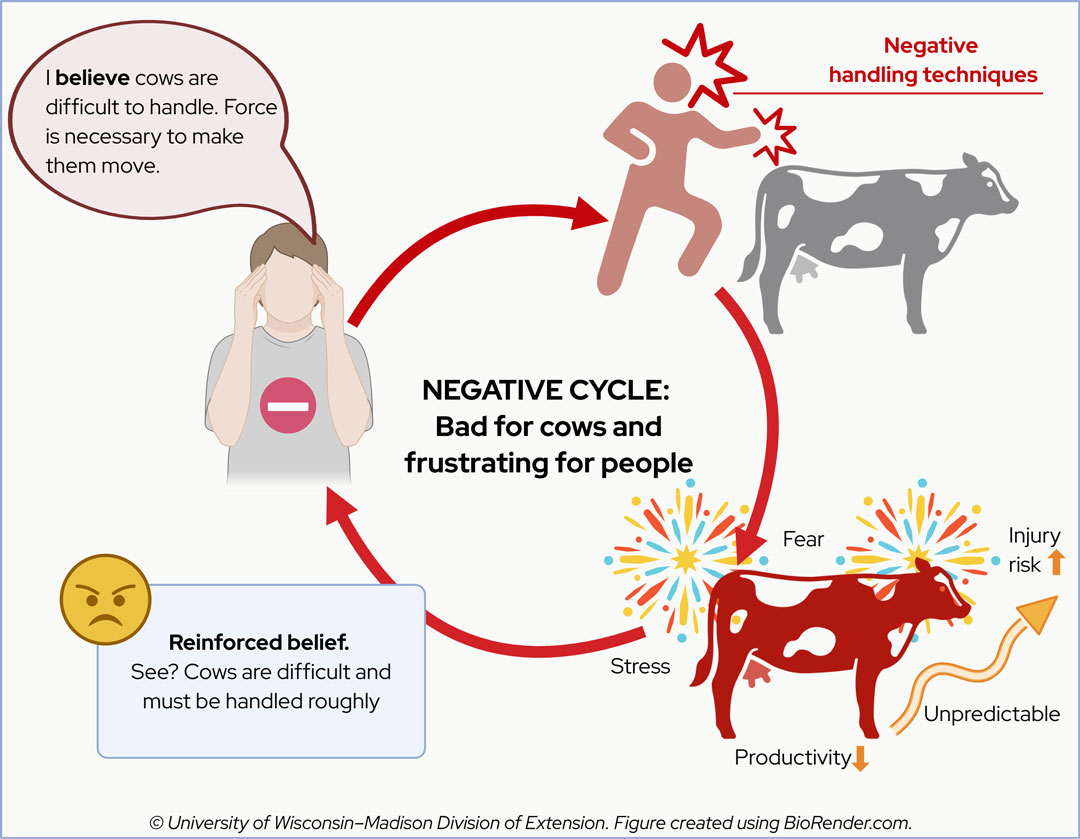
Negative handling techniques, such as shouting, fast movements, or forceful contact, trigger cows’ fight-or-flight responses that degrade herd health and productivity. Stressed cows have impaired milk let-down, defecate in the parlor, and kick off milking units. Furthermore, rough handling creates a self-reinforcing cycle of fear and frustration: frightened cows act unpredictably, making them difficult to move, and further promoting the idea that force is needed to keep cattle in line.
What Strategies Establish Low-Stress Cattle Handling?
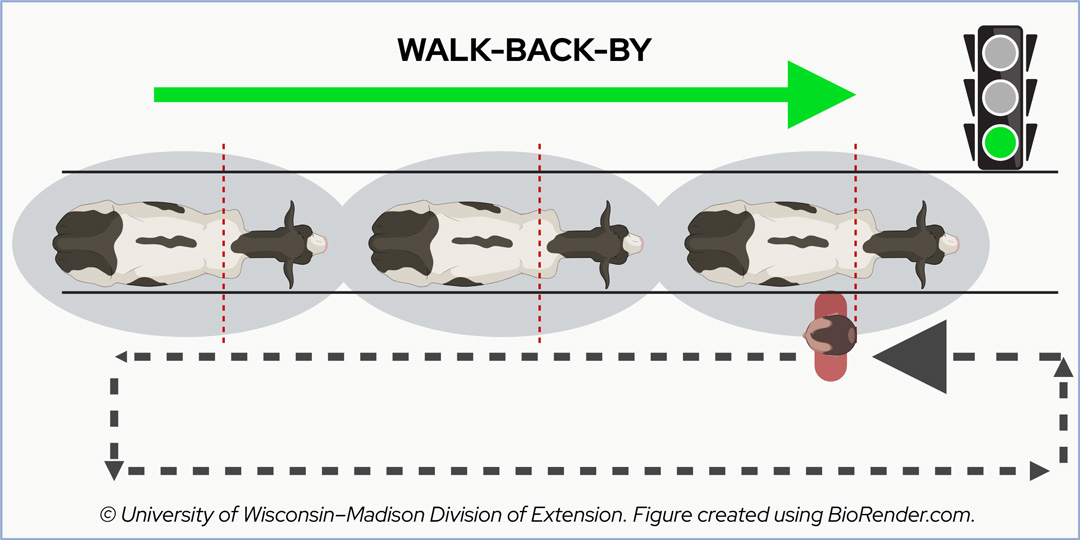
- Master Body Positioning: Step inside the flight zone slowly to initiate cow movement, stay behind the point of balance (shoulder) to drive forward motion, and use the “walk-back-by” technique in the milking parlor to maintain fluid movement without force.
- Optimize Barn Environments: Remove visual and physical obstacles like loose hoses, scrapers, or dark shadows, and eliminate sudden, loud sounds to accommodate cows’ sensitivity to their surroundings.
- Shift Mindset: Execute regular hands-on skill-building sessions covering awareness of natural cattle behavior and the power of calm handling to reinforce a positive handler mindset, replacing force with gentle pressure-and-release techniques.
Why Understanding Cow Behavior Matters
Whether you are handling cows in a freestall barn, a robotic milking facility, or on pasture, understanding cow behavior is essential for moving animals safely and efficiently. Effective cow handling goes beyond simply moving animals from point A to point B; it is based on communication, understanding, and respect. Animals deserve our best efforts, and handling them properly is the right thing to do.
Cows are prey animals with strong herd instincts, keen senses, and a preference for routine. When handlers understand how cows experience their environment and work in harmony following their natural instincts, they can guide animals calmly and confidently while supporting health, productivity, and animal welfare. Good cow handling reduces stress and lowers the risk of injury for both cows and handlers.
Cow handlers have a unique role. They influence not only what happens on the farm, but also how people outside the farm, such as consumers of dairy products, view the industry. Proper handling also improves the reputations of dairy operations and strengthens consumer trust in our commitment to animal welfare.
How Cows Experience Their Environment
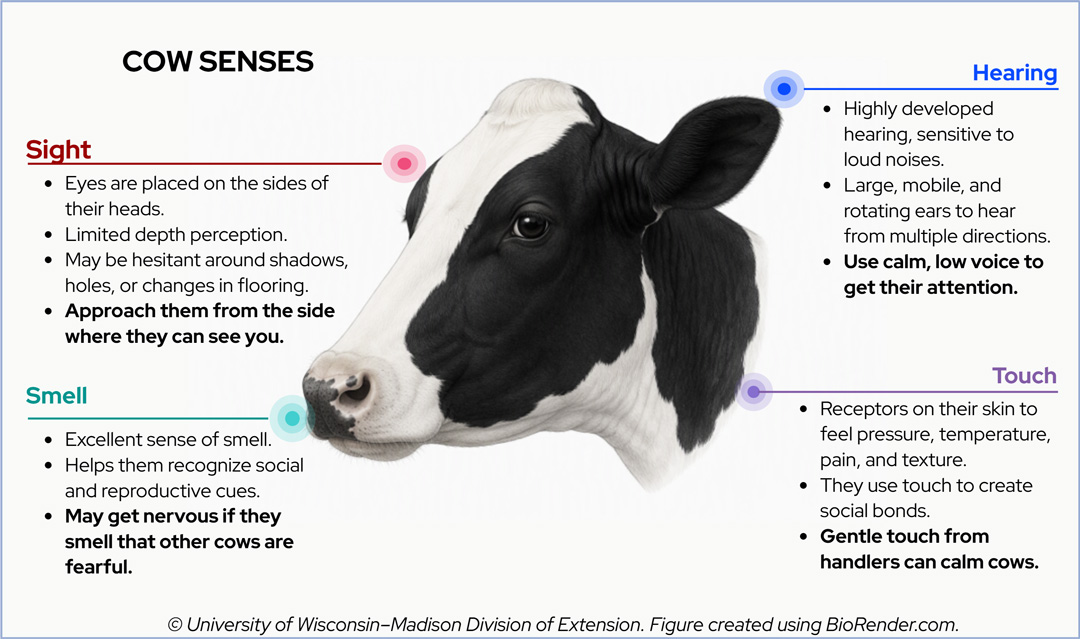
When handlers understand how cows think, perceive, and react to their surroundings, daily work becomes safer, smoother, and more efficient. Because cows experience the world differently than humans, understanding their senses (Figure 1) helps us handle them more effectively and improve daily management practices.
Sight
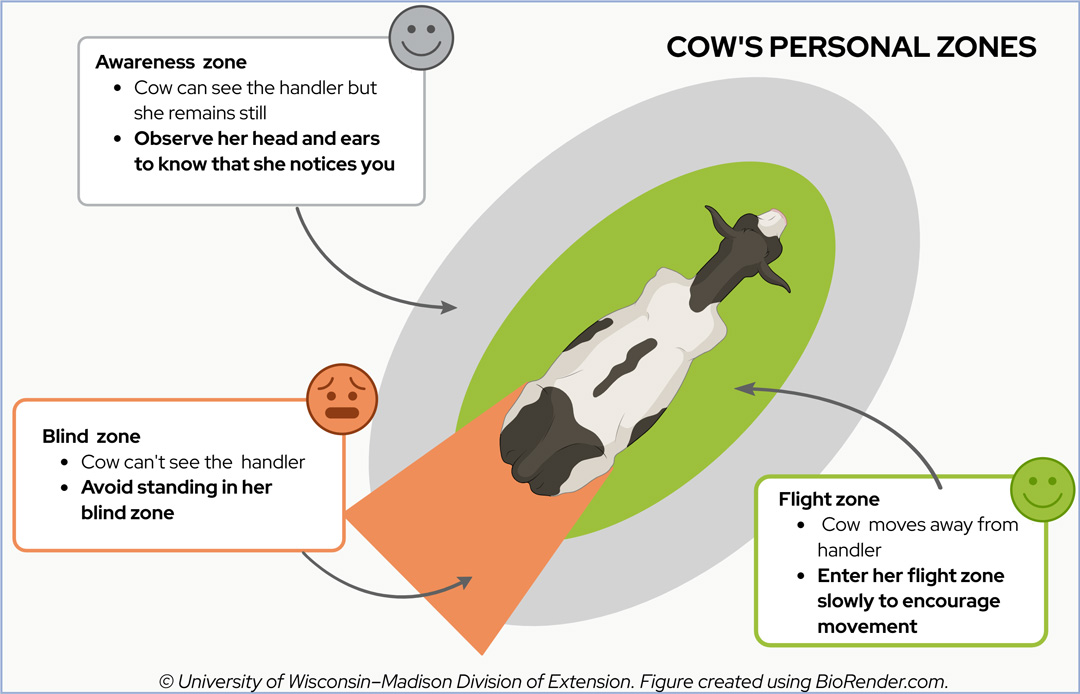
Cattle’s eyes are placed on the sides of their heads, giving them a wide panoramic vision of about 330°. They cannot see directly behind themselves, creating a blind zone (Figure 2). For this reason, approaching from the front or side, where they can see you, is best practice to avoid startling them. Consistently lit environments help them feel more comfortable.
Hearing
Cattle have highly developed hearing and can detect a wider range of sound frequencies than humans, including higher-pitched sounds. They have large, mobile ears that can rotate, helping them detect sounds from multiple directions. Sudden or high-pitched noises such as hissing air or banging metal can cause stress or fear. Use a calm, low voice to get their attention without startling them.
Smell
Cattle have an exceptional sense of smell and can detect very faint odors from long distances. Their well-developed sense of smell helps them recognize social and reproductive cues. When a cow becomes nervous, she may defecate or urinate. Other cows can detect these signals and also become nervous.
Touch
Cattle have receptors on their skin that help them feel pressure, temperature, pain, and texture. Touch also plays a vital social role. For example, mutual grooming and licking among cattle strengthens social bonds and relieves stress. A gentle touch can calm cows, while rough handling increases fear.
(Created with BioRender.com)
Key Cow Behaviors Every Handler Should Know
As professional handlers, it is essential to recognize cows’ natural behaviors and adapt our daily handling practices accordingly.
Cows perceive humans as predators
As prey animals, cows interpret sudden movements, loud noises, or aggressive handling as threats. These stimuli trigger fear responses and may cause cows to attempt to escape, creating hazardous situations. Always approach cows quietly and move deliberately, avoiding sudden, fast, or jerky movements.
Cows have herd instincts
Cows prefer to move in groups because they feel safer. Move cows as a group whenever possible. When sorting is necessary, move cows in pairs or small groups rather than individually. This will reduce their fear and keep them moving where you need them to go.
Cows walk more slowly than humans
Although cows can run fast, they normally walk slowly. Respect their natural pace. Rushing cows increases stress, leads to unpredictable behavior, and raises the risk of injury. Handle cows patiently and calmly. Never chase, yell at, or force cows to move faster. This is especially important for lame or sick cows, which may be in pain. Pushing them to move quickly is ineffective and can worsen their condition, increase stress, and elevate the risk of slips, falls, and injury.
Cows are naturally curious
As prey animals, cows continuously scan their surroundings for potential threats. Obstacles in or near their usual path, such as hoses, chains, scrapers or other objects, can make cows hesitate and become nervous. Minimize environmental distractions and keep walkways and parlors free of clutter to maintain smooth cow flow.
Cows prefer routine and familiarity
Consistent routines help cows remain calm and move more smoothly. When introducing cows to a new environment or process, allow extra time for them to explore and adjust.
Special considerations for fresh heifers
A heifer’s first milking experience shapes her future behavior. A negative first experience can affect how a heifer responds to milking in the future. Gentle and patient handling promotes milk let-down and supports faster, more complete milking. If a nervous heifer kicks or shifts, placing your hand gently on the back of her udder or along the outside of her rear legs can help her settle. Once she stands calmly, remove your hand. Repeat this process so she learns that calm behavior leads to the removal of pressure.
Stay alert for danger
Sometimes changes in hormones cause cows to behave more unpredictably, such as when they are in heat or have recently given birth to a calf. Even when approached calmly and carefully, such cows may behave in ways that can endanger handlers. Remain alert to the cows’ behavior in these situations to stay safe.
How Handler Actions Guide Cow Movement
The way handlers use their body language to apply or release pressure influences how cows move. Pressure is anything that causes a cow to change its behavior, whether the handler intends it or not. Pressure could mean just your position relative to the cow, even if you are not touching her.
Cows respond differently depending on both the location and intensity of the pressure applied. Cattle have several zones near their bodies that influence their movement (Figure 2). Understanding these zones helps handlers move cows smoothly, safely, and with less stress.
The table below describes these zones and other key cow handling concepts and provides practical tips for moving cattle safely and effectively.
Table 1
| Key Concepts | Practical handling tips |
|---|---|
| Awareness Zone: A large imaginary area around the cow where she can see or hear the handler but remains calm and does not move (Figure 2). |
|
| Flight Zone: A smaller imaginary area around the cow that represents her personal space (Figure 2). |
|
| Blind Zone: The area directly behind the cow where she cannot see the handler (Figure 2). |
|
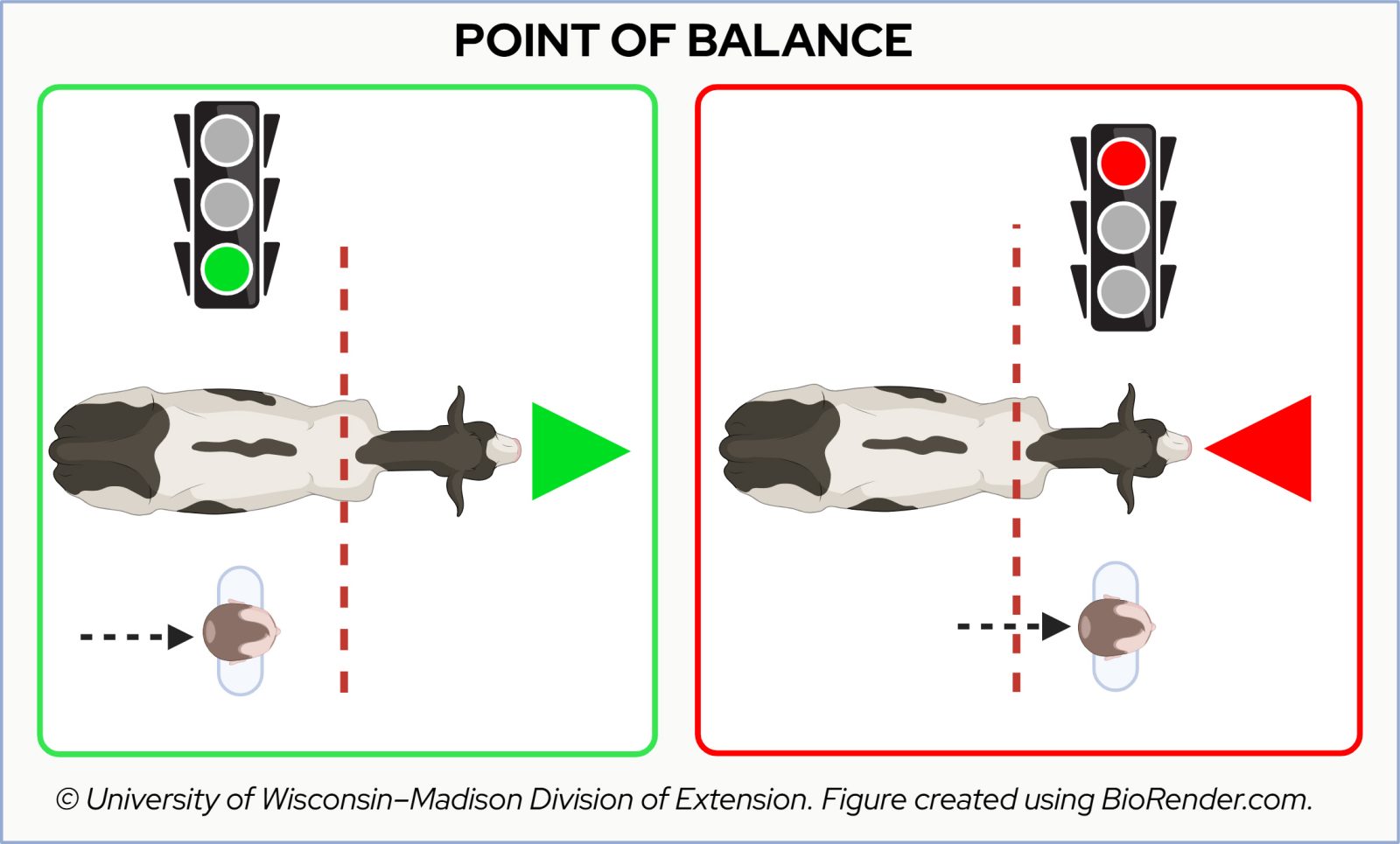
| Point of Balance: An imaginary line or plane at the cow’s shoulder that divides the body into front and back halves and guides her direction of movement (Figure 3). The handler’s position relative to the cow’s point of balance determines the cow’s response. |
|
| Walk-back-by: A cattle handling technique used in confined, single-file spaces, such as a parlor lane or chute (Figure 4). It uses the cow’s flight zone and the point of balance to encourage forward movement. |
|
| Zigzag movement: A cattle handling technique in which the handler stays behind a group of cows and walks in a zigzag pattern. |
|
| Pressure and release: A cattle handling technique in which the handler releases pressure once the cow responds correctly. |
|
(Created with BioRender.com)
(Created with BioRender.com)
(Created with BioRender.com)
Positive vs. Negative Handling Techniques
Cows remember past experiences. For this reason, our interactions should be positive so cows associate humans with good experiences and feel safe around people. You can tell whether cows feel comfortable or fearful by how they behave when humans are nearby. Calm cows remain relaxed around people instead of avoiding them.
Negative handling techniques are typically unnecessary and should be avoided as much as possible. These include hitting or shoving cows, making sudden movements, twisting tails, and creating loud noises. Such actions increase cows’ stress and can lead to injuries. These actions also teach cows that people are to be feared. Nervous animals are unpredictable and more difficult to handle. In the milking parlor, stressed cows may not let down milk properly, may kick units off, and may defecate more, making work more difficult. Ongoing stress can also weaken the cow’s immune system and negatively affect overall health.
Instead, aim to consistently use positive handling techniques. Walk slowly, speak in a gentle tone, and gently touch or pat cows when appropriate. Always be aware of your actions. Positive interactions make cows easier and safer to handle while improving their welfare. Whenever possible, use positive handling techniques and avoid negative ones.
The following table summarizes examples of positive and negative cattle handling techniques. Although it is not an exhaustive list, it serves as a guide to help handlers recognize appropriate techniques that support safe and low-stress cattle handling, versus inappropriate ones.
Table 2
| Category | Positive (+) handling techniques | Negative (−) handling techniques |
| Voice and Noise | Using a low, calm voice or staying silent. Minimizing unnecessary noise. | Yelling, shouting, loud whistling, banging objects, or playing loud music. |
| Body Movement | Moving slowly, calmly, and with purpose. Using smooth, controlled movements. | Running, sudden movements, waving arms, chasing cows, or moving erratically. |
| Touching the Animal | Occasional gentle touching, patting, or stroking shows cows that human contact can be positive. However, constant contact trains cows to expect you to touch them before they move. | Hitting, slapping, punching, twisting tails, pinching, shoving, pulling ears, or rough handling. |
| Use of Handling Aids | Using flags (or your arm) to extend your reach and signal which direction a cow should move, without touching the cow and only when necessary. | Poking, striking, or tapping with objects. Using electric prods. |
The Power of Positive Thinking
Research has shown that what people believe influences how they handle cows. People who perceive cows as difficult to handle are more likely to believe that physical force is necessary to move them. As a result, they use more negative handling techniques, which teach cows to fear people and behave less predictably. This creates a negative cycle that reinforces the belief that cows are difficult and must be handled roughly (Figure 5).
(Created with BioRender.com)
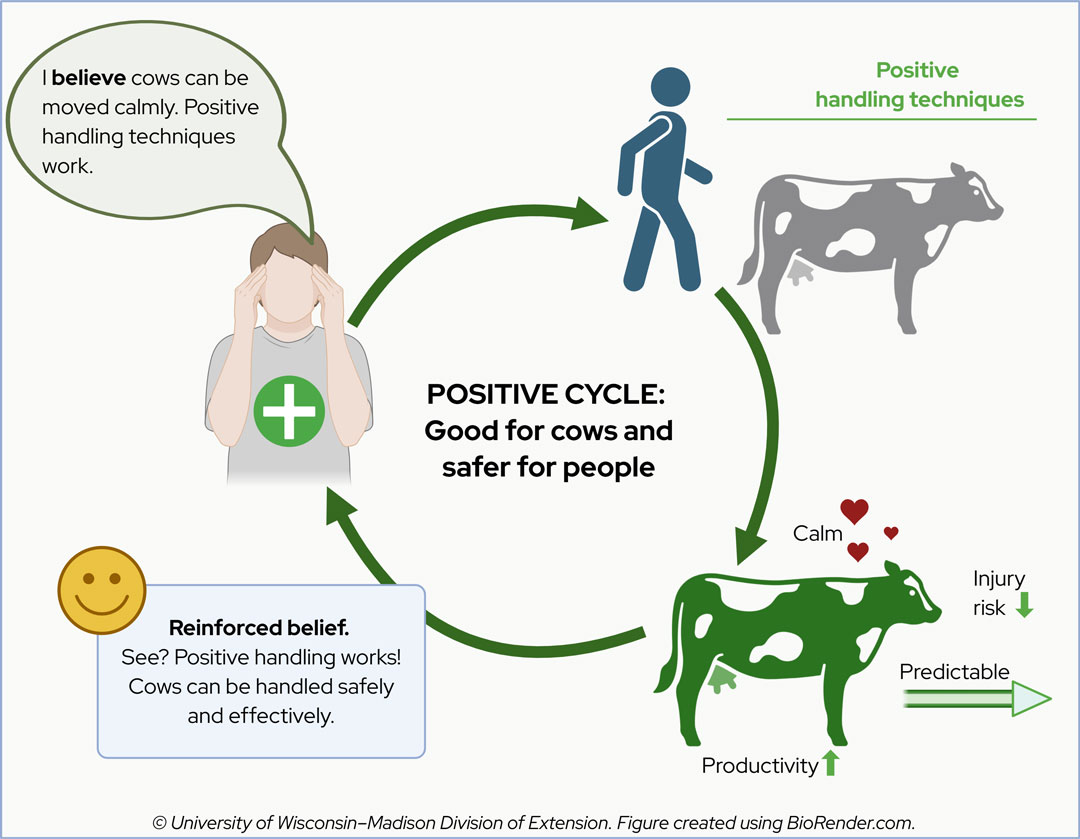
Fortunately, this cycle can be broken. Studies have found that people who believe cows can be moved using positive handling techniques are more likely to use those methods. As cows learn that people are not a threat, they become calmer and easier to move. This creates a positive cycle, reinforcing the belief that cattle can be handled safely and effectively without excessive force (Figure 6).
(Created with BioRender.com)
Improving handling habits starts with believing positive techniques can work. Research shows that a shift in mindset can lead to more positive handling behaviors, making work safer, easier, and less stressful for both cows and people.
Cow Handling Skill-Building Activities
Farm owners and managers should provide proper training on cow handling, both during onboarding and on an annual basis for continuing education. This is required by processors through the FARM Animal Care Program because it improves safety, animal welfare, and efficiency on dairy farms, as well as public confidence in farming practices and consumer trust.
The following activities can help train new handlers, reinforce expectations for experienced ones, build essential skills, and increase confidence.
Observation and behavior recognition
Observe cows as they move through the facility. Identify leaders and followers within the herd, and look for early signs of stress, such as hesitation, crowding, or agitation. This activity builds awareness of natural herd dynamics and how animals behave within a group.
Blind zone awareness training
Approach cows from different positions, including within their line of sight and from their blind zone (Figure 2). Be careful not to get too close or approach too quickly while in their blind zone, as startling the animal may trigger a defensive reaction and increase the risk of being kicked. Compare the cow’s reactions to understand how handler positioning affects movement and behavior.
Flight zone and pressure awareness
Practice identifying when you are inside or outside a cow’s awareness and flight zones (Figure 2). Deliberately step in and out of the zones, observe how cows respond, and discuss how controlled pressure influences movement.
Calm handling techniques
Practice moving among cows using quiet body language, a steady walking pace, and minimal use of voice. Focus on reducing noise and avoiding sudden movements to maintain a low-stress environment.
Environment assessment walks
Regularly walk the routes cows use and identify potential distractions or obstacles, such as hoses, chains, tools, or clutter. Incorporate this assessment into daily routines to maintain clear and safe pathways.
Loading cows in the parlor
Use the cow’s flight zone and point of balance to move cows into the parlor using the walk-back-by technique (Figure 4).
Handling fresh heifers
Practice gentle and patient handling techniques with fresh heifers. Emphasize the importance of providing a calm first milking experience to encourage cooperation and promote positive long-term behavior.
Practicing Better Cow Handling Every Day
Good cow handling is not a single technique, but rather a set of daily practices based on understanding natural cow behavior. These handling principles create real impact only when applied consistently in the barn, parlor, and pasture. Small adjustments in approach, movement, and environment can reduce stress, improve cow flow, and strengthen both safety and performance. Better handling benefits the cows, the people working with them, and the farm and industry as a whole. Cows deserve our best care, science supports these practices, and it is simply the right thing to do.
References
- Breuer, K., P.H. Hemsworth, J.L. Barnett, L.R. Matthews, G.J. Coleman. 2000. Behavioural response to humans and the productivity of commercial dairy cows. Appl Anim Behav Sci 66:273-288. 10.1016/S0168-1591(99)00097-0.
- Hemsworth, P.H., G.J. Coleman, J.L. Barnett, S. Borg. 2000. Relationships between human-animal interactions and productivity of commercial dairy cows. J Anim Sci 78:2821-2831. 10.2527/2000.78112821x.
- Hemsworth, P.H., G.J. Coleman, J.L. Barnett, S. Bord, S. Dowling. 2002. The effects of cognitive behavioral intervention on the attitude and behavior of stockpersons and the behavior and productivity of commercial dairy cows. J Anim Sci 80:68-78. 10.2527/2002.80168x.
- Pajor, E.A., J. Rushen, A.M.B. de Passillé. 2000. Aversion learning techniques to evaluate dairy cattle handling practices. Appl Anim Behav Sci 69:89-102. 10.1016/S0168-1591(00)00119-2.
- Robbins, J., K. Proudfoot, E. Strand, L. Hemsworth, G. Coleman, P. Hemsworth, J. Skuse, P. Krawczel, J. Van Os. 2024. Perceptions of dairy cow-handling situations: A comparison of public and industry samples. J Dairy Sci 107:540-554. 10.3168/jds.2023-23496.
- Robbins, J. K. Proudfoot, L. Hemsworth, G. Coleman, P. Hemsworth, J. Van Os. 2026. Motivational attributions and demographic factors associated with U.S. dairy consumer attitudes toward a hypothetical animal welfare initiative. Front Anim Sci 6:1677465. 10.3389/fanim.2025.1677465.
- Rørvang, M.V., R.K. Meagher, J. Stenfelt, E.K. Miller-Cushon, S.R. Ahmmad, M.C. Ceballos. 2026. The sensory world of cattle: Abilities, limitations, and perceptual challenges in human-designed environments. Appl Anim Behav Sci 304:107117. 10.1016/j.applanim.2026.107117.
Originally Published: August 2026
Authors
- Carolina Pinzón-Sánchez – Division of Extension, University of Wisconsin–Madison
- Jennifer Van Os – Division of Extension & Department of Animal and Dairy Sciences, University of Wisconsin–Madison
Reviewers
- Aerica Bjurstrom – Division of Extension, University of Wisconsin–Madison
- Heather Schlesser – Division of Extension, University of Wisconsin–Madison