

Home » Two Heads Are Better Than One: A Starter Guide to Pairing Dairy Calves
Two Heads Are Better Than One: A Starter Guide to Pairing Dairy Calves
Home » Articles » Collections » Two Heads Are Better Than One: A Starter Guide to Pairing Dairy Calves
Collection

Two Heads Are Better Than One: A Starter Guide to Pairing Dairy Calves
This series of articles is a seven-part starter guide for pairing or group-housing preweaned dairy calves. Throughout this guide, we cover best practices to promote good health and welfare in calves raised in pairs or small groups.
Authors
This guide was created by Jennifer Van Os, PhD, with contributions from:
- Sarah Adcock, PhD, Department of Animal & Dairy Sciences, UW–Madison
- Joao Costa, PhD, Department of Animal & Food Sciences, University of Kentucky
- Courtney Halbach, MBA, Department of Medical Sciences, School of Veterinary Medicine, UW–Madison
- Tina Kohlman, MS, UW–Madison Division of Extension Fond du Lac County
- Emily Miller-Cushon, PhD, Department of Animal Sciences, University of Florida
- Theresa Ollivett, DVM, PhD, Department of Medical Sciences, School of Veterinary Medicine, UW–Madison
- Donald Sockett, DVM, PhD, Wisconsin Veterinary Diagnostic Laboratory, UW–Madison
- Sandy Stuttgen, DVM, UW–Madison Division of Extension Taylor County
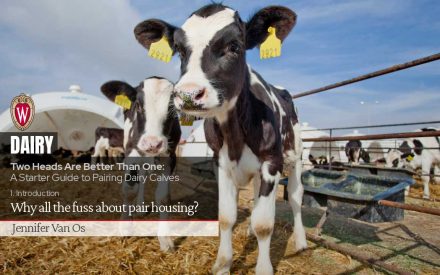
Why all the fuss about pair housing?
Socially housing dairy calves improves welfare, growth, and adaptability. Many producers find that raising calves in pairs benefits the industry.
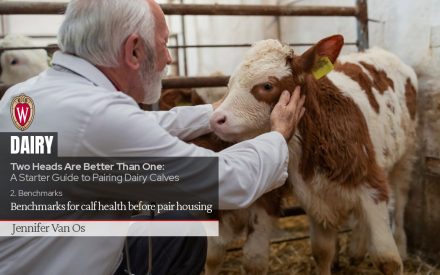
Benchmarks for calf health before pair housing
Socially housing dairy calves improves welfare, growth, and adaptability. Many producers find that raising calves in pairs benefits the industry.
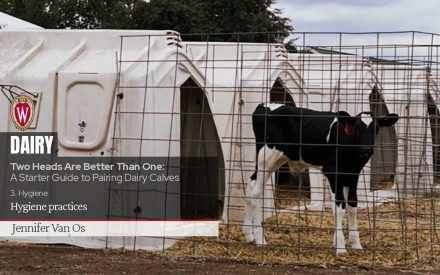
Hygiene Practices
Guidelines for dairy producers transitioning to pair or group calf housing, focusing on biosecurity, sanitation, and bedding management.
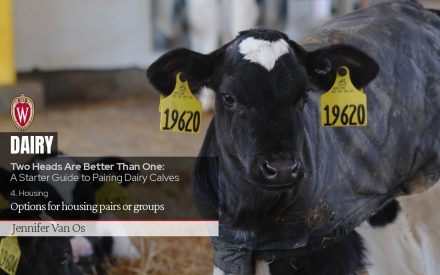
Options for housing pairs or groups
Proper execution of these housing systems ultimately drives better health outcomes, reduced stress, and increased early-life weight gain.
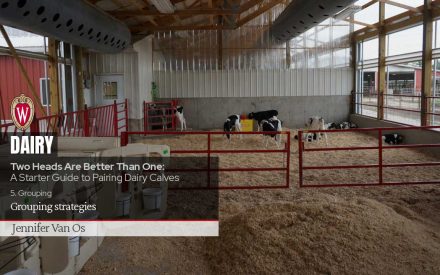
Grouping strategies
Social calf housing improves feed intake and cognitive development when managed through optimal group sizing and age-matching.
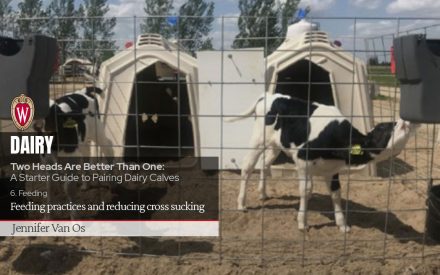
Feeding practices and reducing cross sucking
Cross-sucking and milk-stealing in dairy calves stem from natural, unfulfilled suckling instincts and restricted milk feeding.
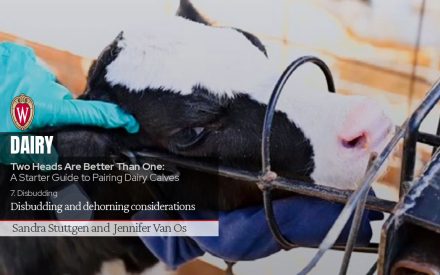
Disbudding and dehorning considerations
Disbud calves before 8 weeks using pain control and approved hot iron or caustic paste methods under veterinarian guidance.

Paired Calf Housing Wagner Farms [Video] ▶️
Paired calf housing boosts dairy farm productivity and calf social development by improving growth rates, reducing disease, and potentially lowering labor costs.