Two Heads Are Better Than One: A Starter Guide to Pairing Dairy Calves
Part 5: Grouping
At a Glance
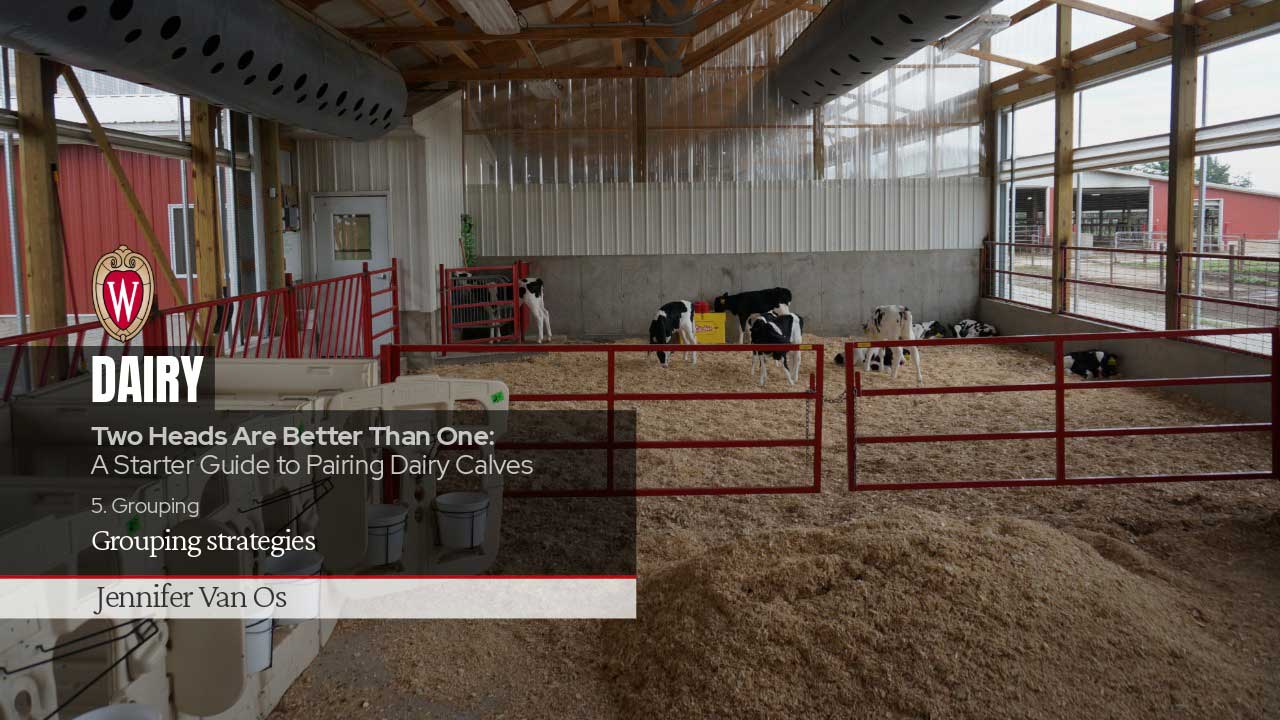
Social calf housing improves feed intake and cognitive development when managed through optimal group sizing and age-matching. Early grouping in pairs or small cohorts of up to eight calves prevents the disease risks and poor monitoring associated with larger groups. Implementing stable, all-in, all-out systems minimizes social stress and disease transmission, leading to superior long-term calf welfare and weight gains.
How Do Group Size and Age Affect Calf Health and Growth?
Housing calves in groups larger than eight escalates respiratory disease and diarrhea risks. Restricting access to a single automatic feeder nipple to more than 20 calves limits milk intake, induces competitive stress, and increases caretaker burnout. Delaying pairing past 14 days of life or allowing age gaps wider than 14 days within a group reduces solid feed intake and stunts cognitive development.
What Best Practices Ensure Successful Group Housing?
- Limit group sizes: Maintain small cohorts of two to eight calves to ease health monitoring.
- Execute stable grouping: Fill pens within seven to 14 days and use an all-in, all-out strategy to prevent social disruption.
- Minimize age variance: Keep the age gap between the oldest and youngest pen mates under 14 days.
Introduction
When housing calves in pairs or groups, producers need to not only choose which housing type to use, but also decide on grouping strategies. How many calves will there be in each group? At which age will calves enter a pair or group? What will the maximum age difference be within a group? Should calves be matched based on their size or behavior rather than age? Lastly, how will calves be moved after weaning? All of these factors have important implications for calf health and welfare and will be discussed in this article.
Number of Calves per Group
Although many farms manage large groups of calves with good health outcomes, research has shown larger group sizes are a risk factor for health issues. There is no magic number for the cutoff between small or large groups, but research suggests pairs or groups of up to six to eight calves might have lower incidence of respiratory disease or diarrhea than groups of 15 calves or more.
In our survey of 413 U.S. producers in 2019, we found 95 farms housed their preweaned heifer calves in social groups. Of those, 61% used groups of two to eight calves, with 90% of these farms reporting satisfaction with the health of their calves. The other 39% of farms kept calves in larger groups with more than eight calves, and 72% of these farms were satisfied with calf health.
The health challenges sometimes seen in larger groups have, in part, been thought to be because of greater difficulties in detecting and treating sick calves. As automated monitoring technologies become more established, it might be possible to overcome some of the difficulties with sickness detection in large group housing. Nonetheless, new technologies do not replace careful observation by experienced calf care personnel.
In automatic milk feeding (“autofeeder”) systems, only one nipple is typically provided to the entire pen of calves, and only one calf per group can drink at a time. Experts recommend group sizes of no more than 15 to 20 calves per nipple. Be wary of suggestions to house more than 20 calves per pen with access to only one nipple. Although on paper this strategy could appear to save money, there is a real chance of unforeseen costs in terms of compromised calf health and welfare, as well as potential calf-caretaker burnout from constantly dealing with sick calves.
Producers sometimes wonder if odd numbers, such as groups of three calves, should be avoided. Will one calf be left out of social bonding or get picked on at feeding time? Studies on groups of two to six calves, including groups of three, have shown benefits for feed intake and growth compared to individual housing (for more details, see the Why all the fuss about pair housing? article in this series). There is no clear evidence against housing calves in groups of three.
When to Form Groups
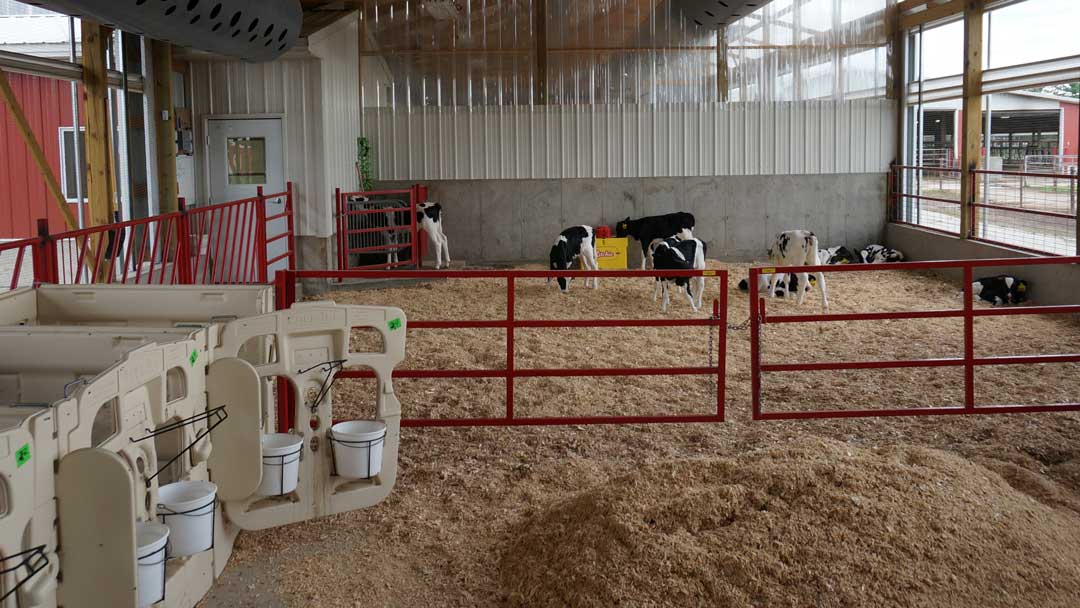
In the United States, some farms choose to pair or group calves on the day of birth; these farms report lower infrastructure costs for pen dividers. Other farms choose to house calves individually for the first few days or weeks of life (Figure 1). Some farms might wait until calves are drinking milk vigorously before moving them to a group. Other farms prefer to wait until after the peak of scours on their farm. The age when most scouring occurs varies among farms within the first 3 weeks of life. Work with your veterinarian on the best age to pair calves if this is a concern on your farm.
(Photo: Credit: The Dairyland Initiative)
Research has not yet provided a definitive answer on the best age for forming pairs or groups of calves. Currently, recommendations from various experts range from pairing calves within the first 3 to 14 days of life to waiting until they are approximately 21 days old. In some parts of Europe, dairy farms are required by law to pair or group calves by the time they are 2 weeks old. In our 2019 survey, 52% of farms formed pairs or groups when calves were in the first week of life, and 22% of farms did so when calves were in the second week of life (Figure 2).
Age when calves enter pairs or groups
|
at least some are >3 weeks old |
|
||||
| 15-21 days old |
|
||||
| 8-14 days old |
|
||||
| ≤ 7 days old |
|
||||
|
|||||
| Percent of farms |
Figure 2. Age when calves typically enter pairs or groups among 93 farms in a 2019 UW–Madison survey.
There are several arguments in favor of pairing calves within the first 2 weeks of life. Nine studies have found advantages for solid feed intakes, growth performance, or both outcomes when forming groups of two to six calves between 0 to 10 days old, on average. However, another three studies found similar advantages compared with individual housing when calves were grouped after they were 4 weeks of age or older. One set of studies found when calves were paired at 1 week old, they had better solid feed intakes, average daily gains in bodyweight, and cognitive development and learning abilities compared to individually housed calves. For more details, see the Why all the fuss about pair housing? article in this series. Note that these benefits were not significant for calves paired at 6 weeks of age, adding to the case for earlier pairing.
Some farms group calves by body size or feeding behavior instead of age to even out their competitive ability. Some experts suggest keeping the weight difference within pairs or groups to 22 pounds (10 kg) or less, although no studies have been done yet to support this guideline. For more information on feeding competition, see the Feeding practices and reducing cross sucking article in this series.
Age Range Within a Group
In smaller herds, fewer calves are born each week. This means the age gap within a pair or group will be larger. To minimize health risks and feed competition, the age range within a pair or group should be minimized. Experts recommend the youngest and oldest calf in a group differ by no more than 14 days of age, but ideally by 7 days of age or fewer. In our 2019 survey, 48% of farms had age ranges of 1 week or less, and 25% of farms had ranges of 2 weeks or less (Figure 3).
Maximum age difference within pairs or groups of calves
| more than 3 weeks |
|
||||
| 3 weeks or less |
|
||||
| 2 weeks or less |
|
||||
| 1 week or less |
|
||||
|
|||||
| Percent of farms |
Figure 3. Typical maximum age difference between the youngest and oldest calves within a pair or group among 93 farms in a 2019 UW–Madison survey.
Farms with only one to two calves born per week might be able to successfully house them in pairs. Larger groups would not be recommended because of the greater age range between the oldest and youngest calves in a group. On smaller farms, creative strategies might be needed to ensure enough calves are born within a short time span to form pairs close in age. These strategies could include synchronized breeding programs, seasonal calving, or raising bull calves as companions for heifer calves. Autofeeder systems require calves to be housed in large groups to be economically feasible. These systems are not recommended for farms with few calves born per week because the age range within a group will be too great.
Moving Calves to New Pens
Dynamic or continuous grouping, also known as “trickle-in, trickle-out,” is not recommended. In this management system, calves are continuously removed from the group as they are weaned, with new calves entering to replace them. Instead, stable groups, typically called “all-in, all-out,” are recommended. Stable grouping has been shown to result in lower incidence of disease and greater average daily gains in bodyweight when compared with continuous systems. Maintaining stable groups reduces the social stress resulting from disrupting group dynamics, social hierarchies, and the bonds between calves.
An all-in, all-out strategy more accurately operates as “trickle-in, all-out” for each group of calves (Figure 4). Calves of the appropriate age or size are added until a group is full, typically within 7 days, or 14 at the most. They stay in the same group until the last calf in the group is weaned, with the option of keeping calves in their original pen for a while after weaning. The group is then moved all at once, and the entire pen can sit empty between groups.
Maximum age difference within pairs or groups of calves
  |
|
Figure 4A. A group is formed, taking up to 7, or at most 14 days to fill.
|
|
Figure 4B. Once the first group is full, the next group is formed.
|
|
|
|
Figure 4C. The entire barn is filled within 3 weeks.
|
|
|
|
Figure 4D. After the youngest calf in the first group is weaned, the entire group leaves.
|
Figure 4E. Entire groups leave until the whole barn is empty.
Figure 4F. The entire barn remains empty and is cleaned, disinfected, then rested for 1 to 2 weeks.
Figures 4 A-F. Illustrations of “all-in, all-out” or “trickle-in, all-out” strategy for forming and removing groups of preweaned calves.
(Calf icon created by Lars Meiertoberens from Noun Project. Diagram by Jennifer Van Os.)
If housing calves indoors, groups are ideally removed from the barn until the entire barn is empty. Then, the barn should be cleaned and rested for 1 to 2 weeks. For more information about cleaning, sanitizing, and resting pens and barns between consecutive pairs or groups of calves, see the Hygiene practices article in this series.
When building new barns, the appropriate capacity will depend on the rate of calves born over a given time span, the average stillbirth rate, and the percentage of calves expected to be raised on-site. For information on these calculations, visit The Dairyland Initiative website ↗️. If possible, the entire barn should take 3 weeks or fewer to fill, limiting the age span within the barn. This strategy limits disease transmission from older to younger calves. The downside is increased infrastructure costs to build and maintain multiple, smaller barns.
When moving calves after weaning, group sizes sometimes change. Research has not yet established the longer-term implications of separation after social bonds are formed. In the meantime, to minimize the risk of social stress, it is recommended to maintain original pairs. For calves housed in larger groups before weaning, maintaining the entire group might not be feasible. If preferential partners can easily be identified, it could be beneficial to keep them together during subsequent regroupings. The exception is in the case of persistent cross sucking that has not been successfully managed by trying other strategies besides breaking the pair. For details on minimizing cross sucking, see the Feeding practices and reducing cross sucking article in this series.
References
- Costa, J.H.C., M.A.G. von Keyserlingk, & D.M. Weary. 2016. Invited review: Effects of group housing of dairy calves on behavior, cognition, performance, and health. J. Dairy Sci. 99:2453-2467.
- Cantor, M.C., H.W. Neave, & J.H.C. Costa. 2020. Effectively raising pair-housed calves: Common questions from transitioning farmers. Progressive Dairy.
- Mills-Lloyd, S. & T. Kohlman. 2017. Heifer blueprint: Finding the balance – Management of calf health versus cost of production. UW–Madison Extension.
- Nordlund, K.V. & C.E. Halbach. 2019. Calf barn design to optimize health and ease of management. Vet Clin. Food Anim. 35:29-45.
- Ollivett, T.L. 2020. How does housing influence Bovine Respiratory Disease in dairy and veal calves? Vet. Clin. Food Anim. 36:385-398.
- Replacement Housing. The Dairyland Initiative. https://thedairylandinitiative.vetmed.wisc.edu/home/housing-module/replacement-housing/
- Silva, F.L.M., J.M.C. Van Os, C. Winder, M. Akins, T. Kohlman, T. Ollivett, H. Schlesser, R. Schley, S. Stuttgen, & J. Versweyveld. In preparation. U.S. farmer-reported housing and milk-feeding practices for preweaned dairy calves.
Originally Published: June 2022
Authors
- Jennifer Van Os, Department of Animal & Dairy Sciences, UW–Madison
Reviewers
- Courtney Halbach, Department of Medical Sciences, UW–Madison School of Veterinary Medicine
- Tina Kohlman, UW–Madison Division of Extension Fond du Lac County
- Theresa Ollivett, Department of Medical Sciences, UW–Madison School of Veterinary Medicine
- Emily Miller-Cushon, Department of Animal Sciences, University of Florida