Two Heads Are Better Than One: A Starter Guide to Pairing Dairy Calves
Part 7: Disbudding
Collection
Two Heads Are Better Than One: A Starter Guide to Pairing Dairy Calves
Part 7: Disbudding
At a Glance
Early calf disbudding minimizes operational hazards and animal distress by destroying horn-producing cells before skull attachment occurs at eight weeks. Transitioning to polled genetics or implementing disbudding before six weeks prevents invasive surgical dehorning. Adopting veterinary-guided local anesthesia and nonsteroidal anti-inflammatory drugs ensures compliance with national standards while improving overall herd welfare.
What Are the Consequences of Delayed Disbudding and Omitting Pain Management?
Delaying horn removal past eight weeks turns routine disbudding into complex surgical dehorning, elevating sinus infection risks and animal trauma. Under FARM 4.0 standards, farms failing to disbud before eight weeks face Mandatory Corrective Action Plans requiring resolution within nine months. Omitting formal pain control protocols triggers Continuous Improvement Plan citations requiring mandatory correction within three years.
What Key Strategies Ensure Safe and Compliant Calf Disbudding?
- Early Intervention: Apply caustic paste within the first two weeks of life, or utilize hot-iron cauterization prior to six weeks to prevent horn attachment to the skull.
- Multimodal Pain Control: Administer a cornual nerve block using 2% lidocaine 5 to 20 minutes prior to disbudding, combined with long-acting oral meloxicam or IV flunixin.
- Proper Restraint and Isolation: Secure the calf’s head using a halter during procedures, and isolate paste-treated calves for at least one hour to prevent chemical transfer between group-housed animals.
Introduction
Preventing horn growth in calves is an important farm safety practice to prevent injuries to people and other animals. Using polled genetics is the best way to avoid having to remove horns. Although beef breeds are often polled, dairy breeds typically are not. Monitor calves during their first 6 weeks of life for the growth of horn buds and disbud immediately as they are identified.
Disbudding Procedures Are Painful
Pain can be minimized by disbudding calves at a young age with proper pain management. Ideally, disbudding should be done before 6 weeks of age, and no later than 8 weeks of age. At around 8 weeks, the horn bud is attached to the calf’s skull. Removing the horn bud or horn at this age is painful and risks opening up the sinuses to infection.
In a 2019 survey by UW–Madison Division of Extension, many producers who do their own disbudding or dehorning reported typically doing the procedure on
calves 8 weeks or older. This shows an opportunity to improve practices and disbud calves earlier. Dehorning after 8 weeks is considered a surgical procedure and
should be done by a licensed veterinarian. In the United States, 99% of dairy farms participate in the Farmers Assuring Responsible Management (FARM) Animal Care program. The most recent version (FARM 4.0) went into effect January 2020. Now, farms not routinely disbudding calves by 8 weeks of age are issued a Mandatory Corrective Action Plan (MCAP). The practice must be corrected within 9 months.
Pain control is considered the standard of care when disbudding or dehorning calves, according to the American Association of Bovine Practitioners (AABP). For disbudding regardless of age or method, a paincontrol protocol created in consultation with your veterinarian is expected. Farms without such a protocol, or whose practices do not align with their protocol, will be issued a Continuous Improvement Plan (CIP) under the FARM program. These practices are expected to show improvements within 3 years. At the start of 2020, most U.S. farms did not use pain control, but this is expected to change with the new FARM expectations. A 2015 survey found 83% of dairy producers and 92% of consumers thought pain relief should be provided when disbudding dairy calves. Increased use of pain control will help improve calf welfare and consumer confidence in dairy farming.
All drugs mentioned in this article require a veterinary prescription and should be used only in the context of a valid Veterinarian/Client/Patient Relationship (VCPR).
Organic producers should consult their certifying agency for the list of approved products for local anesthesia and pain management for disbudding or dehorning.
Disbudding Methods
Acceptable methods for disbudding include application of caustic paste on calves up to 2 weeks old or an electric or gas hot iron to destroy the horn-producing cells on calves less than 8 weeks old. Both methods require proper training and oversight so disbudding is complete.
For young calves, using a hot iron requires greater labor and restraint than using caustic paste. Hot irons are also associated with the smell of burnt hair. Caustic paste should be applied within the first few days of life and is less effective and discouraged after the calf is 2 weeks old. There is potential for damage to calves’ eyes and skin from caustic paste. Improper application or runoff can cause incomplete disbudding, requiring dehorning at a later age
Considerations for Pair or Group Housing
Proper restraint is needed when disbudding calves, regardless of whether they are housed individually or in pairs or groups. For pair- or group-housed calves, loose calves may interfere with the disbudding of other calves. In addition, calves housed in groups may transfer caustic paste onto each other. An option is to administer a sedative in consultation with your veterinarian. Some farms initially house calves individually before forming pairs or moving them to groups. On those farms, an option is to disbud calves while they are still housed individually to reduce interference by other calves.
Steps for Using a Hot Iron
- Nonsteroidal anti-inflammatory drugs (NSAIDs) are recommended in addition to local anesthesia (see Step 4) to reduce the inflammation and associated pain after disbudding.
- Meloxicam is an oral tablet available with a veterinary prescription. This is the recommended NSAID for disbudding and is easy to administer with a long duration of action. The peak action of Meloxicam occurs 12 hours after administration. An option is to administer at the milk feeding before disbudding. Meloxicam for pain management in animals is considered extra-label drug use through the VCPR. Consult your veterinarian for proper dosage. Use of oral meloxicam results in a 21-day meat withhold.
- Flunixin is an anti-inflammatory drug to help alleviate pain by reducing the inflammation caused by disbudding. To alleviate pain after the disbudding procedure, repeated dosing of flunixin is needed. Consult your veterinarian for proper dosage. This drug is given IV only and results in a 4-day meat withhold. Do not use it intramuscularly or subcutaneously. Withdrawal times have not been established in preruminant calves. Flunixin should not be given to veal calves.
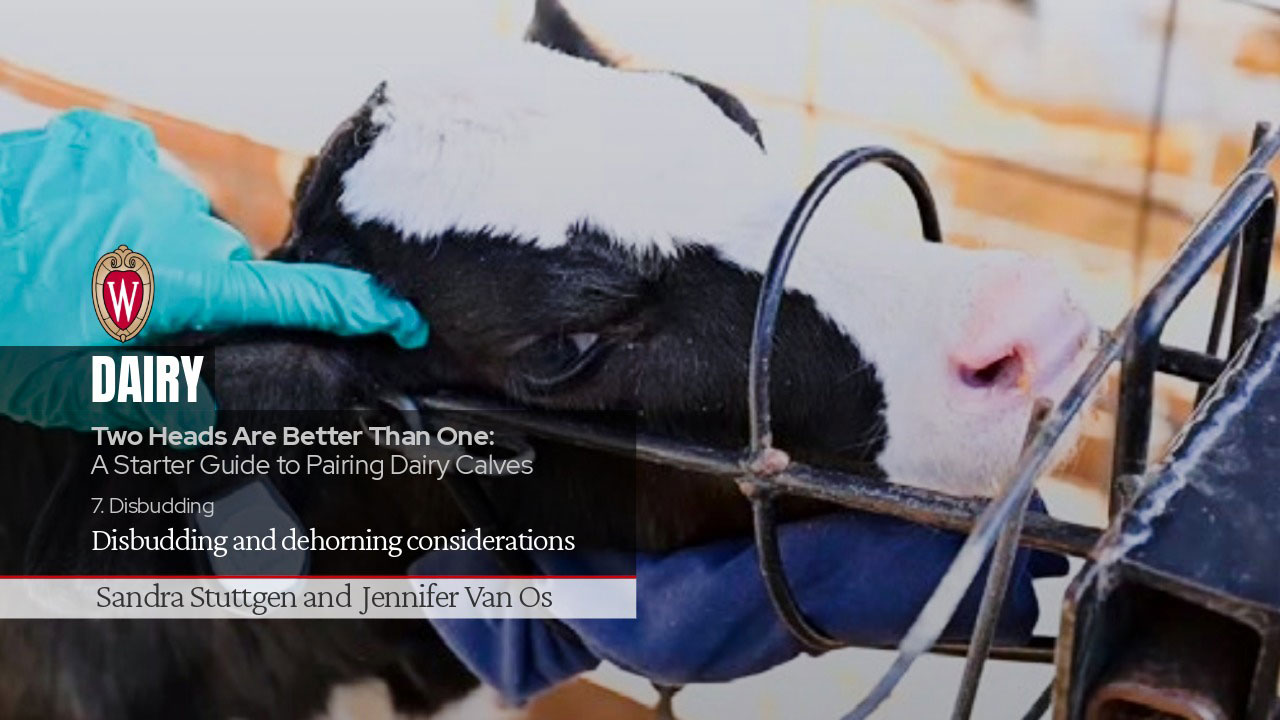
- Restrain the calf’s head using a halter or head restraint (Figure 1). Meanwhile, preheat the butane or electric calf dehorner. As the dehorner preheats, keep it away from all flammable material.
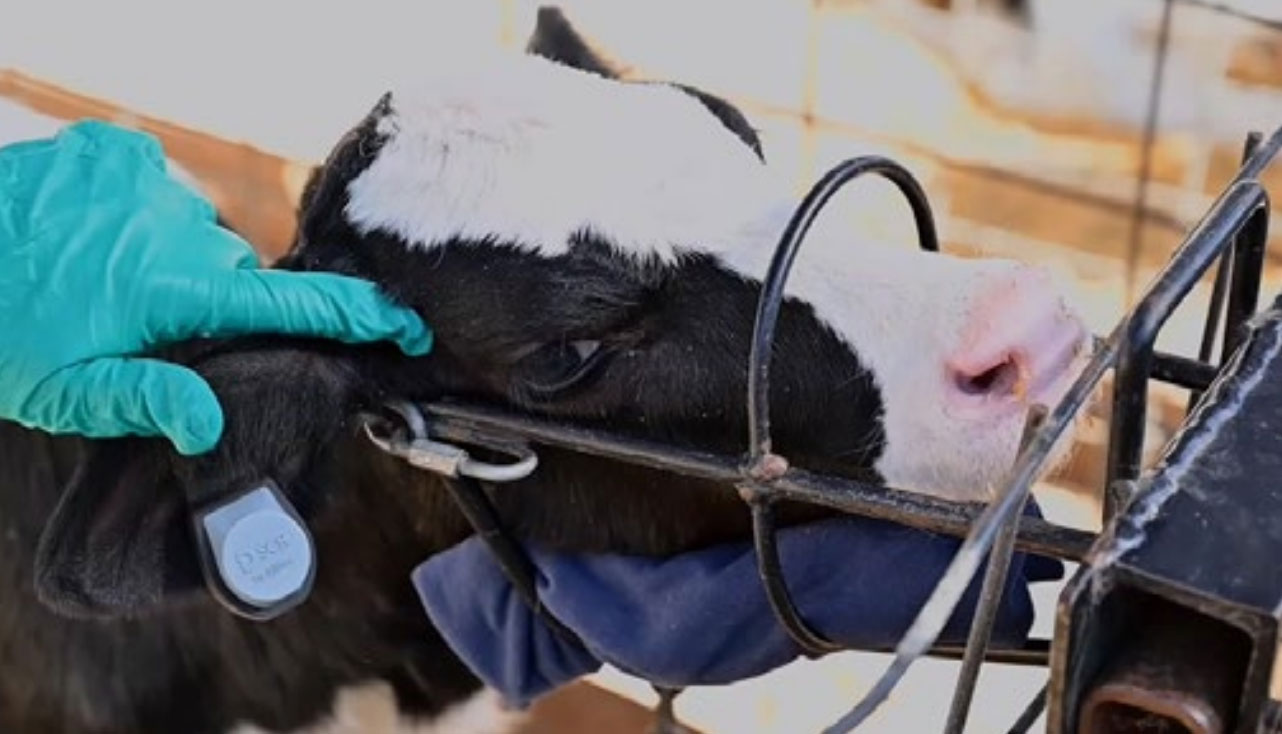
(Credit: Sarah Adcock, UW–Madison)
- Clip the hair to expose each horn bud.
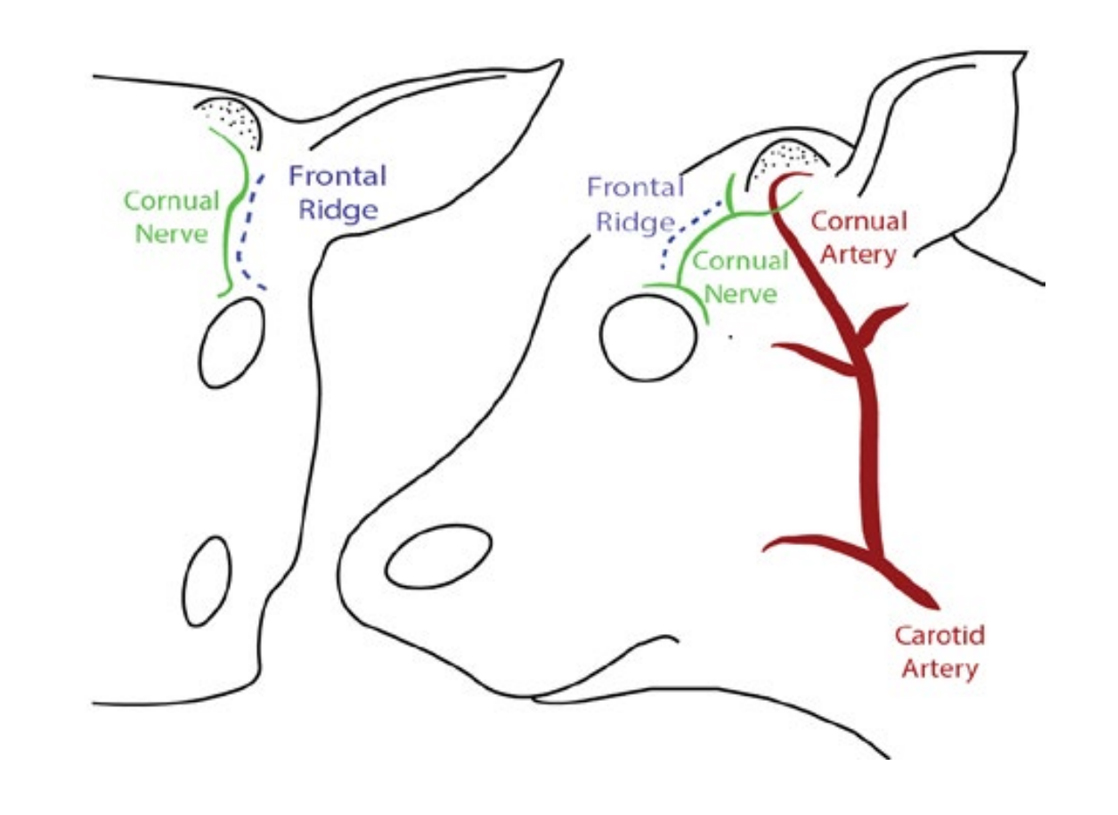
- Inject local anesthesia using a cornual nerve block on both sides of the head. This reduces the acute pain and discomfort associated with hot iron disbudding. The cornual nerve is located between the lateral aspect of the eye and the base of the horn bud, just below the bony ridge formed by the frontal bone (Figure 2). Palpate the ridge between the eye and the horn bud. Slide a 20- to 22-gauge, half-inch needle below the ridge at the midpoint between the eye and the horn bud. Inject 2% lidocaine subcutaneously. Consult your veterinarian for proper dosage. Lidocaine is available with a veterinary prescription. Using lidocaine results in a 4-day meat withhold. The injection should be done 5 to 20 minutes before application of the hot iron. Practice the injection technique with your veterinarian.
- Test the effectiveness of the nerve block before proceeding by pricking around the base of the horn bud with a needle. If the calf responds, wait a bit longer or inject more lidocaine.
- Use a device with a diameter just larger than the horn base. This will cauterize the skin immediately surrounding the horn bud. Apply minimal pressure and rock gently back-and-forth until a copper-colored ring forms. This takes approximately 5 to 20 seconds.
Do not leave the hot iron in place for much longer, especially on young calves. There is little chance of regrowth when the cauterized skin is loose or movable when touched after the procedure. - The horn bud will slough off in approximately 3 weeks. Complete healing takes 9 weeks.
Steps for Using Caustic Paste
- Use an NSAID as described in Step 1 above.
- Restrain the calf’s head using a halter or head restraint.
- Clip the hair to expose each horn bud.
- Inject a nerve bock as described in Step 4 above.
- Apply petroleum jelly in a ring around the horn bud to keep the paste within the correct area.
- Apply paste with gloved hands.
- To prevent smearing after application, keep calves separated for at least 1 hour and out of the rain for at least 6 hours after applying paste. An additional option is to cover each pasted bud with duct tape or vet wrap.
- Vinegar may be used to neutralize caustic paste inadvertently applied to the calf or the handler.
References
- Adcock, S.A. & C.B. Tucker. 2018. The effect of disbudding age on healing and pain sensitivity in dairy calves. J. Dairy Sci. 101:10361-10373.
- American Association of Bovine Practitioners. 2019. Dehorning guidelines. https://aabp.org/Resources/AABP_Guidelines/Dehorning-2019.pdf
- Farmers Assuring Responsible Management (FARM). Animal Care Reference Manual – Version 4.0 Abbreviated. https://nationaldairyfarm.com/wpcontent/uploads/2020/02/Animal-Care-V4-ManualPrint-Friendly.pdf
- Robbins, J.A., D.M. Weary, C.A. Schuppli, & M.A.G. von Keyserlingk. Stakeholder views on treating pain due to dehorning dairy calves. 2015. Anim. Welfare 24:399-406.
- Stuttgen, S. 2018. Important considerations for Banamine Trasdermal® use. Wisconsin Beef Information Center, UW–Madison Extension.
- Winder, C. 2020. Using pain mitigation when disbudding calves. Progressive Dairy. https://www.progressivedairy.com/topics/calves-heifers/using-pain-mitigation-whendisbudding-calves
Originally Published: June 2022
Author
- Jennifer Van Os, Department of Animal & Dairy Sciences, UW–Madison
- Sandra Stuttgen, UW–Madison Division of Extension Taylor County
Reviewers
- Sarah Adcock, Department of Animal & Dairy Sciences, UW–Madison
- Tina Kohlman, UW–Madison Division of Extension Fond du Lac County