Two Heads Are Better Than One: A Starter Guide to Pairing Dairy Calves
Part 6: Feeding
At a Glance
Cross-sucking and milk-stealing in dairy calves stem from natural, unfulfilled suckling instincts and restricted milk feeding. Utilizing slow-flow teat buckets, providing enhanced milk allowances (at least 8 to 10 quarts daily), and incorporating physical barriers during feeding mitigates these abnormal behaviors. These research-backed feeding and housing interventions improve growth rates, support rumen development, and enhance overall calf welfare without increasing health risks.
What is the impact of elevated milk allowances and slow-flow teat usage on calf health and abnormal behaviors?
Enhanced milk feeding of 8 to 10 quarts per day satisfies nutritional requirements and significantly reduces hunger-induced cross-sucking without compromising digestive health. Slow-flow nipples prolong meal times, providing an appropriate physiological outlet for the calves’ suckling drive, which dramatically decreases abnormal sucking directed at pen hardware or other calves. Furthermore, calves on higher milk allowances show superior average daily gains, improved feed efficiency, and faster recovery from health challenges such as diarrhea.
What strategies effectively minimize cross-sucking and competitive milk stealing in group-housed calves?
Implement these targeted feeding and management practices to control undesirable behaviors:
- Provide Artificial Nipples and Slower Delivery: Transition calves from open buckets to slow-flow teats or supply standalone pacifiers for at least 20 minutes post-meal to satisfy the innate urge to suckle.
- Install Physical Feeding Barriers: Position individual milk containers at opposite ends of the pen or erect physical dividers, such as mini-headlocks or 1-meter wire panels, to prevent calves from displacing each other during meals.
- Execute Gradual Weaning Protocols: Initiate weaning no earlier than 6 weeks of age, stepping down milk allowances over a 10-day period until total cessation at 8 weeks or older to ensure adequate solid feed intake and minimize hunger-induced stress.
Introduction
Some producers have expressed concerns about undesirable behaviors when calves are housed in social groups. This includes worries about the opportunity for calves to cross suck on each other. Others wonder about how to minimize milk stealing. In this article, we discuss calves’ natural feeding behavior. An understanding of calf behavior informs research-based solutions to reduce cross sucking, pen-directed sucking, and milk stealing.
Understanding Feeding Behavior
To understand why dairy calves sometimes show undesirable or abnormal behaviors, we can look to their natural behaviors. Older studies in extensive (pasturebased) dairy systems found when calves were reared with their dams, they suckled 4 to 10 times daily for 7 to 10 minutes at a time. These calves were rarely observed cross sucking on other calves. In grazing systems, calves learn about feeding while living in social groups. They begin to sample forages from a young age. The natural weaning process would occur when calves are around 10 months old. In beef cow-calf systems, calves are typically weaned at around 6 months of age. Dairy calves are typically weaned at a few weeks of age. When raised without their dams, dairy calves show suckling behavior at any time of day. However, most suckling occurs around the time of each milk meal. When calves begin a meal of milk or milk replacer and taste lactose, their instinctive suckling behavior is stimulated. The desire to suckle is likely to continue for at least 20 minutes, even after the calves have finished drinking. This post-meal suckling may be directed toward objects in the pen or hutch, such as the fencing or buckets. Suckling can also be directed toward the body parts of other calves (i.e., cross sucking). Post meal suckling does serve a function of promoting digestion and fullness in calves by stimulating the release of digestive hormones.
How Much of a Problem is Cross Sucking?
In a survey conducted at the end of 2019, we asked producers to estimate how often they observed their preweaned calves cross sucking: never, occasionally, sometimes, or frequently. On 318 farms using individual housing for their preweaned calves, 29% reported their calves had tactile contact, for example through the mesh panels of adjacent pens. Within these farms providing tactile contact, 70% observed at least occasional cross sucking while the calves were housed individually, with 7% describing this behavior as frequent. Among the 95 farms using pair or group housing, 85% reported at least occasional cross sucking, with 11% describing it as frequent. These data show occasional cross sucking is seen on most farms with pair- or group-housed calves as well as on farms housing calves individually with mesh pen dividers. However, only a small percentage of producers observe frequent cross sucking in either housing type.
Excessive cross sucking is thought to lead to frostbitten ears, navel infections, mastitis, or udder damage. Producers perceive the behavior as a nuisance and have expressed worries about the potential for blind quarters. However, the few studies evaluating the potential negative outcomes of cross sucking have not found consistent relationships.
For example, across 25 farms in Austria, researchers did not find an association between the incidence of navel infections and the amount of cross sucking shown by preweaned calves. Another long-term study in Canada found a small number of calves continued to cross suck when moved to large groups after weaning. Offending calves targeted specific pen-mates but did not indiscriminately cross suck on all other calves in the pen. When heifers experiencing persistent cross sucking reached their first lactation, they did not have higher somatic cell counts or greater incidence of mastitis.
Nose Flaps
Producers commonly try to stop calves from cross sucking by applying plastic nose flaps to the septum. When calves with nose flaps try to cross suck, other calves react to the feeling of the hard, protruding flap and push away the offender. Unfortunately, nose flaps do not address the underlying motivation to suck. When the nose flap is removed, the offender may start cross sucking again.
There is no silver bullet for eliminating cross sucking because young calves are strongly motivated to suckle. However, several feeding strategies have been shown by many studies to reduce or redirect the behavior more appropriately.
Milk or Milk Replacer Allowance
Many experts now recommend feeding calves at least 8 to 10 quarts per day of milk or milk replacer. This recommendation is regardless of whether calves are housed individually or in pairs or groups and regardless of the season or climate. Some in the industry still advocate for the traditional practice of feeding calves only 10% of their bodyweight, or approximately 4 to 6 quarts per day. This was intended to encourage solid feed intake and rumen development. However, restricted milk feeding is now considered outdated. Although calves start sampling solids early in life, they still need to rely on nutrients from milk for growth before 3 weeks of age. Calves on restricted milk programs show signs of chronic hunger in several studies.
When offered the chance to drink as much milk or replacer as they choose, calves consume about 20% of their bodyweight per day. Some producers feed calves an enhanced milk allowance by 3 weeks of age, ramping up from smaller amounts starting in the first week of life. A study found when calves were fed the peak milk allowance from day 1 of life, they grew better — and with no detrimental effects on health — compared to when milk allowances were ramped up during the first 1 to 2 weeks of life. In fact, calves are capable of drinking 10 quarts per day even in the first week of life. When fed only 4 quarts per day, calves lose weight in the first week of life.
Calves drinking more milk or replacer defecate more because of increased hydration. Feeding a high plane of nutrition using whole milk or modern, high quality milk replacer is not associated with abnormal manure. Research has not detected negative impacts of enhanced milk feeding on gut health, insulin sensitivity, or abomasal overflow into the rumen. In fact, calves on an enhanced milk replacer allowance recovered faster from diarrhea after an experimental cryptosporidium challenge. They also showed better average daily gain and feed efficiency.
In a 2019 survey, we found encouraging data on current feeding practices on U.S. farms (Figure 1). Most farms fed their 4-week-old calves 8 quarts per day or more of milk or milk replacer. Among farms using individual housing, 50% fed at least this amount. Among farms housing their calves in pairs or groups, 66% fed at least 8 quarts per day. Twenty-nine percent of farms with pair or group housing fed 10 quarts or more per day, compared to 12% of farms with individual housing.
FIGURE 1 – sideways
|
|||||||
| <4 |
|
||||||
| 4 to 5 |
|
||||||
| 6 to 7 |
|
||||||
| 8 to 9 |
|
||||||
| ≥10 |
|
||||||
|
|||||||
| Percent of farms | |||||||
When housing calves in pairs or groups, feeding a high plane of milk nutrition is a key practice to provide a strong foundation for good health and welfare outcomes. Cross sucking is partially influenced by hunger and increases when calves are on restricted milk or milk replacer programs. Increasing the daily milk allowance is one way to reduce cross sucking.
Meal length also matters because calves prefer to suckle for a certain length of time. If calves spend insufficient time suckling while drinking, they will continue to be motivated to suckle on other objects in their surroundings. To increase meal length, nipples designed to deliver a slower flow rate are recommended. Neonatal calves may initially need a softer “colostrum” nipple before they transition to harder slow-flow nipples.
In automatic milk feeding (“autofeeder”) systems, calves sometimes cross suck even when daily allowances are set to ad libitum. Although there is not yet research on this topic, we suspect this could occur if the meal size settings are too small. With small, short meals, calves may not only remain hungry, but could also still be motivated to suckle after they finish drinking. Cross sucking could also occur with too many calves in a group because only one calf can access the nipple at a time. Calves may not be able to drink as much as they want due to competition. They may also be motivated to suckle when the feeder is unavailable. It is important to make sure all calves have sufficient access to the feeder and to adjust meal size limits to mimic natural feeding patterns. For more on group size, see the Grouping strategies article in this series.
Providing Nipples to Reduce Cross Sucking
In the United States, producers commonly start neonatal calves on bottles then transition them to buckets. In our 2019 survey, 71% of producers using individual housing fed milk or replacer in buckets. In contrast, only 20% of producers housing calves in pairs or groups fed in buckets or open troughs. Instead, 80% of those farms fed pair- or group-housed calves with bottles, teat buckets, or autofeeder systems with a nipple. This is good news because many studies have shown nipple feeding significantly reduces cross sucking compared to bucket feeding.
Feeding through a nipple gives calves an appropriate outlet for their suckling instinct, both while drinking and afterward. Nipples designed to deliver slow flow rates are effective for extending the meal length. It is important to allow calves access to a nipple for at least 20 minutes after they finish the milk meal. Because bottles need to be removed after each meal for cleaning, it is important for management protocols to allow calves enough time to finish suckling.
When providing prolonged access to a milk nipple is not feasible, an alternative is to provide standalone nipples to serve as pacifiers. These can remain in the pen. When calves are fed milk through teats or given pacifiers, they show the same drinking postures and head-butting behaviors as they would when nursing from their dam. This shows having access to an artificial nipple provides an appropriate outlet for their natural behavior.
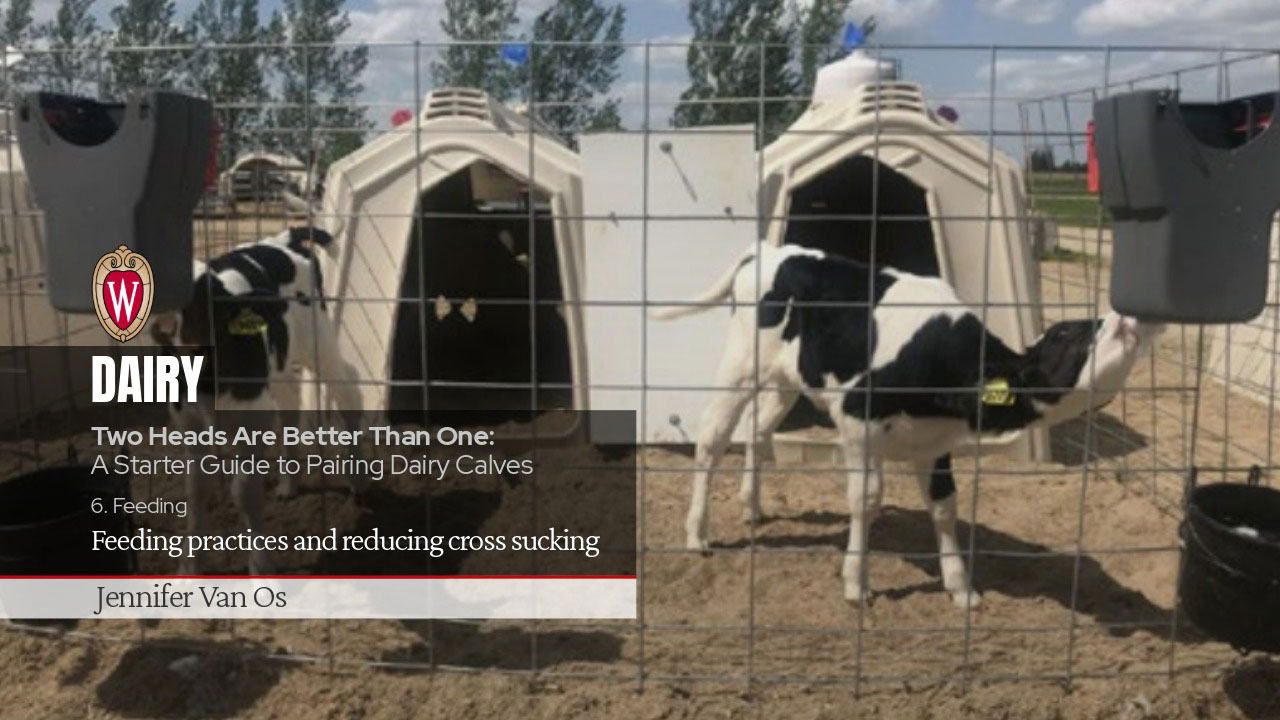
Figure 2. Calves pair-housed in hutches drink pasteurized milk from Milk Bar® slow-flow teat buckets.
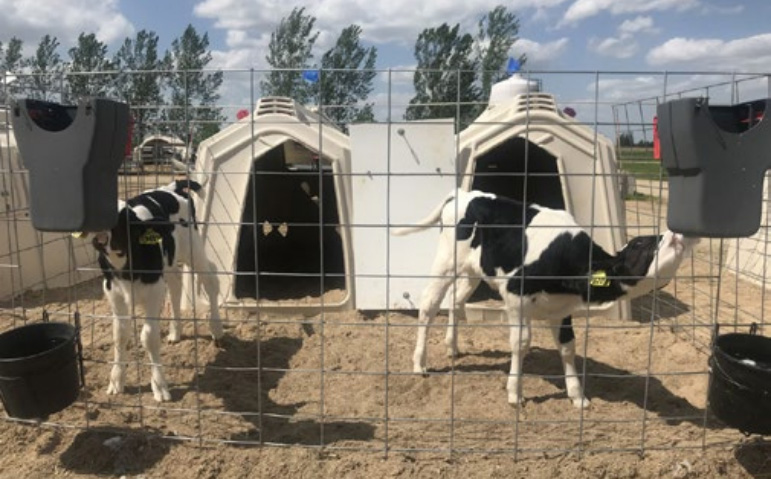
Recently at UW–Madison, we tested several feeding strategies for pair-housed calves. Calves were bottle-fed until they were 2 weeks old, when they were switched to either standard buckets or slow-flow Milk Bar® teat bucket (Figure 2). All calves were fed 8 quarts of pasteurized milk across two daily meals. Half of the calves were fed starter grain in a bucket. The other half had both a bucket and a Braden Start® bottle (Figure 3), which has a specialized nipple allowing solids to pass through.
Figure 3. Calves pair-housed in hutches eat starter grain from Braden Start® bottles.
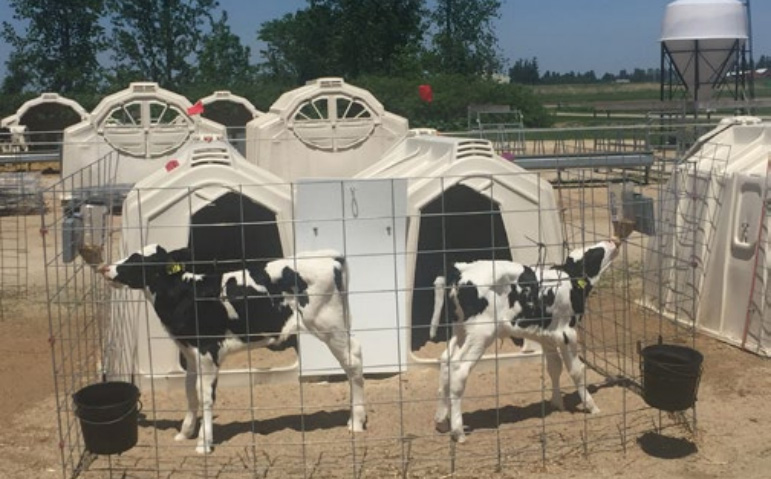
Calves fed milk using the slow-flow teats spent more time drinking milk and less time sucking on their water buckets, hutches, fencing, and — most importantly — each other. Calves fed milk from open buckets had significantly less cross sucking when they also had a Braden Start® bottle. The Braden Start® bottle stayed on the fencing and required less management than the teat buckets. Still, feeding milk with slow-flow teats was the most effective strategy for reducing all abnormal suckling behaviors.
Reducing Milk Stealing
Some producers claim healthy competition motivates pair- or group-housed calves to eat better. Research suggests social housing has positive influences on feeding behavior and growth. Calves prefer to eat at the same time as their companions. At maturity, previously group-housed calves gain better access to resources. However, too much competition, when calves have unequal access to feeding space, can mean some calves fall behind.
Producers can use several strategies to reduce milk stealing. Individual milk containers can be mounted at opposite ends of the pen to create distance between the calves while drinking. If using mob feeders, consider providing more teats than calves in a group. For example, for a group of three calves, use a teat bucket with at least four milk compartments and teats. Research has shown barriers between calves (at least 1 meter or 3’ 3” long) can reduce milk stealing. Some farms even create makeshift “feeding stalls” using wire fencing panels as barriers. Other farms install mini-headlocks in group pens.
In our two studies at UW–Madison, calves paired in connected hutches showed very little milk competition. In one study, calves had slow-flow Milk Bar® nipples attached to 4-quart bottles. In the other study, calves had slow-flow Milk Bar® teat buckets (Figure 2). With the teat buckets, calves sometimes pushed each other off the nipple after the milk was gone. This was likely because they could not see into the opaque plastic buckets. Although the calves looked like they were competing, they were not stealing milk from each other.
Note the size or age difference between calves in a pair or group may affect competition. See the Grouping strategies article in this series for more information.
Providing Hay
Feeding hay to preweaned calves is relatively uncommon in the United States, although it is mandated in parts of Europe. When given the opportunity, calves consistently choose to eat a fraction of hay in their diet. A study found dairy calves sorted mixed rations of texturized starter and chopped hay to eat the hay, even when only a few weeks old. Compared to starter alone, eating both hay and starter increases rumen size and rumen pH (i.e., reduces the acidity). Eating forages is part of the natural behavior of cattle. When hay is not provided, young calves will eat straw bedding. Feeding chopped hay can provide an appropriate behavioral outlet. This practice has been found to reduce abnormal pen-directed suckling.
Weaning Strategies
Weaning is a stressful period for all calves. Regardless of how they are housed before weaning, cross sucking can appear or increase when calves move to group housing after weaning. Because cross sucking is related to hunger, calves better established on solid feed are less likely to cross suck. Instead of abrupt weaning by taking milk away cold turkey, use a gradual or step-down weaning strategy. This is important to ease the transition during this stressful period and to reduce cross sucking.
In our 2019 survey, among the 95 farms housing their calves in pairs or groups, only 4% used abrupt weaning. Similarly, among the 318 farms with individual housing, only 7% used abrupt weaning. The rest of the farms stepped down the milk allowance by reducing the size of each milk meal, reducing the number of meals per day, or a combination.
Calves should begin the weaning process no earlier than 6 weeks of age. Calves fed a greater allowance of milk or replacer will initially consume less grain. To properly develop the rumen, calves should be eating at least ½ lb of grain for 21 to 28 days. Weaning needs to be carefully managed to encourage proper intakes and weight gain. Calves on a higher plane of milk nutrition will likely wean at a later age than calves on a restricted milk program.
Remember, social housing and enhanced milk feeding go hand in hand. A study found when pair-housed calves were fed a milk allowance of 9.5 quarts per day, they ate more grain during weaning compared with calves fed only 5.3 quarts per day. For calves fed the recommended 8 quarts per day or more, milk should be reduced across a period of about 10 days. Sufficient time is needed for calves to increase their grain intake and for the gut adjust to a solid-feed diet. Milk feeding should not completely stop until calves reach 8 weeks of age or older.
According to the Dairy Calf and Heifer Association (DCHA) Gold Standards, calves with a target weaning age of 8 weeks of age or older should ideally be eating 4 to 5 lbs per day of grain for 3 days in a row.
Most farms in our 2019 survey followed the 8-weeks-of-age guideline. Regardless of peak milk allowance, 75% of the farms with individual housing and 71% of the farms using pair or group housing completely weaned their calves at 8 weeks of age or older.
References
- Cantor, M.C., H.W. Neave, & J.H.C. Costa. 2020. Effectively raising pair-housed calves: Common questions from transitioning farmers. Progressive Dairy.
- DCHA Gold Standards, 2nd Edition. 2016. Dairy Calf and Heifer Association.
- de Passillé, A.M., J. Rushen, & M. Janzen. 1997. Some aspects of milk that elicit non-nutritive sucking in the calf. Appl. Anim. Behav. Sci. 53:167-173.
- de Passillé, A.M. 2001. Sucking motivation and related problems in calves. Appl. Anim. Behav. Sci. 72:175-185.
- de Passillé, A.M., B. Sweeney, & J. Rushen. 2010. Crosssucking and gradual weaning of dairy calves. Appl. Anim. Behav. Sci. 124:11-15.
- Fischer, A.J., C. Villot, J.K. van Niekerk, T.T. Yohe, D.L. Renaud, & M.A. Steele. 2019. Invited review: Nutritional regulation of gut function in dairy calves: From colostrum to weaning. Appl. Anim. Sci. 35:498-510.
- Größbacher, V., C. Winckler, & C. Leeb. 2018. On-farm factors associated with cross-sucking in group-housed organic Simmental dairy calves. Appl. Anim. Behav. Sci. 206:18–24.
- Haley, D.B., J. Rushen, I.J.H. Duncan, T.M. Widowski, & A.M. de Passillé. 1998. Effects of resistance to milk flow and the provision of hay on nonnutritive sucking by dairy calves. J. Dairy Sci. 81:2165-2172.
- Horvath, K.C. & E.K. Miller-Cushon. 2017. The effect of milk-feeding method and hay provision on the development of feeding behavior and non-nutritive oral behavior of dairy calves. J. Dairy Sci. 100:3949-3957.
- Jasper, J. & D.M. Weary. 2002. Effects of ad libitum milk intake on dairy calves. J. Dairy Sci. 85:3054-3058.
- Jensen, M.B. 2003. The effects of feeding method, milk allowance and social factors on milk feeding behaviour and cross-sucking in group housed dairy calves. Appl. Anim. Behav. Sci. 80:191-206.
- Jensen, M.B. & M. Budde. 2006. The effects of milk feeding method and group size on feeding behavior and cross-sucking in group-housed dairy calves. J. Dairy Sci. 89:4778-4783.
- Jensen, M.B., A.M. de Passillé, M.A.G. von Keyserlingk, & J. Rushen. 2008. A barrier can reduce competition over teats in pair-housed milk-fed calves. J. Dairy Sci. 91:1607-1613.
- Jensen, M.B., L.R. Duve, & D.M. Weary. 2015. Pair housing and enhanced milk allowance increase play behavior and improve performance in dairy calves. J. Dairy Sci. 98:2568-2575.
- Jung, J. & L. Lidfors. 2001. Effects of amount of milk, milk flow and access to a rubber teat on cross-sucking and non-nutritive sucking in dairy calves. Appl. Anim. Behav. Sci. 72:201-213.
- Keil, N.M. & W. Langhans. 2001. The development of intersucking in dairy calves around weaning. Appl. Anim. Behav. Sci. 72:295-306.
- Khan, A., D.M. Weary, & M.A.G. von Keyserlingk. 2011. Invited review: Effects of milk ration on solid feed intake, weaning, and performance in dairy heifers. J. Dairy Sci. 94:1071-1081.
- Khan, A., D.M. Weary, & M.A.G. von Keyserlingk. Hay intake improves performance and rumen development of calves fed higher quantities of milk. J. Dairy Sci. 94:3547-3553.
- Knauer, W.A., S.M. Godden, S.M. McGuirk, & J. Sorg. Randomized clinical trial of the effect of a fixed or increasing milk allowance in the first 2 weeks of life on health and performance of dairy calves. J. Dairy Sci. 101:8100-8109.
- Loberg, J. & L. Lidfors. 2001. Effect of milk flow rate and presence of a floating nipple on abnormal sucking between dairy calves. Appl. Anim. Behav. Sci. 72:189-199.
- MacPherson, J.A.R., H.Berends, L.N. Leal, J.P. Cant, J. Martín-Tereso, & M.A. Steele. 2016. Effect of plane of milk replacer intake and age on glucose and insulin kinetics and abomasal emptying in female Holstein Friesian dairy calves fed twice daily. J. Dairy Sci. 99:8007-8017.
- Miller-Cushon, E. & J.M.C. Van Os. 2021. Advances in understanding behavioral needs and improving the welfare of calves and heifers. Chapter 8 in Understanding the Behaviour and Improving the Welfare of Dairy Cattle, edited by Marcia Endres. Burleigh Dodds Science Publishing, Cambridge, UK.
- Miller-Cushon, E.K., R. Bergeron, K.E. Leslie, G.J. Mason, & T.J. DeVries. 2013. Effect of early exposure to different feed presentations on feed sorting of dairy calves. J. Dairy Sci. 96:4624-4633.
- Nielsen, P.P., M.B. Jensen, & L. Lidfors. 2008. Milk allowance and weaning method affect the use of a computer controlled milk feeder and the development of cross-sucking in dairy calves. Appl. Anim. Behav. Sci. 109:223-237.
- Ollivett, T.L., D.V. Nydam, T.C. Linden, D.D. Bowman, & M.E. Van Amburgh. 2012. Effect of nutritional plane on health and performance in dairy calves after experimental infection with Cryptosporidium parvum. J. Am. Vet. Med. Assoc. 241:1514-1520.
- Rushen, J. & A.M. de Passillé. 1995. The motivation of non-nutritive sucking in calves, Bos taurus. Anim. Behav. 49:1503-1510.
- Salter, R.S., K.J. Reuscher, & J.M.C. Van Os. 2021. Milkand starter-feeding strategies to reduce cross sucking in pair-housed calves in outdoor hutches. J. Dairy Sci. 104:6096-6112.
- Silva, F.L.M., J.M.C. Van Os, C. Winder, M. Akins, T. Kohlman, T. Ollivett, H. Schlesser, R. Schley, S. Stuttgen, & J. Versweyveld. In preparation. U.S. farmer-reported housing and milk-feeding practices for preweaned dairy calves.
- Vaughan, A., G.G. Miguel-Pacheco, A. Marie de Passillé, & J. Rushen. 2016. Reciprocated cross sucking between dairy calves after weaning off milk does not appear to negatively affect udder health or production. J. Dairy Sci. 99:5596-5603.
- Veissier, I., A.M. De Passillé, G. Després, J. Rushen, I. Charpentier, A.R. Ramirez De La Fe, & P. Pradel. 2002.
- Does nutritive and non-nutritive sucking reduce other oral behaviors and stimulate rest in calves? J. Anim. Sci. 80:2574-2587.
Originally Published: June 2022
Author
- Jennifer Van Os, Department of Animal & Dairy Sciences, UW–Madison
Reviewers
- Emily Miller-Cushon, Department of Animal Sciences, University of Florida
- Tina Kohlman, UW–Madison Division of Extension Fond du Lac County
- Theresa Ollivett, Department of Medical Sciences, UW–Madison School of Veterinary Medicine