Two Heads Are Better Than One: A Starter Guide to Pairing Dairy Calves
Part 3: Hygiene
At a Glance
Transitioning calves to pair or group housing requires stringent biosecurity, sanitation, and bedding management to limit pathogen transmission. Contamination spreads rapidly via farm traffic, shared equipment, and soiled environments, directly impacting calf health and immune development. Implementing rigorous biocontainment protocols and targeted cleaning cycles effectively breaks the cycle of infectious disease.
What are the critical consequences of poor biosecurity and sanitation?
Pathogen accumulation on boots, tires, and feeding equipment leads to widespread transmission of salmonella, mycoplasma, coronavirus, and rotavirus. Contaminated bedding and pooling liquids expose vulnerable neonatal navels to infections, while matted hair coats compromise crucial thermoregulation. Failure to disinfect hospital pens and automated feeding components creates immediate disease vectors across calf cohorts.
What strategies optimize calf health outcomes?
- Implement Strict Biocontainment: Establish daily-maintained disinfectant footbaths, utilize disposable gloves, and always work sequentially from the youngest calves to the oldest or sick groups.
- Execute Multi-Step Sanitation: Wash feeding gear with chlorinated alkaline detergent at 140°F, rinse with an acid solution, and sanitize using NSF/ANSI Standard 60 certified chlorine dioxide.
- Optimize Housing and Bedding: Provide a minimum 1-week rest period for pens between groups, and maintain 12 inches of dry straw bedding, adding 2–3 pounds daily.
Introduction
In recent years, an increasing number of dairy producers have been successfully raising calves in pairs or groups. Some of these producers found changing their calf-raising practices came with a few hiccups along the way. For a smooth transition from individual to pair or group housing, it is beneficial to review the principles for promoting good calf health outcomes. These principles are similar, whether managing individuals, pairs, or groups. Although calves within a pair or group have full contact, limiting the spread of disease between different pairs or groups remains a best practice. This includes reducing the buildup of bacteria, viruses, and other pathogens in the calves’ environment by paying attention to biosecurity, sanitation practices, and proper bedding management.
Biocontainment and Biosecurity
Biocontainment and biosecurity practices protect healthy calves from being infected with pathogens spread from elsewhere within or outside the farm. Pathogens can cling to tires, boots, clothing, tools, and other items and get tracked from one area of the farm to another.
Outside visitors should wear clean clothing and clean, disinfected boots or disposable boot covers when entering the calf area. Plan tours to visit calves before older animals.
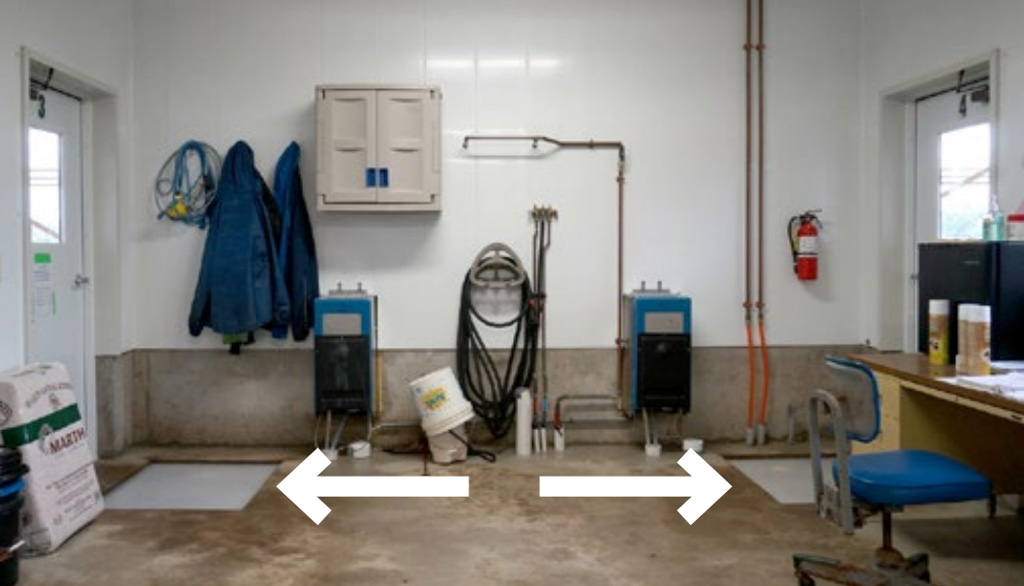
(Photo credit: The Dairyland Initiative.)
If visitors have interacted with older animals, they should avoid touching calves, or at a minimum, wash their hands with soap first.
To prevent contamination between barns, consider using disinfectant footbaths (Figure 1) or foamers at calf barn entrances. The disinfectant should be labeled for common pathogens affecting calves, such as salmonella, mycoplasma, and both enveloped and nonenveloped viruses (including bovine coronavirus and rotavirus). For efficient killing of the microorganisms, the disinfectant should also work within short contact times of less than 1 to 2 minutes.
Footbaths are only effective if used consistently and kept clean. Route foot traffic so everyone has to walk through the footbath when entering. Footbath solutions should be maintained daily or more frequently. An alternative to footbaths are doorway entry foamers, which spray disinfectant foam onto the floor. These can be activated with timers or motion sensors. The foaming surfactant increases disinfectant contact time and surface area contact with boots and equipment wheels.
Check for liquids running off from the calf pens to ensure they do not drain into areas of foot traffic. Also check and make sure liquids from outdoor manure piles do not run into the barn or onto walkways between barns.
When handling calves, the best practice is to wear clean clothing and disposable gloves. It is best to change clothes after working with older cattle because of contamination from manure, saliva, discharge, or amniotic fluid. Work from the youngest calves, with the least-developed immune systems, to the oldest. Handle any sick calves last if possible. If you must work with healthy animals afterward, first disinfect your boots and put on fresh gloves and outerwear.
Some farms have hospital pens to monitor and treat sick calves. To limit the spread of disease, the hospital pen should not allow physical contact or have shared waterers with calves in adjacent pens. The hospital pen should have solid sides or physical distance from other pens.
Although sick animals sometimes seek distance from the herd as part of their natural behavioral response to illness, separating a calf from its social group may cause distress in either the sick animal, its companions, or both. Depending on the illness and its severity, it may be less stressful to allow a calf to remain in its normal pen, as long as there is enough space so the sick calf will not be constantly disturbed by energetic, healthy pen-mates. Within pairs or groups, pen-mates of sick animals do not always develop clinical signs or require treatment. Consult with your veterinarian to determine appropriate treatment protocols or to evaluate whether removing a sick calf from a pair or group is the best strategy.
Sanitation
When cleaning calf-feeding equipment, the best practice is to follow the steps below. This protocol was developed by Dr. Donald Sockett of the Wisconsin Veterinary Diagnostic Laboratory.
- Rinse surfaces with cool or lukewarm water.
- Wash with hot water and a chlorinated alkaline detergent (pH = 11 to 12). Physically scrub to break down biofilms. Note some detergents are labeled for use with 160 °F water, which is too hot for comfortable use by most people. Choose a detergent labeled for 140 °F and which will work with the hardness of your water.
- Rinse with lukewarm water.
- Rinse with an acid solution (pH = 2 to 3) and warm water (around 100 °F) to remove mineral buildups.
- Rinse again with lukewarm water.
- Just before use, sanitize calf feeding equipment. The sanitizer should not be applied more than 1 to 2 hours before the feeding equipment will be used.
Experts recommended sanitizing calf feeding equipment with carefully selected chlorine dioxide products. For more details on choosing a chlorine dioxide product, see Box 1. Inexpensive test strips should be used to verify whether your cleaning products’ pH and chlorine dioxide concentration are correct. To evaluate the effectiveness of your sanitation practices, consult with your veterinarian. Some veterinary practices offer services such as checking dry surfaces for cleanliness using a luminometer (ATP meter). Periodic assessments using this method can help find areas where cleaning and sanitation protocols may need adjustment.
For those overwhelmed with the amount of cleaning involved in caring for calves, a strategy could be to prioritize the highest-risk areas. Focus on doing an excellent job with sanitation in the maternity area, calf transport equipment, scales used on the first day of life, liquid feed and mixing equipment, and housing for calves 3 weeks of age or younger.
Housing
Hutches or pens should be cleaned and disinfected between new pairs or groups of calves. Accumulated manure and other organic matter should be removed from the walls. Inside a barn, high-pressure washing should be avoided because this does not efficiently disrupt and remove biofilms and can also aerosolize pathogens. Instead, use a low-pressure foamer containing a caustic detergent or a slow-flow hose and a scrub brush. Alternatively, move panels outdoors to wash them.
Each hutch, pen, or ideally, the entire barn, should have at least a 1-week rest period before new calves are moved in. This duration of rest period has been shown to be very effective in breaking the cycle of infectious disease. In the Grouping strategies article within this guide, we discuss strategies for pen and barn moves.
Feeding Equipment
All feeding and watering equipment must be kept clean. This includes milk bottles and nipples, milk buckets, water buckets, waterers, starter buckets, feed troughs, and mixing equipment. Milk supplies should be cleaned after each feeding. Waterers should be cleaned weekly, when visibly dirty, or more frequently during a disease outbreak.
Keep in mind plastic or rubber feeding equipment can develop scratches, which harbor microbes, and these supplies will need to be replaced more frequently than those made of stainless steel. Most producers who have purchased stainless steel feeding supplies have indicated the switch is worth the investment.
Scrub brushes used to clean calf feeding equipment should be separate from those used to clean calf housing and other equipment. Scrub brushes should be replaced monthly or at least quarterly. Proper lighting in the work area can be helpful for ensuring feeding supplies are cleaned properly.
In automated milk-feeding systems, all components of the system must be cleaned regularly. The effectiveness of the cleaning program can be assessed by culturing milk or milk replacer samples collected from the nipple. Nipples should be washed daily. Hoses must be fully replaced every 1 to 2 weeks or more often.
Bedding
Preweaned calves spend more than half the time lying down, and neonatal calves spend over three-quarters of their time lying down. Regardless of the season, bedding is important to create a comfortable, cushioned surface for lying. Bedding should be clean, dry, and low dust. Options, depending on availability, include straw, wood shavings or sawdust, almond hulls, or a combination.
Clean, dry bedding is also important for calf hygiene. Clean bedding can reduce the chance of pathogens entering the not-yet-healed navels of neonatal calves. To prevent the navel from touching the bare ground, bedding should be laid before the calf is placed in the pen or hutch. Initially, approximately 20 to 25 pounds of bedding to a depth of 12 inches should be provided for each calf. Bedding also provides a barrier between the calf and fluids, including excrement or spilled milk or water. Moist environments harbor pathogens. Proper drainage below any type of bedding is key. For details on drainage, visit The Dairyland Initiative website ↗️.
Fresh, clean bedding helps keep the calf’s hair coat clean. Accumulated manure results in clumped or matted hair, whereas a dry, fluffy hair coat maintains its insulation, keeping the calf warm in cool weather. Straw is the best bedding material for allowing calves to nest and maintain warmth, especially when less than 21 days old or when sick. For more on bedding and thermoregulation, see the Options for housing pairs or groups article in this guide.
As calves grow, soiled or damp bedding accumulates more quickly. To maintain a dry, clean surface, at least 2 to 3 pounds of fresh bedding should be added at a time, ideally daily or every other day. Calves on a higher plane of milk nutrition will generate greater volumes of manure and urine, as will calves with diarrhea. In those situations, monitor and increase bedding frequency to maintain a dry lying surface.
Box 1
Choice of Disinfectant
By Donald C. Sockett, DVM, MS, PHD, DACVIM (large animal)
It is important for livestock barns, calf pens, and calf feeding equipment to be properly cleaned before the disinfectant is applied. If surfaces are not properly cleaned, the disinfection step is much less effective at killing disease-causing microorganisms.
Many disinfectants available are effective against microorganisms under laboratory conditions. Unfortunately, many fail to mention whether the disinfectant can penetrate biofilms, is inactivated by organic material, or is adversely affected by low temperatures, hard water, or by pH. As well, minimum contact time information is often not available.
Chlorine dioxide has emerged as an excellent choice because it can be used at low concentrations, it has very short contact times for pathogen inactivation, resistance does not develop, and it is the least corrosive of all the oxidizing disinfectants. Corrosion of metal surfaces, including some types of stainless steel, is a significant problem with oxidizing disinfectants. Chlorine dioxide activity is not affected by pH or organic material, it can penetrate biofilms, and it is EPA approved to treat potable drinking water.
Typically, chlorine dioxide is used at a concentration of 25 to 50 parts per million (ppm) with 2 to 4 minutes of contact time for sanitizing calf feeding equipment, and at a concentration of 250 to 500 ppm with 5 to 10 minutes of contact time for disinfecting facilities and calf pens.
Before using any chlorine dioxide product, it is essential to verify the concentration of chlorine dioxide because there is tremendous variability in the chlorine dioxide concentration of commercial products in the marketplace.
The chlorine dioxide product you choose should meet or exceed the following specifications:
- The product is NSF/ANSI Standard 60 certified for chemical treatment of potable drinking water and for equipment sanitation. Certification means an independent organization has reviewed the product and it complies with governmental standards for safety, quality, purity, sustainability, and performance.
- Food grade chemicals are used. Non-food-grade chemicals often contain impurities which reduce the efficiency of chlorine dioxide sanitation and disinfection.
- The product is activated with a strong acid, not a weak acid. Strong acids are 60% more efficient than weak acids in converting sodium chlorite to chlorine dioxide. Unlike weak acids, strong acids produce no toxic residues and do not have large amounts of unreacted sodium chlorite. Large amounts of unreacted sodium chlorite reduce the predictability and performance of chlorine dioxide.
- The vendor has expertise in cleaning, sanitation, disinfection, and chemical treatment of potable drinking water.
- The vendor has knowledge and expertise of the subtle intricacies of chlorine dioxide generation and how changing variables such as temperature and time can have a marked effect on chlorine dioxide concentration.
- The vendor provides the capability to quickly and reliably verify the chlorine dioxide concentrations are correct for different applications, such as chemical treatment of potable drinking water, sanitation, disinfection, and thermal fogging.
References
- DCHA Gold Standards, 2nd Edition. 2016. Dairy Calf and Heifer Association.
- Mills-Lloyd, S. & T. Kohlman. 2017. Heifer blueprint: Bedding comfort. UW–Madison Extension.
- Mills-Lloyd, S. & T. Kohlman. 2017. Heifer blueprint: Best practices for biosecurity. UW–Madison Extension.
- Mills-Lloyd, S. & T. Kohlman. 2017. Heifer blueprint: Best practices for cleaning & disinfecting. UW–Madison Extension.
- Mills-Lloyd, S. 2018. Heifer blueprint: Biofilms – Your biological foe. UW–Madison Extension.
- Nordlund, K.V. & C.E. Halbach. 2019. Calf barn design to optimize health and ease of management. Vet Clin. Food Anim. 35:29-45.
- Ollivett, T.L. 2020. How does housing influence Bovine Respiratory Disease in dairy and veal calves? Vet. Clin. Food Anim. 36:385-398.
- Replacement Housing. The Dairyland Initiative. https://thedairylandinitiative.vetmed.wisc.edu/home/housing-module/replacement-housing/
- Urie, N.J., J.E. Lombard, C.B. Shivley, C.A. Kopral, A.E. Adams, T.J. Earleywine, J.D. Olson, & F.B. Garry. 2018. Preweaned heifers management on US dairy operations: Part V. Factors associated with morbidity and mortality in preweaned dairy heifer calves. J. Dairy Sci. 101:9229-9244.
- USDA. 2018. Dairy 2014: Health and management practices on U.S. dairy operations, 2014. USDA-APHIS-VS-CEAH. Fort Collins, Co. https://www.aphis.usda.gov/animal_health/nahms/dairy/downloads/dairy14/Dairy14_dr_PartIII.pdf
Originally Published: June 2022
Author
- Jennifer Van Os, Department of Animal & Dairy Sciences, UW–Madison
Reviewers
- Courtney Halbach, Department of Medical Sciences, UW–Madison School of Veterinary Medicine
- Tina Kohlman, UW–Madison Division of Extension Fond du Lac County
- Theresa Ollivett, Department of Medical Sciences, UW–Madison School of Veterinary Medicine
- Donald Sockett, Wisconsin Veterinary Diagnostic Laboratory, UW–Madison